Why Buyers Walk Away From Acquisitions
Published: November 13, 2026
Updated: November 13, 2026

Key Insights
- An LOI does not guarantee closing — due diligence can still uncover deal-breaking issues.
- Financial discrepancies and hidden liabilities can quickly erode buyer confidence.
- Owner dependence and weak operations can make the business harder to transfer.
- Valuation gaps may lead to renegotiation, but flexible deal structures can help bridge them.
- Financing, regulatory and cross-border issues can derail otherwise viable deals.
- Slow communication and deal fatigue can cause buyers to lose momentum.
- Preparation, transparency and clear communication give sellers the best chance of keeping a deal on track.
Table of Contents
1.Common Reasons Buyers Walk Away From a Deal1.1.Due Diligence Red Flags That Worry Buyers1.2.Earnings That Dont Hold Up1.3.Heavy Reliance on the Owner1.4.Price Disagreements After the LOI1.5.Financing That Falls Through1.6.Poor Cultural Fit1.7.Slow Responses and Deal Fatigue1.8.Changes on the Buyers Side2.CrossBorder Issues That Stop Asian Deals3.Signs a Buyer Is Backing Out of a Deal4.How to Keep a Business Sale From Falling Through?4.1.Prepare the Data Room Early4.2.Be Honest About Problems4.3.Keep the Business Performing4.4.Make the Valuation Defensible4.5.Address Exit Readiness Before Going to Market4.6.Keep Communication Moving4.7.Choose the Right Buyer Not Just the Highest Offer5.Conclusion6.Frequently Asked QuestionsA buyer agreeing to an offer or signing a Letter of Intent (LOI) can feel like the hardest part of selling a business is over. In reality, the period between the LOI and closing is often when the buyer takes the deepest look at the business and decides whether the original deal still makes sense. This is where financial records are tested, contracts are reviewed, liabilities are uncovered, employees and customers are assessed, and the buyer's assumptions are compared with the reality of the business. So, why do buyers walk away from acquisitions? Usually, it is not because a buyer suddenly changes their mind without reason. A deal may fall apart because new information changes the buyer's assessment of risk, value or strategic fit. In other cases, the problem comes from financing, negotiations, delays or a change on the buyer's side. Understanding these risks can help sellers prepare earlier and protect buyer confidence throughout the transaction.
Common Reasons Buyers Walk Away From a Deal
Many acquisition problems become visible after an LOI, when the buyer moves from evaluating the opportunity to verifying it. Due diligence, financing, legal documentation and final negotiations can all expose issues that were not obvious at the beginning. Here are some of the most common reasons acquisitions fall through.
1. Due Diligence Red Flags That Worry Buyers
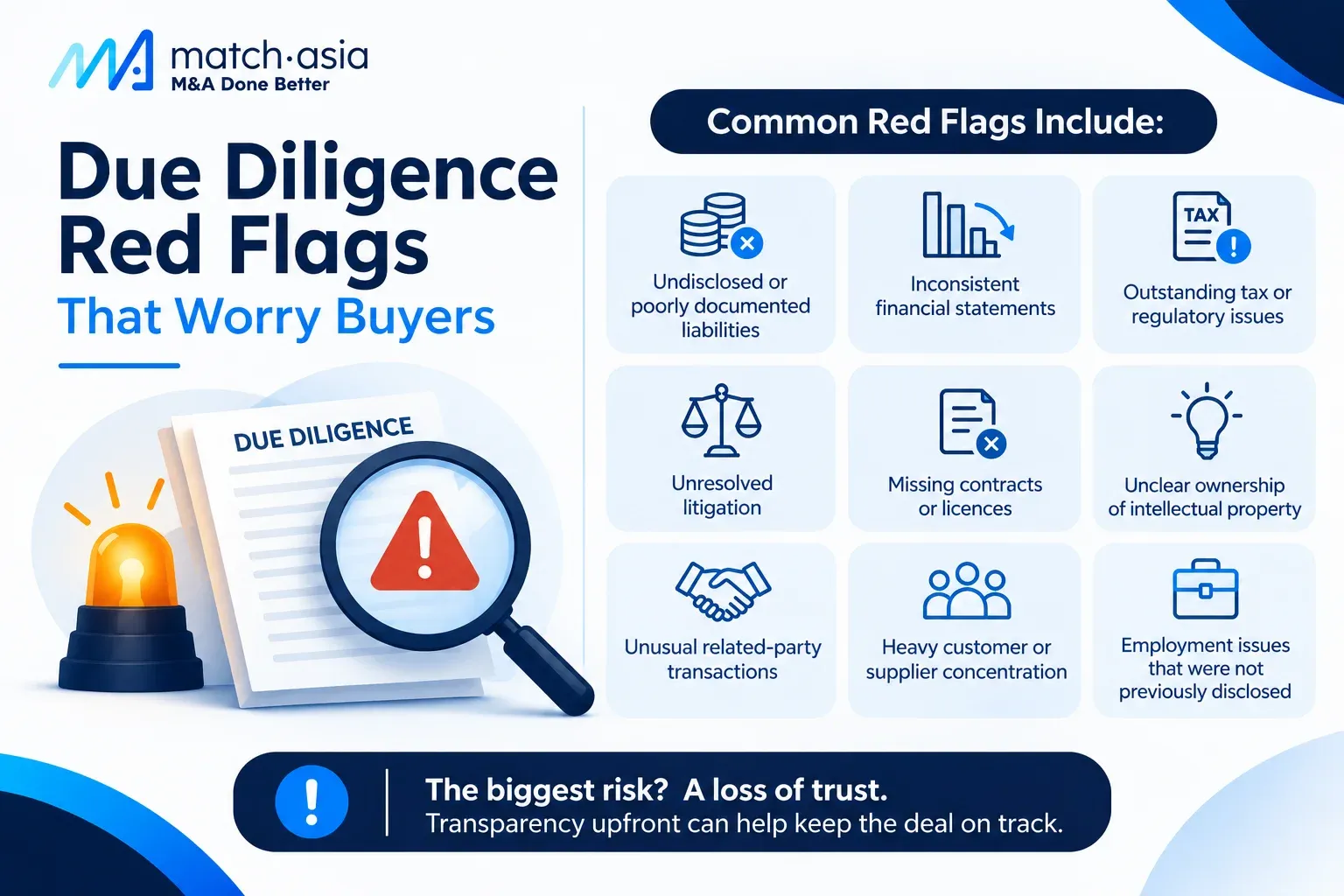
Due diligence is designed to verify what the buyer has been told about the business. It covers areas such as financial performance, tax, legal matters, customers, suppliers, employees, intellectual property, licences and contracts. Problems do not necessarily have to be catastrophic to concern a buyer. A pattern of inconsistencies can be enough to reduce confidence.
Examples include:
-
- Undisclosed or poorly documented liabilities
-
- Inconsistent financial statements
-
- Outstanding tax or regulatory issues
-
- Unresolved litigation
-
- Missing contracts or licences
-
- Unclear ownership of intellectual property
-
- Unusual related-party transactions
-
- Heavy customer or supplier concentration
-
- Employment issues that were not previously disclosed
The biggest problem may be the loss of trust. If the buyer discovers one material issue that was not disclosed, they may begin questioning what else they have not been told. This is why transparency matters before the buyer discovers the problem independently. A known issue with a clear explanation and mitigation plan can be easier to manage than a surprise discovered during diligence.
2. Earnings That Don't Hold Up
A business can look highly profitable during the initial sale process but produce a different picture when the buyer examines the numbers closely. Buyers are interested not simply in reported profit, but in the quality and sustainability of those earnings. They want to understand whether the reported performance is recurring, supported by cash flow and likely to continue after the acquisition. For example, profit may have been increased by one-off income, unusual add-backs, personal expenses, temporary cost reductions or revenue that is unlikely to recur. This is where quality of earnings becomes important. If the buyer originally agreed to a valuation based on a particular level of earnings but due diligence shows that sustainable earnings are lower, the buyer may seek a price reduction. If the gap is large enough, the buyer may decide that the acquisition no longer meets its investment criteria. A seller can reduce this risk by preparing clean financial records and being able to explain significant movements, adjustments and non-recurring items before the buyer asks.
3. Heavy Reliance on the Owner
Owner dependence is another common reason a buyer walks away from a deal. A buyer is not only purchasing historical revenue and profit. They are purchasing a business that needs to continue operating after ownership changes. If the owner personally controls most customer relationships, negotiates with key suppliers, manages employees, approves every important decision and holds critical operational knowledge, the buyer may question what happens after the owner leaves. This becomes particularly concerning when:
-
- Major customers deal directly with the owner
-
- Suppliers rely on the owner's relationships
-
- Important processes exist only in the owner's head
-
- No second layer of management exists
-
- Employees are unsure about the transition
-
- The owner is responsible for nearly every major decision
A business does not need to be completely independent of its founder to be attractive. But the buyer needs confidence that the business can continue functioning without the owner being involved in every decision. Documented processes, capable key employees and transferable customer relationships can help demonstrate that independence.
4. Price Disagreements After the LOI
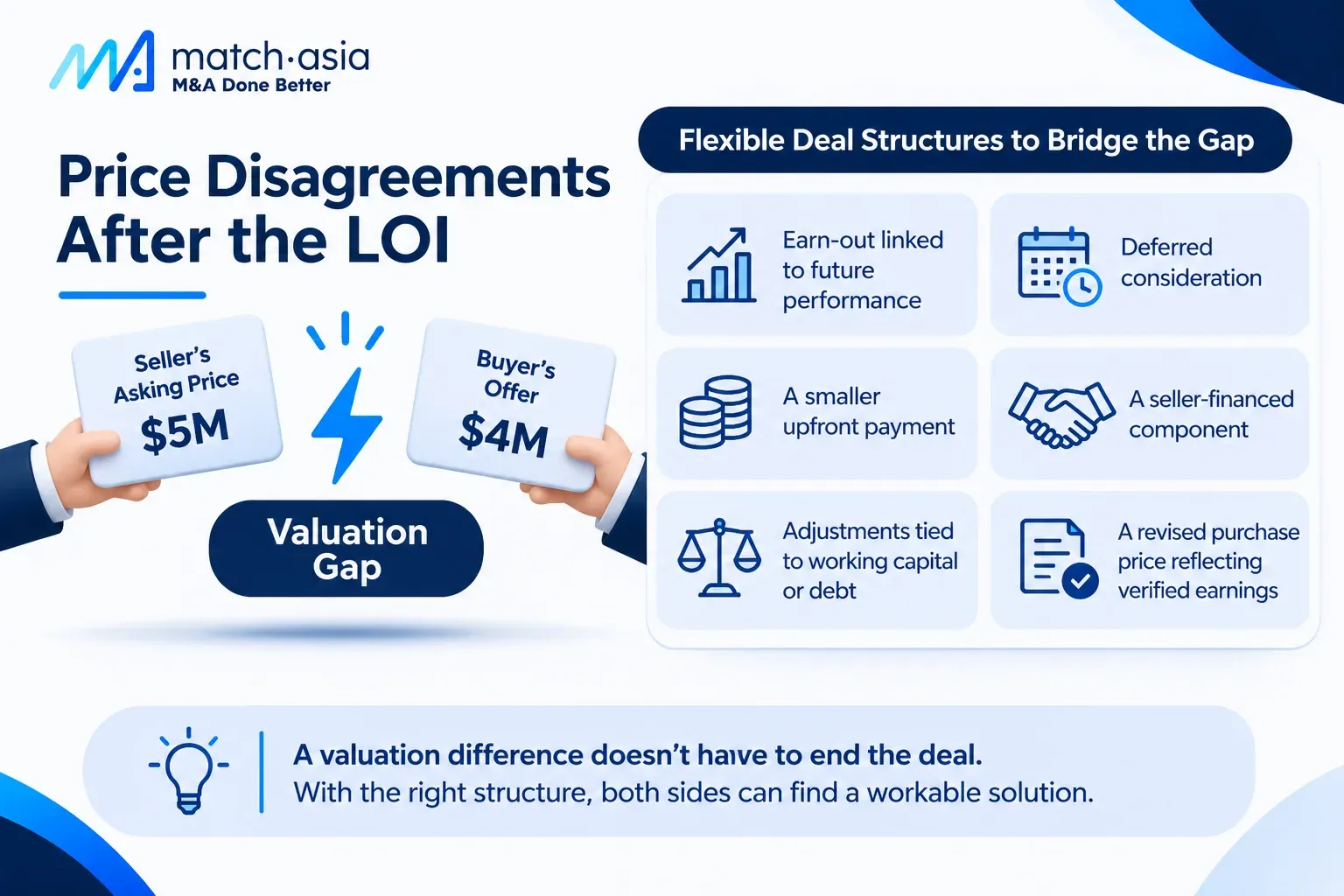
One of the most difficult situations is when the buyer and seller no longer agree on what the business is worth. The LOI may establish an indicative price based on the information available at the time. Later, due diligence can reveal lower earnings, higher working-capital requirements, additional liabilities or other factors that affect value. This creates a valuation gap. The buyer may want to renegotiate while the seller believes the original price should remain unchanged. If neither side can bridge the gap, the deal may collapse. However, a valuation difference does not always have to end the transaction. The parties may consider a different deal structure, such as:
-
- An earn-out linked to future performance
-
- Deferred consideration
-
- A smaller upfront payment
-
- A seller-financed component
-
- Adjustments tied to working capital or debt
-
- A revised purchase price reflecting verified earnings
The right structure depends on the transaction, but flexibility can sometimes turn a disagreement over value into a workable commercial arrangement.
5. Financing That Falls Through
A buyer may have a strong interest in acquiring the business but still be unable to complete the transaction if acquisition financing is not secured. A lender may reject the proposed financing, reduce the amount it is willing to lend, increase the required equity contribution or impose conditions that change the economics of the deal. This can happen when the lender's assessment of the target differs from the buyer's original assumptions. For sellers, the lesson is simple: buyer funding should be tested early rather than assumed. Understanding whether the buyer is using cash, debt, investor capital or a combination of sources can provide a clearer picture of the buyer's ability to close.
6. Poor Cultural Fit
Not every deal breaker appears in a spreadsheet. During management meetings and due diligence, buyers and sellers may discover significant differences in leadership style, employee expectations, decision-making or plans for the business. A buyer may want to restructure the company, replace management or accelerate growth. The seller may care deeply about preserving the existing team, brand or operating culture. These differences can become more visible as the parties spend more time together. Cultural fit is particularly important where the seller is expected to remain involved after closing or where key employees are essential to the business. If the buyer concludes that the post-acquisition relationship will be difficult, they may decide that the financial opportunity is not worth the integration risk.
7. Slow Responses and Deal Fatigue
M&A transactions require a significant amount of information, communication and decision-making. When responses take too long, documents arrive in stages, questions remain unanswered or negotiations repeatedly stall, the buyer can lose momentum. This is deal fatigue. It can be especially damaging when the buyer has other acquisition opportunities under consideration. A business that initially appeared attractive may become less appealing simply because completing the transaction feels unnecessarily difficult. Fast does not mean careless. Sellers should instead aim for a structured process where information is organised, responsibilities are clear and questions are answered promptly. Maintaining momentum also helps prevent the buyer from interpreting delays as a sign that something is wrong.
8. Changes on the Buyer's Side
Sometimes the reason a buyer walks away has little to do with the seller. A buyer's strategy can change after an LOI. Their board may redirect capital toward another market. A key executive may leave. Financing conditions may change. The buyer may face budget cuts or decide to pursue another acquisition. Strategic changes can therefore cause an otherwise healthy transaction to stop. These situations are difficult for sellers because they may have done everything correctly. The best protection is to avoid relying entirely on one potential buyer for too long and to maintain transaction discipline until closing.
Cross-Border Issues That Stop Asian Deals

Cross-border acquisitions can introduce another layer of uncertainty. A buyer from one Asian market may be interested in a business in another country, but the transaction still needs to comply with the rules of the target market. Foreign ownership restrictions can affect whether the buyer can acquire the business outright or whether a local structure or partner is required. Certain sectors may also require regulatory approval, licences or specific ownership arrangements. Contracts can create another problem. Some customer, supplier, distribution, lease or franchise agreements may restrict assignment or require consent when ownership changes.
Accounting and reporting practices can also differ between countries. Even where the underlying business is sound, differences in accounting treatment can make financial information harder to compare and may trigger additional diligence. These issues do not automatically mean a cross-border deal will fail. But they can create uncertainty over timing, cost, ownership and the buyer's ability to operate the business after closing. For sellers, identifying these issues before the buyer reaches them can make the transaction much easier to manage.
Signs a Buyer Is Backing Out of a Deal
A buyer rarely announces at the first sign of trouble that they are leaving the transaction. More often, confidence declines gradually.
| Warning sign | What it usually means | What the seller can do |
|---|---|---|
| Due diligence requests keep increasing | The buyer has found unanswered questions or areas of risk | Respond clearly, organise documents and address issues directly |
| Buyer becomes less responsive | Interest or internal deal priority may be declining | Re-establish the timeline and identify outstanding decisions |
| Buyer challenges previously accepted financials | The buyer may be reassessing earnings or valuation | Provide supporting records and explain adjustments transparently |
| Negotiations focus heavily on price | A valuation gap may have emerged | Explore deal structure, earn-outs or deferred consideration |
| Lender changes financing terms | Acquisition financing may no longer support the original offer | Confirm funding status and discuss whether the structure can be revised |
| Buyer requests repeated extensions | The transaction may be losing internal priority | Agree on clear milestones and deadlines |
| Key buyer decision-makers stop attending meetings | Internal support for the acquisition may be weakening | Clarify who remains responsible for the transaction |
| Buyer raises cultural or management concerns | The post-acquisition relationship may be in doubt | Address expectations around management, employees and transition |
| Buyer starts comparing the deal with alternatives | The opportunity may no longer be the buyer's preferred option | Reinforce the business case without hiding weaknesses |
These signs do not necessarily mean a deal is dead. They indicate that buyer confidence may need attention before the transaction progresses further.
How to Keep a Business Sale From Falling Through?
Sellers cannot control every reason a buyer may walk away. They can, however, reduce avoidable uncertainty.
1. Prepare the Data Room Early
A buyer should not have to chase basic information during due diligence. Financial statements, tax records, contracts, employee information, licences, corporate documents, customer data and other relevant records should be organised before the transaction reaches an advanced stage. A well-prepared data room makes the business easier to evaluate and reduces unnecessary delays.
2. Be Honest About Problems
Trying to hide a weakness rarely makes it disappear. If the business has a customer concentration issue, pending legal matter, unusual expense or operational dependency, identify it early and explain what is being done about it. Buyers can price known risks. Unexpected risks are more likely to damage trust.
3. Keep the Business Performing
One of the worst things a seller can do during an acquisition is become so focused on the transaction that the underlying business suffers. Revenue, margins, customer relationships and employee stability still matter right up to closing. A buyer who sees performance deteriorating during the process may question whether the original valuation still reflects the business.
4. Make the Valuation Defensible
A seller's asking price should be supported by a clear understanding of the business's earnings, assets, market position and future prospects. Using a business valuation calculator can be a useful starting point for understanding the factors that influence business value, although a transaction valuation may require more detailed analysis. The goal is not to guarantee the buyer accepts the original price. It is to ensure the seller can explain how the price was reached.
5. Address Exit Readiness Before Going to Market
Preparation should begin before a buyer appears. An exit readiness assessment can help identify weaknesses across areas such as financial readiness, legal and governance matters, operations, intellectual property, people and overall deal readiness. Finding a problem before the sale process is generally easier than discovering it after an LOI has been signed.
6. Keep Communication Moving
M&A is a process of repeated decisions. Long periods without updates can create uncertainty. Set expectations around response times, document delivery and key milestones. When something is delayed, explain why and provide a realistic next step. Good communication does not eliminate difficult negotiations, but it helps preserve trust when those negotiations happen.
7. Choose the Right Buyer, Not Just the Highest Offer
The highest initial offer is not necessarily the offer most likely to close. A buyer with sufficient funding, a clear acquisition strategy and a realistic understanding of the business may be more valuable than a buyer offering a higher price but creating uncertainty around financing or deal terms. For sellers, this is one of the most important lessons in understanding M&A platform for SMEs in Asia: a successful transaction is not simply about finding interest. It is about finding the right fit and taking that opportunity through the entire acquisition process.
Conclusion
Understanding why buyers walk away from acquisitions helps sellers focus on what can actually be controlled. Some deal failures are caused by serious due diligence findings. Others come from a valuation gap, owner dependence, financing problems, cultural differences or simple deal fatigue. Cross-border transactions can introduce additional complications around ownership, regulation, licences and contracts. The common thread is buyer confidence. A buyer needs to believe that the business is what it was presented to be, that the earnings are sustainable, that the risks are understood and that the transaction can be completed without unnecessary surprises. That confidence is built long before closing. For sellers, the strongest approach is therefore not to wait for due diligence to expose problems. Prepare the financials, organise the records, address weaknesses, communicate quickly and remain focused on running the business. A signed LOI is an important milestone. It is not the finish line.