What Affects Business Valuation?
Published: November 20, 2026
Updated: November 20, 2026

Key Insights
- Business valuation depends on more than revenue or profit alone.
- Profitability, earnings quality and sustainable growth strongly influence value.
- Customer concentration and revenue predictability affect buyer confidence and risk.
- A capable management team and low owner dependence can strengthen business value.
- Market position, brand, intellectual property and competitive advantage can support valuation.
- Debt, working capital requirements and other business risks can reduce value.
- Industry trends, market conditions and buyer appetite can influence valuation.
- Strong valuations are supported by sustainable performance, not short-term cosmetic improvements.
- Different valuation methods reflect factors such as earnings, market comparables, assets and risk.
- Understanding these value drivers early can help owners improve the business before a sale.
Table of Contents
1.Financial Performance and Growth1.1.a Profitability and Earnings1.2.b Revenue Growth and Future Earnings2.Customers Management and Operations2.1.a Customer Concentration and Revenue Stability2.2.b Owner Dependence and Management3.Competitive Position Assets and Business Risk3.1.a Market Position Brand and Intellectual Property3.2.b Assets Debt and Working Capital4.Industry and Market Conditions5.What Can Reduce Business Valuation?6.How Valuation Methods Reflect These Factors?7.How match.asia Can Help You Calculate the Value of Your Business?8.Conclusion9.Frequently Asked QuestionsBusiness valuation is influenced by far more than revenue or profit alone. Buyers, investors and valuation professionals look at the quality of earnings, future growth potential, customer relationships, management strength, assets, liabilities, competitive position and the risks that could affect future performance. External factors such as industry trends, economic conditions and the availability of acquisition financing can also influence what a business is worth. Understanding what affects business valuation is particularly important if you are considering selling your company. The same business can attract different valuations depending on how sustainable its earnings are, how predictable its revenue is and how much risk a buyer believes they are taking on. In simple terms, what determines business value is the combination of financial performance, future potential and risk. Strong performance and credible growth can support higher value, while uncertainty, concentration and operational weaknesses can lead buyers to apply a discount.

1. Financial Performance and Growth
Financial performance is one of the most important starting points for assessing a business. Buyers want to understand not only what the company earns today, but how reliably it has generated those results and what its financial performance could look like in the future.
a) Profitability and Earnings
Profitability gives buyers an indication of how effectively the business converts revenue into earnings. However, the headline profit figure is only part of the picture. Buyers are also interested in earnings quality — whether reported earnings are sustainable, repeatable and representative of the underlying business. A company with stable or improving profit margins may be more attractive than one with similar revenue but inconsistent or declining profitability. Recurring revenue, predictable costs and a business model that can maintain margins as it grows can also support confidence in future earnings.
The consistency of financial performance matters as well. Significant swings in profit from year to year can make future results harder to predict and may increase the risk a buyer associates with the business. Conversely, a track record of stable earnings can provide stronger evidence that current performance is sustainable. Owners should also ensure that financial statements clearly reflect the underlying performance of the business. Unusual, one-off or owner-related expenses may require explanation during valuation, while unsupported adjustments can create questions rather than strengthen the valuation case.
b) Revenue Growth and Future Earnings
Revenue growth is another important business value driver, but growth by itself does not necessarily make a business more valuable. Buyers will consider the quality, sustainability and profitability of that growth. For example, rapid revenue growth accompanied by falling margins may be less attractive than moderate growth supported by strong margins and recurring customer relationships. Buyers may also look at whether growth comes from a broad customer base or depends heavily on a small number of accounts.
Future earnings are particularly important because a valuation is ultimately concerned with the economic benefits a buyer expects to receive from owning the business. A company with credible opportunities to expand into new markets, increase customer penetration, introduce additional products or improve operating efficiency may have stronger future potential than a business with limited growth prospects. The key is credibility. A forecast showing significant future growth needs to be supported by evidence such as existing demand, customer pipelines, capacity, market opportunities or a clear operating plan. A growth story without supporting evidence is unlikely to have the same impact on valuation.
2. Customers, Management and Operations
Financial results do not exist in isolation. Buyers also assess how the business generates those results and whether the underlying operating model can continue after the transaction.
a) Customer Concentration and Revenue Stability
Customer concentration is an important factor affecting business valuation because heavy dependence on a small number of customers can create significant revenue risk. If one customer represents a large proportion of total revenue, the loss or renegotiation of that relationship could materially affect the business. Buyers may therefore examine customer concentration, contract duration, renewal rates, customer retention and the stability of recurring or repeat revenue. A diversified customer base can reduce this risk. It does not mean every business needs hundreds of customers, but revenue is generally more resilient when the company is not dependent on a single account or a small group of customers.
The same principle can apply to suppliers. A business that depends heavily on one critical supplier may face operational disruption if that relationship changes. Diversification of important commercial relationships can therefore support buyer confidence and reduce perceived risk. Revenue predictability is another consideration. Long-term contracts, recurring subscriptions, repeat purchasing behaviour and strong customer retention can make future revenue easier to understand and forecast.
b) Owner Dependence and Management
A business that depends heavily on its owner can be harder to transfer to a new buyer. If the owner personally manages key customers, makes most operational decisions, controls important relationships or holds critical knowledge that has not been documented, the buyer may question whether the business can perform at the same level after the transaction. This is why the strength of the management team can have a meaningful effect on value. Buyers may prefer businesses where responsibilities are clearly distributed and experienced managers can continue running the company without constant involvement from the seller.
Documented processes also matter. Clear operating procedures, reporting systems, financial controls and defined responsibilities make it easier for a buyer to understand how the company works and how it can continue operating after closing. In practical terms, a business that can run well without its owner is generally easier to transfer than one built around the owner personally.
3. Competitive Position, Assets and Business Risk
The next group of business valuation factors relates to the company's position in its market, the resources it owns and the risks that could affect future performance.
a) Market Position, Brand and Intellectual Property
A strong market position can support business value when it gives the company a defensible advantage over competitors. This may come from brand recognition, specialist expertise, customer relationships, proprietary technology, intellectual property, distribution capabilities or a reputation for quality. Intellectual property can be particularly important where it contributes directly to competitive advantage or future revenue. Buyers may therefore examine whether patents, trademarks, software, proprietary processes or other IP are clearly owned by the company and properly documented.
Market position should also be considered in the context of competition. A business operating in a growing market with attractive long-term demand may have greater future potential than one operating in a shrinking or highly competitive market. However, a strong brand or valuable IP does not automatically guarantee a high valuation. Buyers will consider how those assets contribute to future earnings and whether the advantage can be sustained.
b) Assets, Debt and Working Capital
The assets and liabilities of a business can also influence value. Depending on the business model, buyers may examine property, equipment, inventory, intellectual property, cash requirements and other assets needed to operate the company. Debt is particularly relevant because high leverage can increase financial risk and reduce the amount of value ultimately available to shareholders. A buyer will also consider the company's ability to service its debt and whether additional capital may be required after the acquisition.
Working capital requirements matter as well. A business that consistently requires significant cash to fund inventory, receivables or day-to-day operations may have different economics from an asset-light business with faster cash conversion. The quality of assets is important too. Outdated equipment, obsolete inventory or assets requiring substantial replacement expenditure can create additional costs for a buyer. On the other hand, strategically important assets that support revenue generation can strengthen the overall business case.
4. Industry and Market Conditions
Not all factors affecting company valuation are within the owner's control. Industry and broader market conditions can influence both buyer appetite and the valuation range available for a business. Industry growth is one consideration. Businesses operating in sectors with strong demand, attractive margins and long-term growth prospects may benefit from greater buyer interest. Companies in declining or structurally challenged industries may face more conservative valuations, even when they remain profitable. Competitive intensity also matters. A business operating in a crowded market with limited differentiation may face more pressure on pricing and margins. By contrast, a company with a defensible niche or clear competitive advantage may be better positioned.
Broader economic conditions can affect valuation as well. Interest rates influence the cost of acquisition financing and the returns buyers require. Economic uncertainty can make buyers more cautious, while strong capital availability and healthy M&A activity can increase competition for attractive businesses. External conditions can therefore influence the valuation environment even when the company's own performance has not changed significantly. Industry-specific factors can also be important. For example, a construction company may be assessed partly on its order backlog and customer concentration, while a subscription business may receive greater attention for recurring revenue and retention. The relevant factors depend on how the business generates and sustains its earnings.
What Can Reduce Business Valuation?
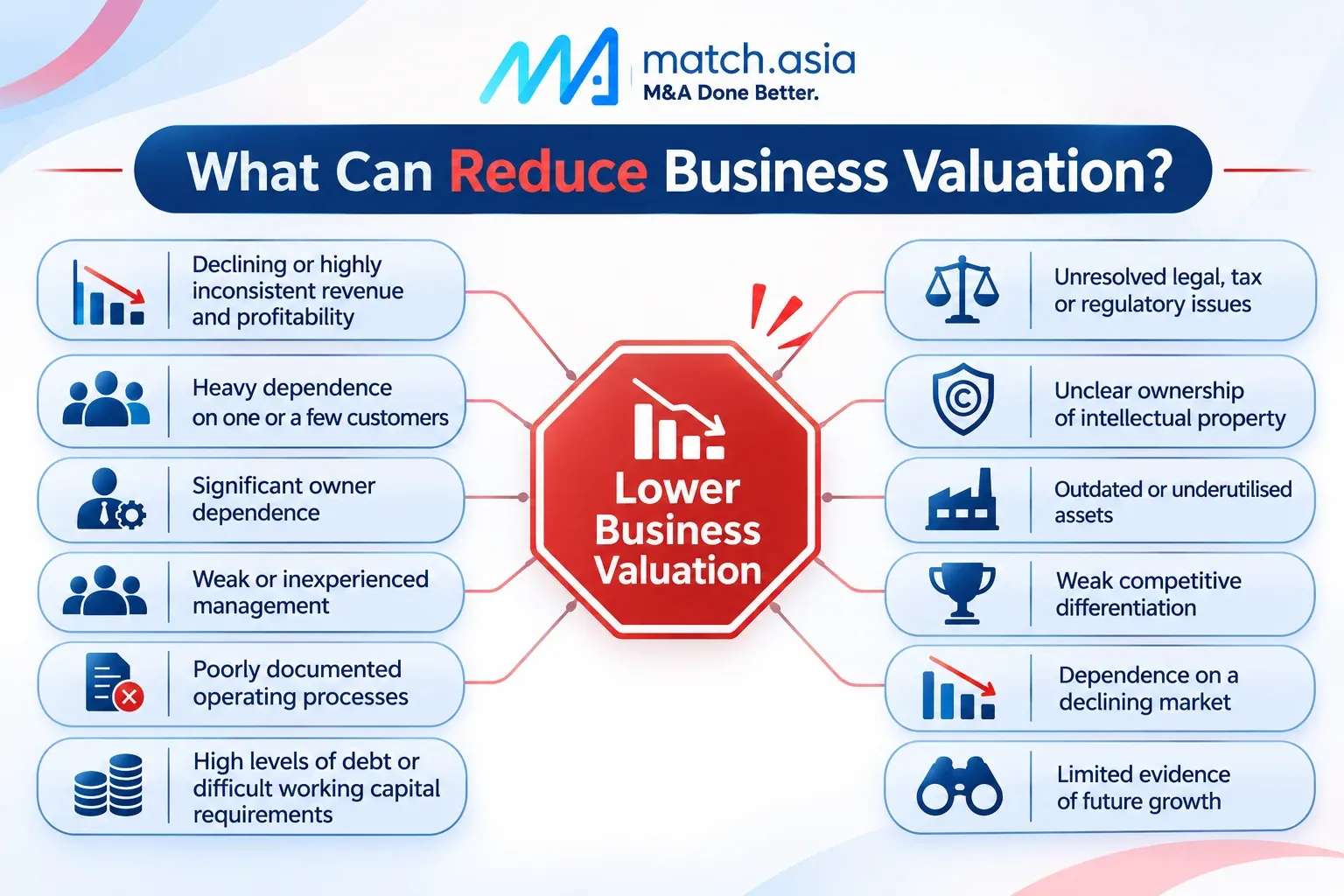
The factors that reduce business value are generally those that increase uncertainty, weaken future earnings or make the business harder for a buyer to operate after acquisition. Common valuation risks include:
-
- Declining or highly inconsistent revenue and profitability
-
- Heavy dependence on one or a few customers
-
- Significant owner dependence
-
- Weak or inexperienced management
-
- Poorly documented operating processes
-
- High levels of debt or difficult working capital requirements
-
- Unresolved legal, tax or regulatory issues
-
- Unclear ownership of intellectual property
-
- Outdated or underutilised assets
-
- Weak competitive differentiation
-
- Dependence on a declining market
-
- Limited evidence of future growth
These issues do not necessarily make a business unsellable. Instead, they can affect how a buyer assesses risk and therefore how much they are willing to pay. The important distinction is between a temporary issue that can be explained and a structural weakness that threatens future performance. A short-term decline supported by a credible recovery plan may be viewed differently from several years of deteriorating earnings with no clear explanation. For owners preparing for a sale, identifying these risks early can create an opportunity to address them before approaching the market.
How Valuation Methods Reflect These Factors?
Different valuation approaches translate business performance, assets and risk into an estimate of value. While the exact approach depends on the business and purpose of the valuation, three broad methods are commonly considered: income-based, market-based and asset-based approaches.
| Valuation approach | What it focuses on | How business factors influence it |
|---|---|---|
| Income approach | Future earnings or cash flows | Growth, profitability, earnings stability and risk can affect expected future cash flows and the rate used to reflect risk. |
| Market approach | Comparable businesses or transactions | Industry conditions, size, growth, margins, market sentiment and company-specific strengths or weaknesses influence the comparison. |
| Asset approach | Assets less liabilities | Asset quality, debt, working capital and the value of tangible and relevant intangible assets become particularly important. |
This is why the factors affecting business valuation are interconnected. Strong revenue growth can increase expected future earnings, but if that growth depends on one customer, the associated risk may offset part of the benefit. Similarly, a valuable brand may support competitive advantage, but its impact depends on whether it contributes to sustainable future earnings. Ultimately, valuation methods provide the framework for translating these underlying characteristics into a financial estimate. A professional valuation therefore looks beyond a single metric and considers the business as a whole.
For an initial indication of potential value, match.asia's business valuation calculator considers information such as sector, business model, revenue, growth and other company characteristics to provide an indicative valuation and identify key value drivers. For owners considering a future sale, it is equally important to understand which factors could affect buyer confidence. An exit readiness assessment can help identify potential gaps across areas that may influence valuation, buyer interest and deal execution. Understanding these drivers can also help owners approach the market more effectively. match.asia is an M&A platform for SMEs in Asia that combines buyer access, data-driven matching and transaction support across the M&A journey.
How match.asia Can Help You Calculate the Value of Your Business?**

Understanding what your business may be worth is an important first step when planning for a potential sale. match.asia’s Business Valuation Calculator provides an initial indication of your business value based on key information about the company, helping you understand the factors that may influence its valuation. The calculator considers business characteristics such as revenue, growth, profitability and other company-specific factors to provide an indicative valuation and highlight potential value drivers. It is designed to give business owners a practical starting point before entering more detailed valuation or M&A discussions. mFor owners considering a future sale, this can help answer an important question early in the process: What is my business worth today, and what factors could influence its value? Understanding this before going to market can help you set more realistic expectations and identify areas where strengthening the business may improve buyer confidence.
Conclusion
Business valuation is shaped by the overall strength, sustainability and risk profile of a company—not by a single financial metric. Profitability, revenue growth, customer relationships, management capability, competitive position, assets and market conditions all contribute to how buyers assess value. The most valuable businesses are typically those with sustainable earnings, predictable revenue, strong operations and clear potential for future growth. For business owners considering a future sale, understanding these factors early can help identify where improvements may be needed. Strengthening the underlying business, reducing key risks and building a more transferable operation can improve buyer confidence and create a stronger position when the time comes to sell. Ultimately, the goal is not simply to achieve a higher valuation on paper, but to build a business that buyers can understand, trust and see long-term value in.