Where Can I Sell My Business?
Published: November 4, 2026
Updated: November 6, 2026

Key Insights
- Multiple ways to sell a business: Business owners can explore business-for-sale marketplaces, business brokers, M&A advisors and direct outreach through professional networks.
- Choose the right selling platform: The best place to sell depends on your business size, industry, financial performance, location, confidentiality requirements and transaction objectives.
- Finding qualified buyers matters more than enquiry volume: Strategic buyers, financial investors, individual entrepreneurs and international acquirers may offer different opportunities depending on your business.
- Online business marketplaces offer wider reach: General business-for-sale websites, industry-specific platforms and M&A platforms provide different ways to connect with potential acquirers.
- Preparation improves buyer confidence: Accurate financial records, realistic business valuation, organised documentation and a clear sale proposition can help make your business more attractive to buyers.
- Confidentiality and buyer screening are essential: Verify potential buyers, assess their financial capabilities and use appropriate confidentiality arrangements before sharing sensitive business information.
- Selling a business in Asia involves cross-border considerations: SMEs in Southeast Asia should consider regional buyer demand, foreign ownership restrictions, regulatory requirements, tax implications and corporate structures.
- match.asia connects SME owners with potential buyers across Asia: Its M&A-focused platform helps business owners explore acquisition opportunities and take the next steps towards selling their businesses.
Table of Contents
1.What Are the Main Options for Selling a Business?1.1.BusinessforSale Marketplaces1.2.Business Brokers1.3.MA Advisors1.4.Direct Outreach and Professional Networks2.Where Can I Sell My Business Online?3.How Can I Find the Right Buyers for My Business?3.1.Define your ideal buyer3.2.Prepare accurate business information3.3.Present a credible sale proposition3.4.Screen potential buyers3.5.Compare the overall offer3.6.Keep the process organised4.How Do I Choose the Right Place to Sell My Business?4.1.Business size and complexity4.2.Industry experience4.3.Buyer reach and relevance4.4.Confidentiality4.5.Fees and services4.6.Control and support4.7.Geographic reach5.Where Can I Sell My Business in Asia?6.What Should I Consider Before Listing My Business?6.1.Understand your reasons for selling6.2.Develop a realistic view of value6.3.Organise your financial and legal records6.4.Protect confidential information6.5.Assess how dependent the business is on you6.6.Consider your role after the sale6.7.Plan for the transaction timeline6.8.Seek professional advice when needed7.Conclusion8.Frequently Asked Questions About Selling a BusinessSelling a business is a significant decision. Whether you have built a company over several decades, grown a profitable small business, or developed an online business that is ready for its next owner, finding the right buyer is one of the most important parts of the process. If you are wondering, “Where can I sell my business?”, there are several options to consider. You can list your company on a business-for-sale marketplace, work with a business broker or M&A advisor, approach potential buyers directly, or use your professional network to identify acquisition opportunities. Each option offers different levels of visibility, support, confidentiality and cost.
The best choice depends on your business's size, industry, financial performance, location and sale objectives. For example, a small online business may be suitable for a specialist website marketplace, while an established manufacturing company may benefit from a more structured M&A process involving strategic buyers or financial investors. For business owners in Southeast Asia, the decision also involves understanding regional buyer demand, cross-border considerations and the importance of protecting confidential business information. This guide explains where you can sell your business, how the different options work, and what to consider before choosing the right route.
What Are the Main Options for Selling a Business?
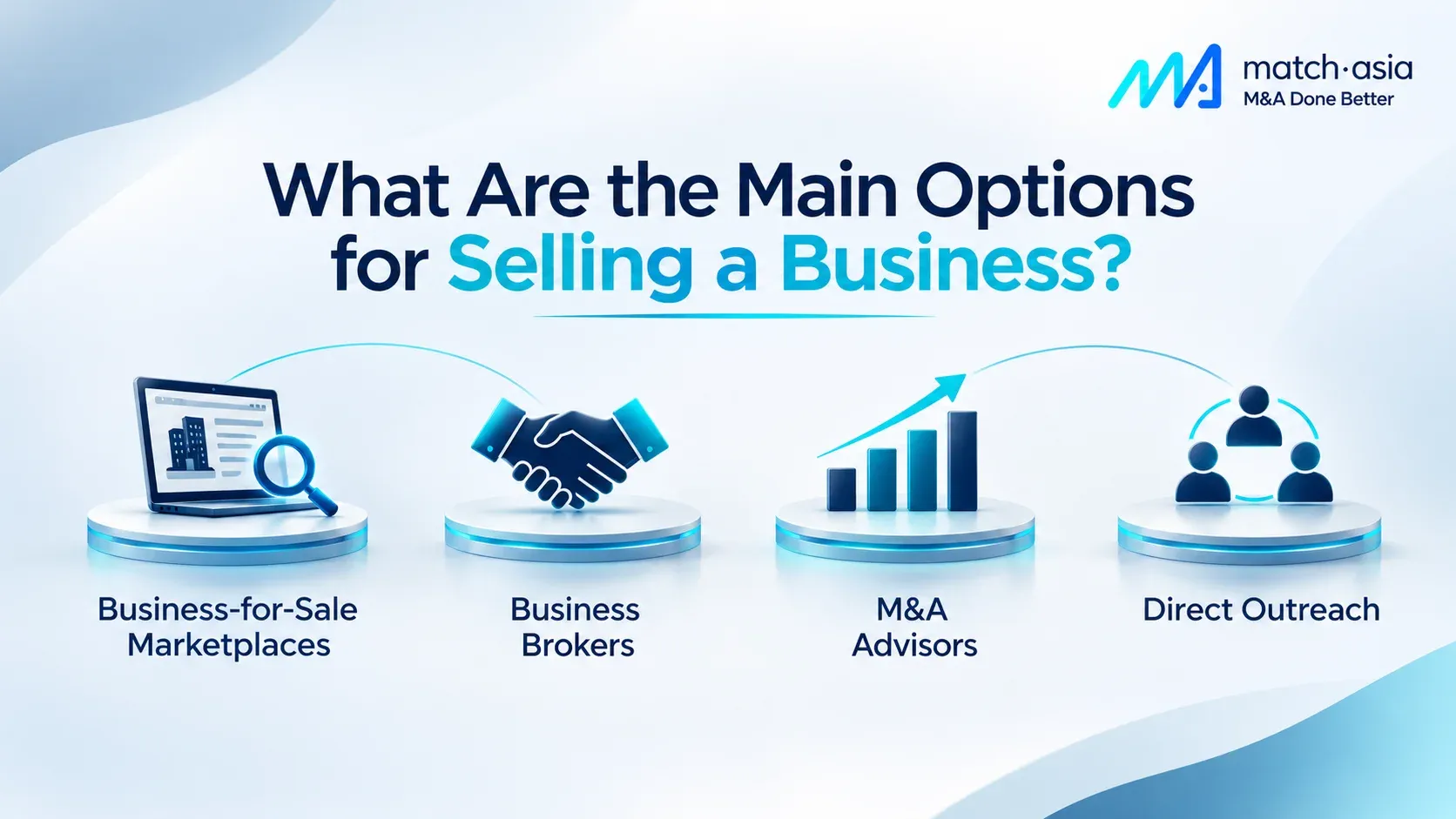
There is no single best place to sell every business. Some owners prioritise reaching as many potential buyers as possible, while others prefer a confidential process with assistance from experienced professionals. The main options are business-for-sale marketplaces, business brokers, M&A advisors, and direct outreach through professional networks.
1. Business-for-Sale Marketplaces
Business-for-sale marketplaces allow owners to advertise their companies to people actively looking for acquisition opportunities. Depending on the platform, listings may include information about the industry, location, asking price, revenue, profitability and reason for selling. These platforms can be particularly useful for small businesses that want to reach a wider audience without immediately hiring an intermediary.
Advantages:
- Reach buyers who are already searching for businesses to acquire.
- Present your company alongside other acquisition opportunities.
- Compare different listing packages and pricing structures.
- Generate enquiries from individuals, entrepreneurs and investors.
- Manage parts of the initial sales process yourself.
Limitations:
- Enquiry volume does not necessarily translate into serious offers.
- Some potential buyers may lack the funds or experience to complete a purchase.
- Public listings can expose sensitive information if not managed carefully.
- Owners may need to handle buyer screening, negotiations and due diligence themselves.
- Listing fees and additional services vary between platforms.
Before choosing a business sale platform, check how it handles buyer enquiries, confidentiality, listing visibility and verification. You should also understand whether it provides only advertising or offers additional support during the transaction. A listing can help attract attention, but a successful sale requires more than visibility. You need buyers who understand your business, can justify the acquisition financially and have the resources to complete the deal.
2. Business Brokers
A business broker acts as an intermediary between a business owner and potential buyers. Brokers typically help owners prepare the business for sale, estimate an appropriate asking price, market the opportunity and manage initial buyer discussions. The services provided depend on the broker, the size of the business and the terms of the engagement.
Advantages:
- Assistance preparing a business for sale.
- Access to the broker's existing network of buyers.
- Support with marketing, enquiries and initial negotiations.
- Less administrative work for the owner.
- Guidance through the stages of the sales process.
Limitations:
- Fees and commission arrangements can vary.
- The broker's buyer network may be stronger in some industries or locations than others.
- The quality of support depends on the broker's experience and resources.
- Some owners may have less direct control over buyer communication.
A business broker may be a suitable choice if you want hands-on assistance but do not have an internal team to manage the sale. When evaluating a broker, ask about previous transactions involving businesses of a similar size and type. Clarify the services included, how potential buyers are qualified, how confidentiality is maintained, and whether the broker will support negotiations through to completion.
3. M&A Advisors
Mergers and acquisitions (M&A) advisors help businesses navigate the sale process, particularly when a transaction involves more complex financial, operational or strategic considerations. They may assist with valuation, sale preparation, identifying suitable acquirers, preparing transaction materials, managing negotiations and coordinating due diligence. Their work can also include approaching selected buyers confidentially rather than advertising the company publicly. M&A advisory services are often relevant to established SMEs, companies with multiple shareholders, businesses with significant growth potential and owners considering a strategic exit.
Advantages:
- Structured preparation and transaction planning.
- Support developing a compelling investment proposition.
- Access to strategic buyers, financial investors and other acquisition networks.
- Assistance evaluating offers beyond the headline purchase price.
- Coordination of negotiations and due diligence.
Limitations:
- Fees and engagement requirements may be higher than those of a basic listing service.
- Some advisors focus on particular transaction sizes, sectors or markets.
- A sale is not guaranteed, even with professional support.
- The process may require considerable preparation and management time.
M&A advisors can be particularly valuable when a business has several possible buyer groups or when the owner needs help evaluating deal structures, payment terms and other conditions. The key is to select an advisor whose experience matches your business and transaction objectives. Ask about the expected process, likely buyer universe, fee structure and the advisor's role after an offer is received.
4. Direct Outreach and Professional Networks
You do not always need to advertise a business publicly to find a buyer. You can approach potential acquirers directly or use relationships with accountants, lawyers, investors, industry contacts and other business owners. Potential buyers might include competitors, suppliers, customers, companies entering a new market, entrepreneurs seeking an established business, or investors looking for acquisition opportunities. Direct outreach can work well when you already have a clear idea of who might benefit from acquiring your company.
Advantages:
- Allows you to target buyers with a strong strategic reason to acquire the business.
- Can help maintain confidentiality when handled carefully.
- Gives you greater control over whom you approach.
- May lead to discussions with buyers who understand your industry.
Limitations:
- Identifying suitable buyers can be time-consuming.
- Your existing network may not include enough qualified prospects.
- Approaching competitors or commercial partners can create confidentiality risks.
- Negotiations may become difficult without experience or independent advice.
If you choose this route, prepare a clear explanation of the opportunity and identify what makes the business attractive to a potential acquirer. Avoid sharing detailed financial or customer information before assessing the buyer's credibility and agreeing on appropriate confidentiality protections.
Where Can I Sell My Business Online?
If you want to sell a business online, you can use a general business-for-sale website, an industry-specific platform, an online marketplace for digital businesses, or an M&A platform that connects owners with prospective acquirers. The right option depends on what you are selling and the type of buyer you want to reach.
| Online option | Best suited for | What to consider |
|---|---|---|
| General business-for-sale websites | Small and established businesses across different industries | Audience reach, listing costs and buyer quality |
| Industry-specific platforms | Businesses in sectors such as hospitality, technology or manufacturing | Whether the platform attracts relevant industry buyers |
| Online business marketplaces | Websites, e-commerce stores and other digital businesses | How revenue, traffic and operating performance are assessed |
| M&A platforms | SMEs seeking buyers or investors for a business acquisition | Buyer screening, confidentiality, matching and transaction support |
| Professional networks and directories | Owners who already have relevant industry connections | How to reach decision-makers and manage the process |
Before selecting a platform, look beyond the number of listings or visitors it claims to attract. A large audience is not necessarily useful if most users are not suitable buyers for your business. Instead, assess whether the platform serves your industry, business size and target geography. Check whether buyers can filter opportunities by sector, location, revenue or other relevant criteria. Find out what information becomes public, whether buyer identities are checked and whether the platform provides help after an enquiry is received. You should also understand the commercial terms. Some business sale websites charge a fixed listing fee, while others offer different packages or charge for additional services. Certain transaction services may use a success-fee model. Always review the applicable terms before committing. For SMEs looking beyond a basic advertisement, match.asia offers an M&A-focused approach to connecting business owners with prospective buyers across Asia. When assessing any platform, consider how its matching process, buyer network, confidentiality measures and available transaction support fit your needs.
Remember: Listing your business online is a way to begin the sale process, not a guarantee that a transaction will happen. A successful outcome depends on the quality of the opportunity, the suitability of buyers, realistic expectations and the ability to complete the deal.
How Can I Find the Right Buyers for My Business?
Finding the right buyer for your business is not simply about collecting as many enquiries as possible. A suitable buyer needs a genuine interest in the business, a credible plan for acquiring it and the financial ability to complete the transaction. The following steps can help you identify stronger prospects.
1. Define your ideal buyer
Start by considering who would benefit most from acquiring your company. Possible buyer groups include:
- Strategic buyers: Existing businesses that want to expand their product range, enter a new market, acquire customers or strengthen their operations.
- Financial investors: Investors who evaluate a company based on its financial performance, growth prospects and potential returns.
- Individual buyers: Entrepreneurs or professionals looking to purchase an established business rather than start one from scratch.
- Competitors: Companies that may see value in your customer base, assets, capabilities or market position.
- International buyers: Companies or investors seeking an entry point into your industry or a new Asian market.
Not every buyer group will be appropriate. Consider which types of acquirers are most likely to understand your business and have a compelling reason to purchase it.
2. Prepare accurate business information
Buyers need enough information to decide whether an opportunity deserves further investigation. Prepare reliable financial statements and a clear overview of the company's operations, products, customers, management structure and growth prospects. Depending on the business, useful information may include revenue trends, profitability, customer concentration, recurring income, key contracts, assets, outstanding liabilities and the extent to which the company depends on its owner. Keep supporting documents organised. Accurate information makes it easier to respond to buyer questions and helps prevent delays later in the process.
3. Present a credible sale proposition
A strong business sale listing should explain what the company does, who its customers are, how it generates revenue and what makes it attractive to an acquirer. Highlight meaningful strengths rather than relying on broad claims. These could include established customer relationships, repeat revenue, specialised capabilities, a recognised brand, efficient operations or opportunities to expand into new markets. If you include financial figures, make sure they are accurate, clearly defined and supported by records.
4. Screen potential buyers
An enquiry does not automatically mean someone is ready to acquire your business. Before sharing sensitive information, assess the buyer's identity, acquisition objectives, relevant experience and ability to fund the purchase. Depending on the circumstances, you may request background information, evidence of funding or other appropriate documentation. A confidentiality agreement can help establish expectations before more detailed information is shared.
5. Compare the overall offer
The highest initial offer is not always the best offer. Consider the proposed purchase price alongside payment terms, financing conditions, completion timelines, due diligence requirements and any ongoing obligations. For example, one buyer may offer a higher price but require uncertain financing. Another may offer a lower amount with a more credible route to completion. The relative merits depend on the circumstances and the risks involved.
6. Keep the process organised
Maintain a record of buyer enquiries, meetings, documents shared and outstanding questions. If you are speaking with several buyers, use a consistent approach to evaluate their interest and progress. A structured process helps you identify serious prospects, manage expectations and make better-informed decisions.
How Do I Choose the Right Place to Sell My Business?
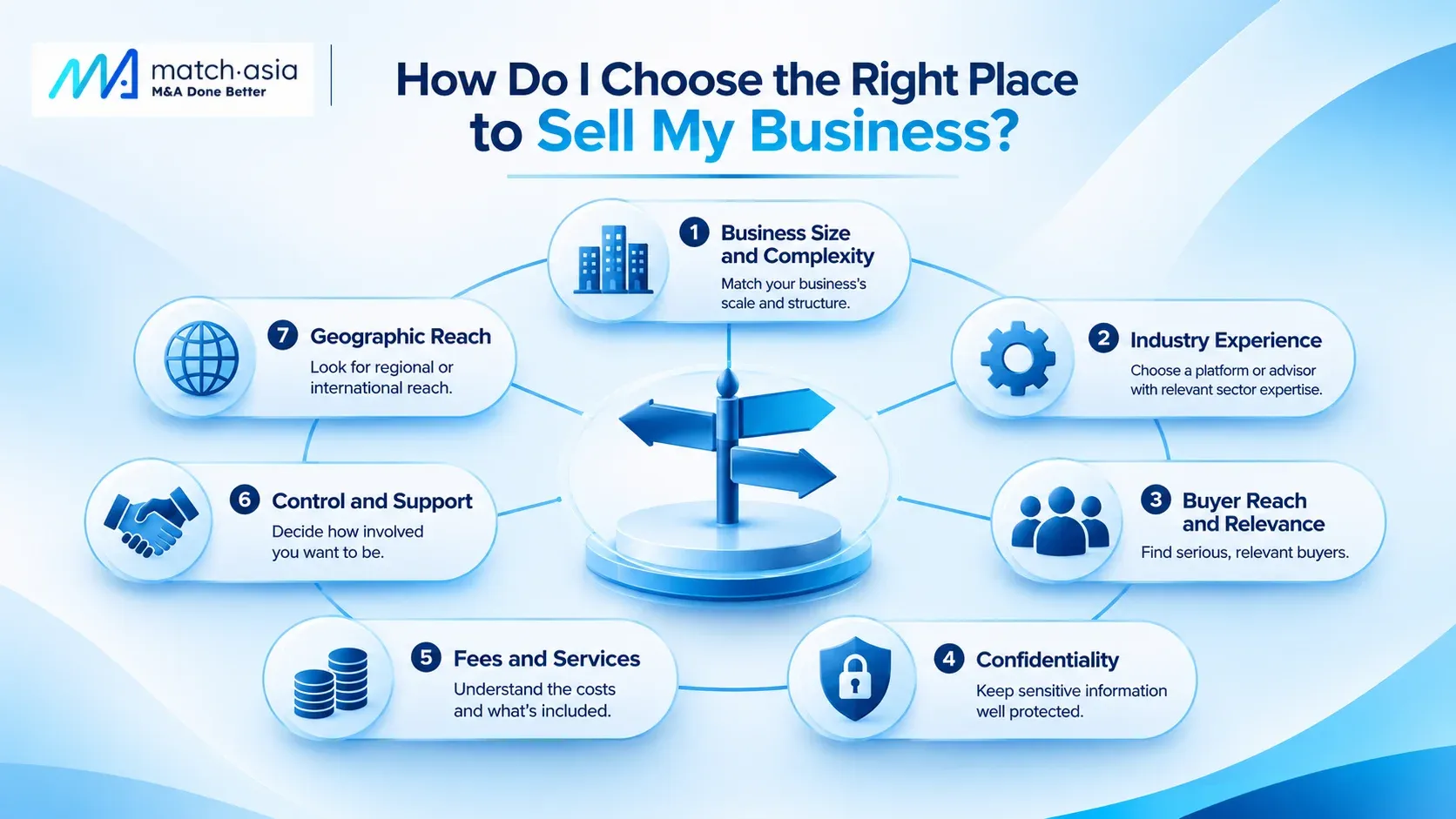
The best places to sell a business depend on your priorities. Before choosing a platform or professional intermediary, consider the following factors.
1. Business size and complexity
A small owner-operated business may need a straightforward listing and help with initial buyer enquiries. A larger company with multiple business units, shareholders or complex financial arrangements may require a more structured M&A process.
2. Industry experience
Choose a platform or advisor with experience relevant to your sector. An understanding of industry economics, customer relationships and operational risks can help buyers assess your business more effectively.
3. Buyer reach and relevance
Ask whether the service reaches buyers who are likely to be interested in your company. Relevant prospects are often more valuable than a large number of unrelated enquiries.
4. Confidentiality
Consider how much information is visible to the public and what protections are available before a buyer receives sensitive documents. If your employees, customers or suppliers are unaware of the sale, confidentiality may be especially important.
5. Fees and services
Compare listing charges, advisory fees, commissions and any additional costs. Establish exactly what is included, such as valuation guidance, marketing, buyer screening, negotiation support or transaction coordination.
6. Control and support
Some owners prefer to manage the process themselves, while others want an intermediary to handle much of the communication. Choose an arrangement that reflects your experience, availability and comfort with negotiations.
7. Geographic reach
If your business serves customers across several countries or could attract overseas acquirers, look for a service with relevant regional reach. Confirm whether it can help you connect with buyers in the markets that matter to your business. Finally, do not choose a provider based solely on promises of a quick sale or a high valuation. No platform or advisor can guarantee a successful transaction. A realistic process, well-prepared information and suitable buyers are more useful indicators of a credible approach.
Where Can I Sell My Business in Asia?
Business owners in Asia can explore local business-for-sale websites, regional M&A platforms, professional advisory firms and direct approaches to potential acquirers.The most suitable route depends on the business's location, industry, size and likely buyer profile. For owners in Southeast Asia, a regional approach may be worth considering. A business based in Singapore, Malaysia, Indonesia, Thailand, Vietnam or the Philippines may attract interest from buyers in its home market as well as companies seeking expansion opportunities elsewhere in the region. For example, a food manufacturer might attract a strategic buyer looking to expand its production capacity or distribution network. A business services company could interest a regional group seeking established customers and experienced staff. A technology business might appeal to an acquirer looking for specialised capabilities or access to a particular market.
However, cross-border transactions involve more than finding an interested buyer. Differences in corporate structures, tax rules, foreign ownership restrictions, employment requirements and regulatory approvals may affect the transaction. The relevant considerations depend on the countries involved and the type of business being sold. Currency movements, language differences and practical challenges in reviewing overseas buyers can also influence negotiations and completion timelines. When considering where to sell your business in Asia, look for a service that understands the regional SME environment and can help you reach relevant buyers. Explore businesses for sale in Asia to understand the types of acquisition opportunities available through match.asia. If you are preparing to exit, you should also consider whether your business is ready for scrutiny from a new owner. Clear financial records, documented processes, sound governance and reduced dependence on the founder can make the business easier to assess. A regional buyer network can widen your options, but it does not remove the need for careful preparation, buyer screening and appropriate professional advice.
What Should I Consider Before Listing My Business?
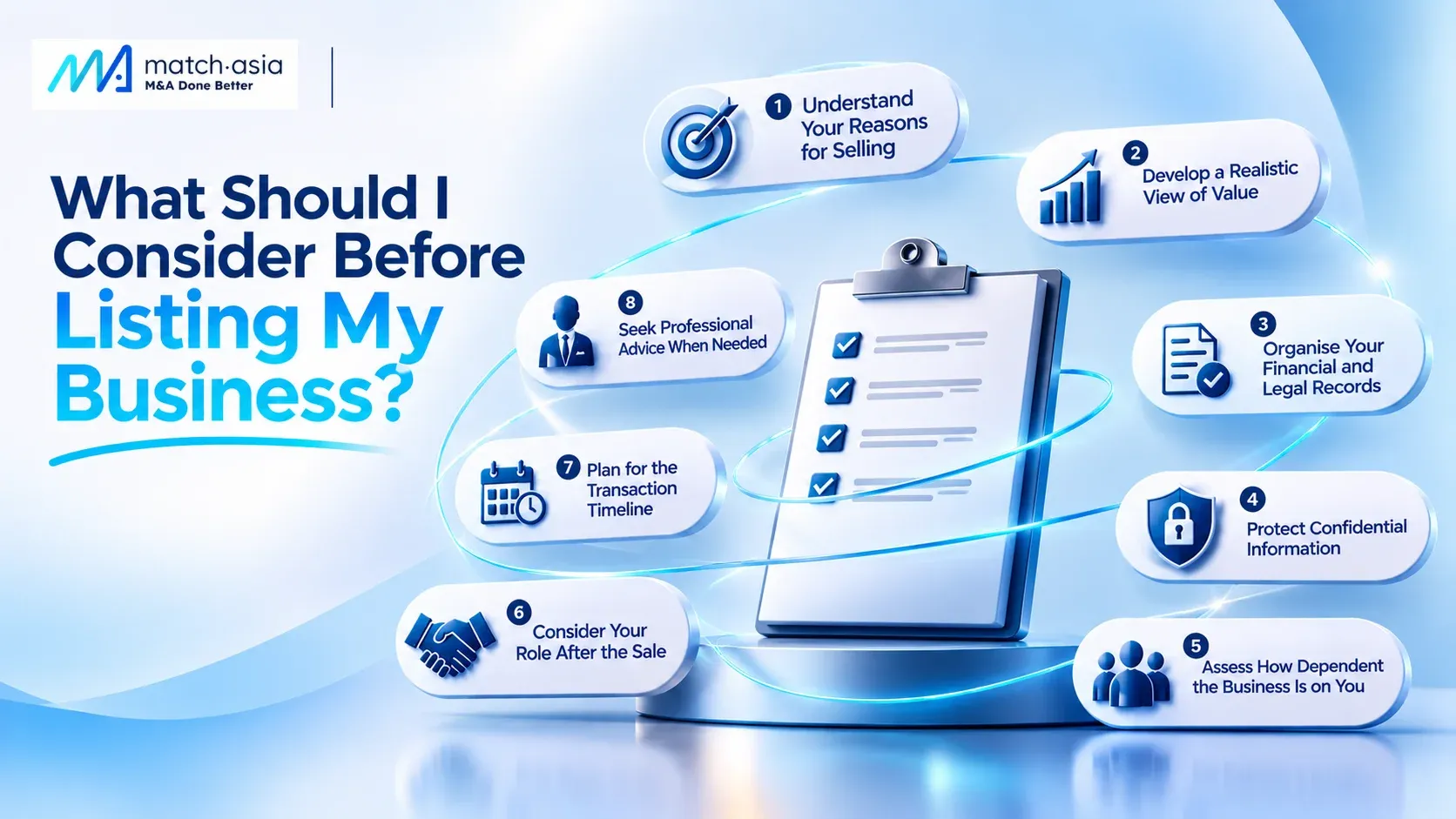
Before publishing a business sale listing or approaching potential acquirers, take time to prepare. The quality of your preparation can influence buyer confidence, negotiations and the likelihood of completing a transaction.
1. Understand your reasons for selling
Be clear about why you want to sell and what you want from the transaction. Your priorities may include maximising proceeds, retiring, reducing personal responsibilities, finding a partner for growth or ensuring continuity for employees. Your objectives can influence the type of buyer you target and the terms you are willing to consider.
2. Develop a realistic view of value
A buyer will assess your business based on factors such as financial performance, future prospects, industry conditions, assets, risks and the potential benefits of ownership. Do not assume that the amount you have invested in the business or the price you would like to receive will determine its market value. Consider obtaining an appropriate valuation or professional advice to develop realistic expectations.
3. Organise your financial and legal records
Gather financial statements, tax records, relevant contracts, ownership documents, licences and other material a buyer may reasonably need to review. Identify any outstanding disputes, liabilities or compliance issues that could affect the transaction. The documents required will depend on your business and the proposed deal.
4. Protect confidential information
Decide what information can be shared publicly and what should be disclosed only after a buyer has been screened. Avoid including sensitive customer details, trade secrets or confidential financial information in a public listing. Use appropriate confidentiality arrangements and seek professional advice when necessary.
5. Assess how dependent the business is on you
If the company relies heavily on your personal relationships, knowledge or daily involvement, a buyer may worry about what happens after you leave. Document important processes, clarify management responsibilities and identify employees or systems that support day-to-day operations. Where possible, demonstrate that the business can continue functioning without constant involvement from its owner.
6. Consider your role after the sale
Some buyers expect the seller to provide a transition period, train the new owner or remain involved for a defined period. Others may prefer a cleaner exit. Understand what you are willing to offer before negotiations progress.
7. Plan for the transaction timeline
A business sale can take months or longer, depending on the complexity of the company, buyer interest, due diligence, financing and regulatory requirements. Avoid making major commitments based on an assumed completion date.
8. Seek professional advice when needed
Accountants, lawyers, tax specialists and M&A professionals can help you understand financial, legal and transaction-related considerations. The level of support required depends on the circumstances. Preparing before you list your company gives you a clearer understanding of its strengths, helps you answer buyer questions and puts you in a better position to evaluate offers. If you are ready to explore the next steps, learn more about how to sell your business in Asia through match.asia.
Conclusion
Selling a business starts with finding the right place to reach suitable buyers, but a successful transaction depends on much more than a listing. Understanding your business's value, preparing accurate information, protecting confidentiality and identifying qualified buyers can help you navigate the process with greater confidence. Whether you choose a business-for-sale website, a broker, an M&A advisor or direct outreach, select an approach that fits your goals and the complexity of your business. For SME owners looking to explore acquisition opportunities across the region, match.asia provides an M&A-focused platform to connect with potential buyers and explore the next steps towards a sale. With the right preparation and approach, you can put your business in a stronger position for its next chapter.