How to Sell My Business?
Published: November 4, 2026
Updated: November 4, 2026

Key Insights
- Prepare your business before approaching buyers: Organise financial records, strengthen management, document key agreements and address potential risks that could affect buyer confidence or due diligence.
- Understand what your business is worth: Use earnings-based valuation, comparable transactions, discounted cash flow and asset-based approaches to establish realistic valuation expectations.
- Identify the right potential buyers: Consider strategic buyers, private equity firms, family offices and individual investors whose acquisition objectives, financial capacity and industry experience align with the business.
- Prepare for due diligence: Ensure financial, legal, commercial, operational and corporate records are accurate, consistent and readily available for buyer assessment.
- Evaluate deal structures and negotiate beyond price: Consider full or partial sales, share or asset sales, payment terms, earn-outs, warranties and continuing obligations when assessing an offer.
- Understand the transaction timeline and completion requirements: Account for negotiations, regulatory approvals, third-party consents, ownership transfers and post-sale transition arrangements, particularly in cross-border transactions across Southeast Asia.
Table of Contents
1.How to Prepare Your Business for Sale?1.1.Review financial performance1.2.Reduce dependence on the founder1.3.Document key relationships and agreements1.4.Assess corporate and operational readiness1.5.Identify potential risks early2.How to Value Your Business?3.How to Find the Right Buyer?4.Prepare for Due Diligence5.Negotiate the Sale and Deal Structure6.Complete the Sale and Transfer Ownership7.How Long Does It Take to Sell a Business?7.1.Stages of Selling a Business8.Common Mistakes to Avoid When Selling a Business9.How match.asia Can Help You Sell Your Business?10.Conclusion11.Frequently Asked Questions About Selling a BusinessSelling a business is an important financial and strategic decision. For many owners, it represents years of work building a company, developing customer relationships and establishing a position in the market. However, deciding to sell is only the beginning of the process. A successful sale requires more than finding someone willing to buy the business. Owners need to understand what their company is worth, prepare it for buyer scrutiny, identify suitable potential buyers and negotiate terms that reflect their objectives. These considerations are particularly important for small and medium-sized enterprises (SMEs) in Southeast Asia. Businesses operating across the region may attract local, regional and international buyers, each with different acquisition objectives, financial expectations and requirements for completing a transaction. Differences in corporate structures, contract arrangements, tax treatment and local regulations can also influence how a sale progresses.
The practical challenges of SME transactions are central to match.asia's approach. Founded by Marcus Yeung, Co-Founder & Managing Partner, and Patrick Linden, Co-Founder & Managing Partner, match.asia combines complementary experience across M&A advisory, investing and business building. Marcus brings over 30 years of experience as an M&A adviser, investor, buyer and seller, while Patrick is a serial entrepreneur who has successfully exited multiple companies. This article explains how to sell a business, from initial preparation and valuation to buyer identification, negotiations, due diligence and the final transfer of ownership.
How to Prepare Your Business for Sale?
The steps to sell a business should begin well before approaching potential buyers. Preparation helps owners identify issues that could affect valuation, delay negotiations or create uncertainty during due diligence. The first step is to clarify your reasons for selling. You may be planning retirement, pursuing another business opportunity, seeking liquidity or bringing in a partner to support the company's next stage of growth. Your objectives will influence the type of buyer you approach and the transaction structure you consider. Next, assess how prepared the business is for a change in ownership.
1. Review financial performance
Organise financial statements, management accounts, tax records, revenue breakdowns and information about outstanding debt. Buyers need to understand how the business generates revenue, manages expenses and sustains profitability. For businesses operating across several Asian markets, financial reporting should also clearly explain revenue by country, currency exposure and any significant intercompany transactions.
2. Reduce dependence on the founder
A founder-led business can be attractive to buyers, but excessive dependence on the owner may create concerns about continuity. Document important processes, delegate responsibilities and strengthen the management team where possible.
3. Document key relationships and agreements
Review customer and supplier contracts, employment arrangements, leases, licences and other agreements. Pay particular attention to change-of-control provisions, assignment restrictions and consent requirements. A contract may not automatically transfer to a buyer simply because the business is sold.
4. Assess corporate and operational readiness
Ensure that share registers, ownership records, shareholder agreements, statutory filings and relevant corporate approvals are properly maintained. For businesses with subsidiaries or operations in multiple countries, clarify how the entities relate to one another and which assets, liabilities and contracts belong to each entity.
5. Identify potential risks early
Outstanding disputes, tax issues, inconsistent records and customer concentration may affect buyer confidence. Cross-border businesses should also review local licensing requirements, foreign ownership restrictions and any outstanding regulatory obligations that could affect a transaction. Preparation does not mean every issue must be resolved before a sale can begin. It means understanding the business's strengths, identifying its weaknesses and being ready to explain both.
How to Value Your Business?
Understanding how to value a business for sale is one of the most important parts of the process. Owners often have an expected price based on the effort they have invested, the company's growth or the income it generates. Buyers, however, assess value based on financial performance, future prospects, risk and the price they believe the business can justify.
Several approaches can help establish an indicative business valuation:
- 1. Earnings-based valuation: This approach estimates value using the business's earnings and an appropriate valuation multiple. EBITDA, which stands for earnings before interest, taxes, depreciation and amortisation, is commonly used when assessing established businesses. A buyer may apply a multiple to sustainable EBITDA to estimate enterprise value. The appropriate multiple depends on factors such as industry, company size, growth prospects, profitability, customer concentration and perceived risk. Businesses with reliable financial reporting and management teams that can operate independently of the founder may be better positioned to demonstrate the sustainability of their earnings.
- 2. Comparable transactions: This approach considers prices paid for similar businesses in previous acquisitions. Differences in scale, market conditions, financial performance and transaction structure must be taken into account when interpreting these comparisons. In Southeast Asia, comparing businesses across countries also requires attention to differences in market maturity, operating costs, currency and regulatory conditions.
- 3. Discounted cash flow: This method estimates value based on projected future cash flows, adjusted to reflect their present value and the risks involved. It can be useful when a business has reasonably predictable cash flows and credible financial projections.
- 4. Asset-based valuation: This approach assesses the value of the company's assets after accounting for relevant liabilities. It may be particularly relevant for asset-intensive businesses, although it may not fully capture the earning potential of an established operating company.
Goodwill can also contribute to business value. It may reflect factors such as an established reputation, customer relationships, a strong brand or other advantages that support future earnings. When considering how to calculate goodwill when selling a business, owners should recognise that it is not simply an arbitrary amount added to the asking price. Its value depends on the benefits a buyer expects to receive and the extent to which those benefits can continue after the sale. The asking price should be informed by the valuation, the company's prospects and likely buyer demand. An indicative valuation is a starting point for discussions, not a guarantee of the final transaction price. Business owners can obtain an initial understanding of these factors through business valuation, helping them establish more informed expectations before approaching buyers.
How to Find the Right Buyer?
Finding the right buyer is not simply a matter of reaching as many people as possible. The objective is to identify potential buyers who have a credible reason to acquire the business and the resources to complete the transaction. Different buyers may see different opportunities in the same company.
- 1. Strategic buyers are existing businesses looking to expand their market presence, acquire complementary products, access new customers or strengthen their capabilities. An established company in Malaysia, for example, may consider acquiring an Indonesian distributor to expand its regional reach.
- 2. Private equity firms invest in businesses to generate returns. They may be interested in companies with sustainable earnings, capable management teams and opportunities for expansion or operational improvement. Their investment criteria vary by fund, geography and transaction size.
- 3. Family offices and holding companies may pursue long-term ownership, portfolio diversification or opportunities to build a group of complementary businesses.
- 4. Individual buyers may be entrepreneurs or experienced executives seeking to acquire and operate an established company. Their suitability depends partly on their funding, experience and ability to manage the business after completion.
For cross-border transactions, sellers should assess more than the buyer's stated interest. They should understand the buyer's legal identity, ownership structure, acquisition rationale, funding capacity and decision-making process. Where appropriate, this may involve reviewing corporate records, confirming the identity of the acquiring entity and understanding whether funding depends on third-party financing or investment committee approval. An overseas buyer may offer access to capital, distribution networks or new markets, but geographic reach alone does not establish that the buyer is suitable or transaction-ready.
Confidentiality is also important. Sharing sensitive information too early can expose customer relationships, commercial arrangements or strategic plans. An initial business profile can present the opportunity without immediately identifying the company. More detailed information can be provided as credible buyers progress through the process and appropriate confidentiality arrangements are established. Owners can pursue introductions through professional networks, approach strategic acquirers, work with M&A advisers or use an M&A platform to reach a broader pool of relevant buyers. The priority is to focus on buyer relevance rather than enquiry volume.
Prepare for Due Diligence
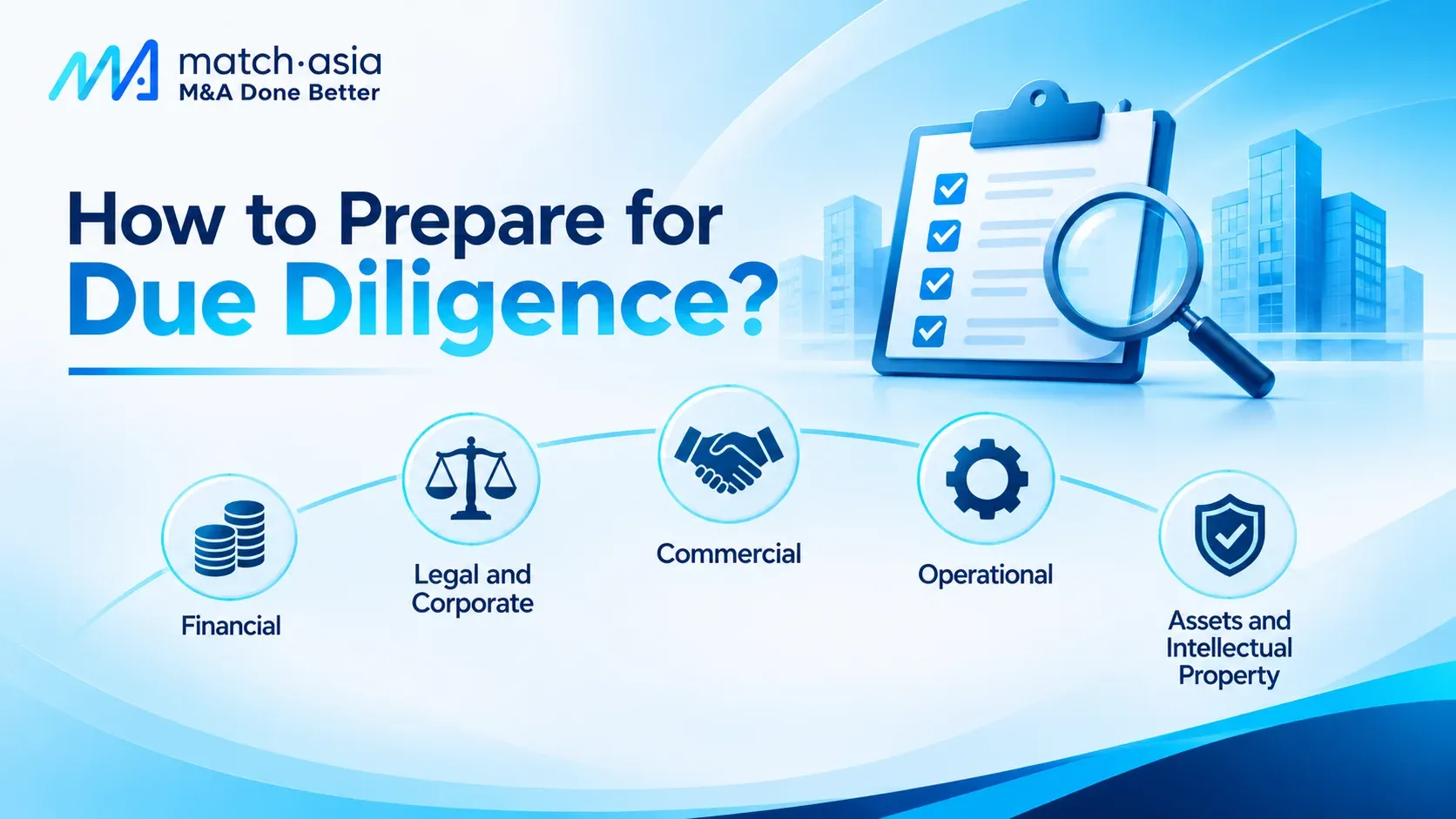
Due diligence is the process through which a prospective buyer examines the business before completing an acquisition. It allows the buyer to verify the information provided, assess risks and determine whether the proposed transaction remains commercially justified. This stage can cover several areas:
- Financial: Revenue, profitability, cash flow, debt, working capital, tax records and the sustainability of reported earnings.
- Legal and corporate: Ownership records, shareholder agreements, licences, disputes and contractual obligations.
- Commercial: Customer concentration, supplier relationships, competitive position and market prospects.
- Operational: Management structure, key employees, systems, processes and business continuity.
- Assets and intellectual property: Ownership of equipment, property, software, trademarks and other relevant assets.
For SMEs in Southeast Asia, cross-border due diligence can require additional coordination. A buyer may need to understand the relationship between the operating company and its holding company, verify the ownership of subsidiaries, review intercompany transactions and establish whether relevant licences and approvals remain valid following a change in ownership. Contracts deserve particular attention. Customer agreements, distribution arrangements, leases and technology licences may contain restrictions on assignment or provisions triggered by a change of control. The implications depend on the wording of the agreement and the applicable law. Identifying these requirements early helps the parties understand which consents may be needed before completion. Preparing documents in advance helps owners respond to requests more efficiently. It also provides an opportunity to identify inconsistencies before a buyer discovers them.
💡 Practical M&A insight:
A risk discovered during due diligence does not automatically prevent a transaction. The difficulty often arises when the seller cannot explain the issue, provide supporting documentation or establish what is required to resolve it. Early disclosure and a clear remediation plan can help the parties assess the issue more constructively. Owners should approach due diligence with accurate records, consistent explanations and realistic expectations. A structured due diligence process helps both parties examine the business and resolve important questions before completion.
Negotiate the Sale and Deal Structure
Once a buyer has assessed the opportunity and expressed serious interest, negotiations move beyond the headline price. The parties may document their initial understanding in a letter of intent (LOI). Depending on the transaction, this can outline the proposed purchase price, the stake being acquired, key conditions, the due diligence process, exclusivity and the expected timeline. Some provisions may be binding while others remain indicative, so the document should be reviewed carefully. The deal structure determines how the transaction will take place and how the consideration will be paid.
- 1. Full or partial sale: An owner may sell the entire business, a majority stake or a minority interest. The appropriate structure depends on the seller's financial objectives, desired level of involvement and the buyer's requirements.
- 2. Share sale or asset sale: In a share sale, the buyer acquires shares in the company. In an asset sale, the buyer acquires specified business assets and, where agreed, associated contracts or liabilities. These structures can have different implications for existing obligations, employees, licences and contractual relationships. For a business operating across several Asian jurisdictions, the legal and tax consequences may also differ between the countries involved.
- 3. Payment terms: Some transactions involve payment at completion, while others include deferred consideration or an earn-out linked to future performance. Sellers should understand the conditions attached to any amount that is not paid immediately, including how performance will be measured and what happens if the parties disagree.
- 4. Continuing obligations: Buyers may request warranties, indemnities, transition support or a non-compete clause when selling a business. These terms can affect the seller's responsibilities after completion and should be negotiated with appropriate legal advice. The enforceability and permitted scope of restrictive covenants vary by jurisdiction.
- 5. Regulatory and completion conditions: Cross-border transactions may require corporate approvals, third-party consents, regulatory clearances or foreign investment approvals, depending on the sector, ownership structure and countries involved. The parties should identify these requirements before committing to a completion timetable.
An attractive offer is not necessarily the one with the highest headline price. The seller should also consider funding certainty, completion conditions, payment timing, continuing obligations and the likelihood of the transaction closing.
❓ Practical M&A insight:
A deal structure should be evaluated against the seller's actual objectives, not just the proposed valuation. A higher offer with significant deferred consideration, extensive warranties or uncertain completion conditions may carry different risks from a lower offer with greater payment certainty. Business owners who want support understanding the stages of a sale can explore match.asia's seller platform, which brings together buyer matching and transaction support. Tax treatment, regulatory requirements and the legal implications of different structures should be assessed with qualified advisers before the parties commit to definitive terms.
Complete the Sale and Transfer Ownership
After negotiations and due diligence, the parties work towards final agreements and completion. The precise requirements depend on the transaction structure, jurisdiction and any approvals that apply. The purchase agreement records the definitive terms of the transaction. It typically addresses the purchase price, payment arrangements, representations and warranties, indemnities, conditions to completion and other obligations agreed by the parties. Before closing the sale, the parties must confirm that the required conditions have been satisfied or appropriately waived. These may include corporate approvals, regulatory clearances, third-party consents, financing arrangements and the completion of agreed documentation.
In a cross-border transaction, the parties may also need to coordinate company registry filings, share transfer formalities, tax documentation and any approvals applicable to foreign ownership. If the transaction involves an asset sale, contracts, licences, intellectual property and employees may require separate transfer arrangements or consent. These requirements should be assessed for each relevant jurisdiction rather than assumed to be identical across Southeast Asia. The transfer of ownership then takes place in accordance with the transaction documents. This may involve transferring shares or specified assets, making the agreed payment, updating corporate records and completing relevant registration or notification requirements.
The seller's responsibilities may continue after completion. The buyer may require a handover period during which the former owner introduces key customers, explains operating procedures or supports the management team. Other obligations may continue for a defined period under the purchase agreement. A clear transition plan helps protect business continuity, preserve important relationships and establish responsibilities after the transaction. Closing is therefore not just the moment when payment is made. It is the completion of a process that transfers the agreed ownership rights and puts the arrangements for operating the business under new ownership into effect.
How Long Does It Take to Sell a Business?
There is no fixed answer to how long it takes to sell a business. The timeline depends on the company's size, financial performance, industry, readiness, buyer demand and transaction complexity. As a general planning guide, a sale may take several months to a year or longer from initial preparation to completion. Some transactions progress more quickly, while others take longer because of valuation differences, financing requirements, due diligence findings or regulatory approvals. This is an indicative range, not a guarantee.
Stages of Selling a Business
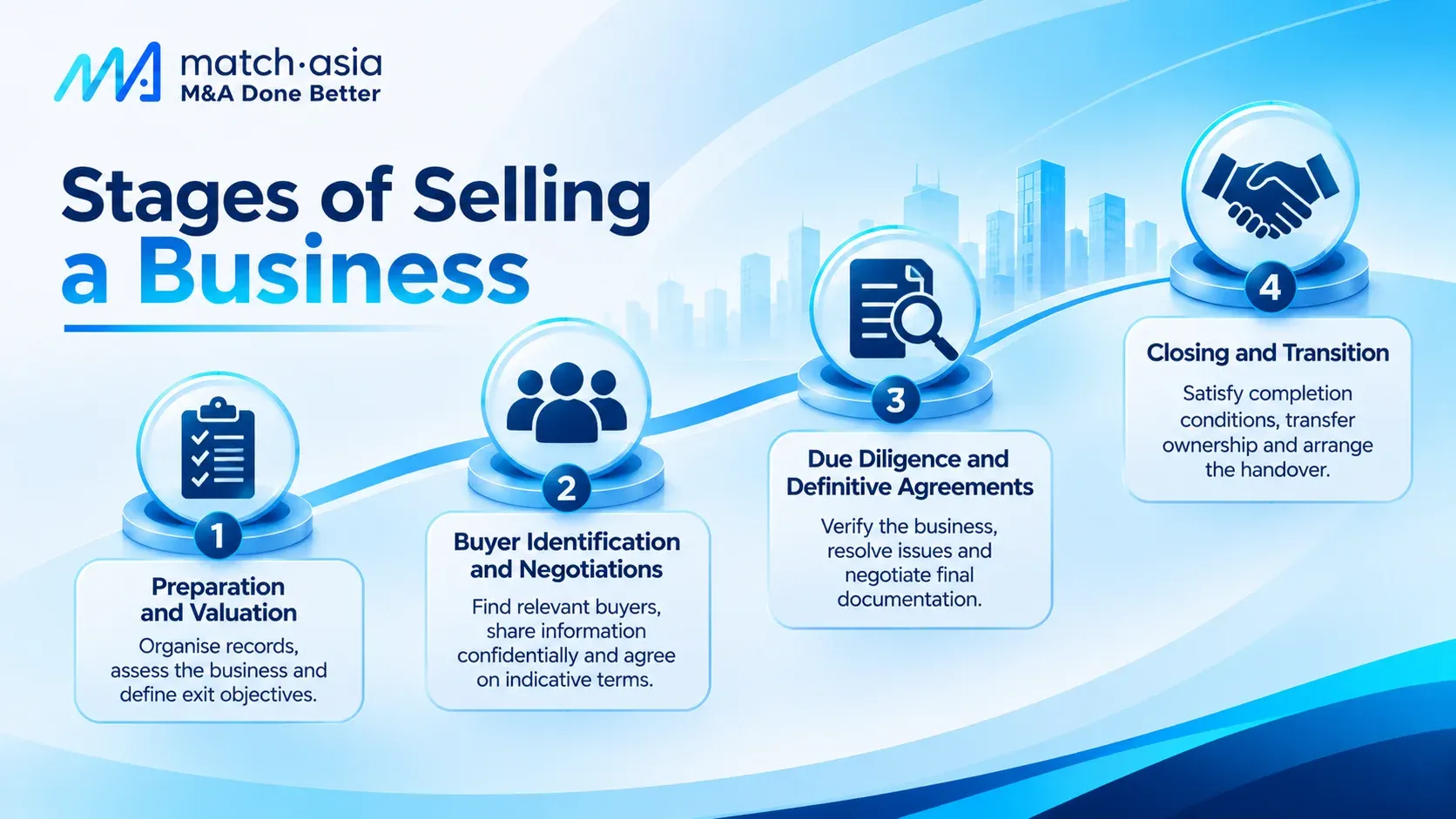
The process generally involves four overlapping stages:
- 1. Preparation and valuation: Organising records, assessing the business and defining exit objectives.
- 2. Buyer identification and negotiations: Finding relevant buyers, sharing information confidentially and agreeing on indicative terms.
- 3. Due diligence and definitive agreements: Verifying the business, resolving issues and negotiating final documentation.
- 4. Closing and transition: Satisfying completion conditions, transferring ownership and arranging the handover.
Cross-border transactions may require additional time to verify international buyers, coordinate advisers in different jurisdictions, obtain third-party consents and satisfy local regulatory requirements. The complexity depends on the countries, corporate structures and industries involved. A well-prepared business with reliable financial records, clear ownership arrangements and realistic valuation expectations may be easier for buyers to assess. However, preparation cannot guarantee a quick sale. Finding a buyer whose objectives align with the seller's expectations remains an important part of the process.
Common Mistakes to Avoid When Selling a Business
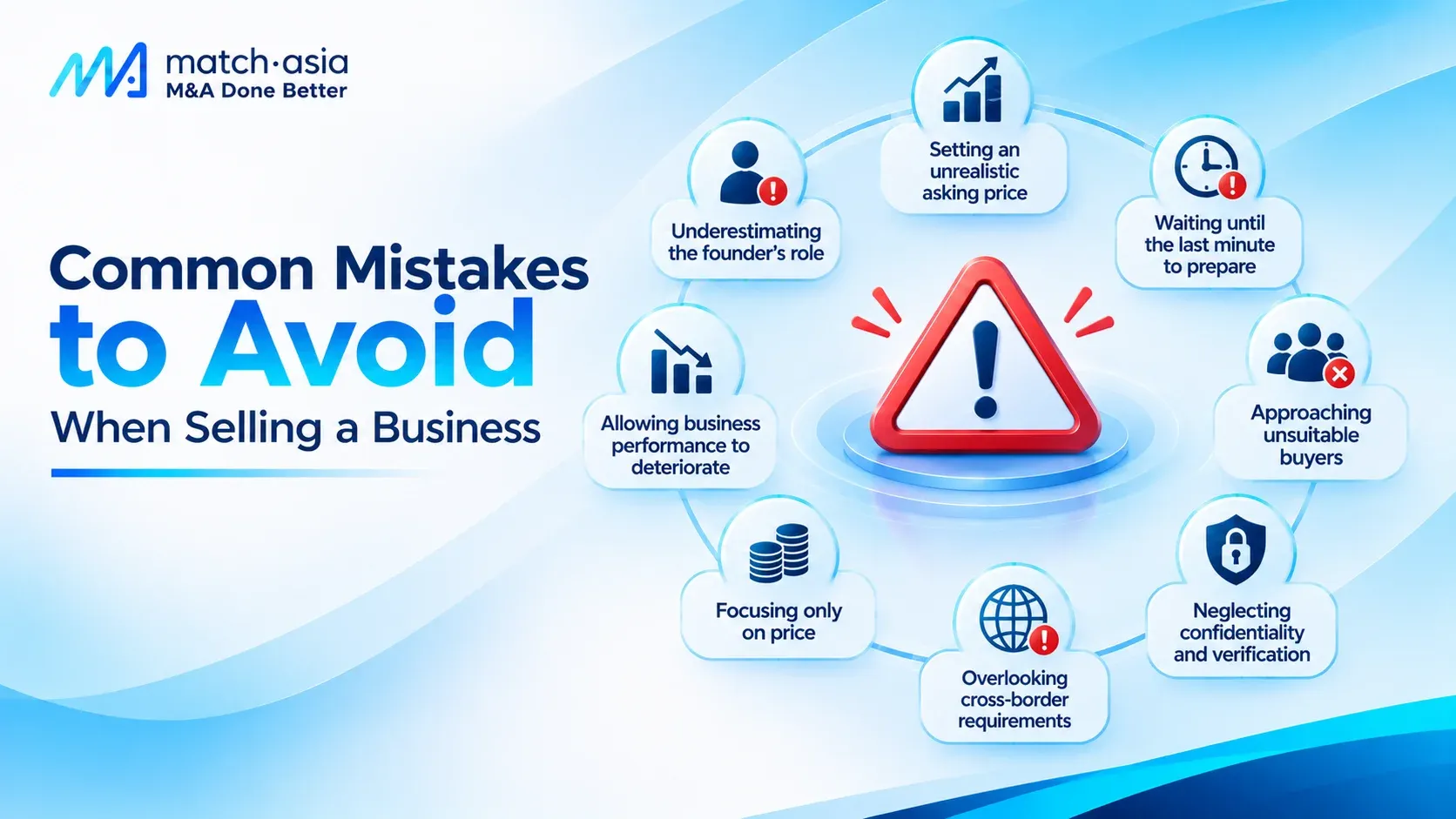
Several common mistakes can make selling a business more difficult than necessary:
- 1. Setting an unrealistic asking price. Owners may overestimate value based on personal investment or future potential that has not yet been demonstrated. An evidence-based valuation and an understanding of buyer expectations provide a stronger starting point.
- 2. Waiting until the last minute to prepare. Incomplete financial records, undocumented processes and unresolved legal matters can delay due diligence. Preparing early creates more time to address these issues.
- 3. Approaching unsuitable buyers. A large number of enquiries does not necessarily indicate strong demand. Prioritising buyers with relevant acquisition objectives and credible funding can make the process more productive.
- 4. Neglecting confidentiality and buyer verification. Disclosing sensitive information without appropriate safeguards can create commercial risks. Sellers should establish who the buyer is, understand its acquisition rationale and control the release of confidential information, particularly when dealing with overseas parties or competitors.
- 5. Overlooking cross-border requirements. Assuming that contracts, licences or corporate approvals will transfer automatically can create delays. Sellers should identify relevant change-of-control provisions, ownership restrictions, tax considerations and regulatory requirements early.
- 6. Focusing only on price. Payment conditions, financing, deferred consideration, warranties and post-sale obligations can materially affect the outcome. Every offer should be assessed as a complete transaction.
- 7. Allowing business performance to deteriorate. A prolonged sale process can distract owners from running the company. Maintaining customer relationships, staff engagement and financial performance remains important throughout negotiations.
- 8. Underestimating the founder's role. If the business depends heavily on the owner, buyers may question whether its performance can continue after the sale. Documenting processes and strengthening management can help address these concerns.
Avoiding these mistakes does not eliminate every transaction risk. It helps owners approach the sale with clearer expectations and a better understanding of what buyers need to evaluate.
How match.asia Can Help You Sell Your Business?
Selling a business requires coordination across preparation, valuation, buyer identification, negotiations and transaction execution. For SME owners, managing these activities independently can be challenging, particularly when the business continues to require their attention. match.asia is an AI-native investment bank for SMEs in Asia, combining experienced M&A professionals with intelligent technology to make the business sale process more structured and accessible. Its approach is built around a simple principle: investment bankers supercharged by AI, with technology enhancing human judgement rather than replacing it.
The process begins with understanding the business, its financial profile and the owner's objectives. This helps establish realistic expectations and identify the types of buyers that may be relevant. Technology-enabled matching can help identify potential counterparts based on factors such as sector, business size, geography and transaction structure, while experienced M&A professionals bring the commercial understanding needed to assess transaction opportunities. Preparation is equally important. Financial performance, operational maturity, management depth and the clarity of the company's growth opportunities can all influence how buyers assess the opportunity. Identifying these factors early helps owners understand how their business may be perceived by potential acquirers and where further preparation may be beneficial.
Buyer matching then focuses on relevance rather than simply generating enquiries. Strategic and financial buyers have different acquisition criteria, and identifying those whose objectives align with the business can support more productive discussions. For businesses in Southeast Asia, this also means considering potential cross-border buyers and the commercial rationale, transaction requirements and operating considerations associated with different markets. As a transaction progresses, structured information sharing, buyer assessment and support through negotiations and due diligence help the parties work towards an informed decision. The combination of intelligent technology and experienced M&A professionals supports the transaction process while keeping human judgement central to important commercial decisions.
match.asia's seller offering uses a success-fee-aligned approach for its qualifying transaction facilitation service, without a seller retainer. Service terms and any optional paid offerings should be reviewed before engagement. The platform does not guarantee a particular valuation, buyer response or completed transaction. Business owners can learn more about selling their business through match.asia to understand how the platform supports the different stages of an SME sale. Ultimately, selling a business is not simply about finding someone willing to pay for it. It is about preparing the company, identifying the right buyer and negotiating terms that support a viable transaction for both parties. By bringing together investment banking expertise, regional buyer access and AI-enabled technology, match.asia aims to make the sale process more structured for SMEs across Asia.
Conclusion
Selling a business involves more than agreeing on a price. It requires careful preparation, a realistic understanding of business value, the right buyer and a structured approach to negotiations, due diligence and the transfer of ownership. For SME owners in Southeast Asia, the process also requires attention to cross-border buyer verification, corporate structures, contractual obligations and local regulatory requirements. Addressing these considerations early can help reduce avoidable delays, strengthen buyer confidence and create a clearer path towards completion. Ultimately, a successful sale depends on aligning the business's strengths with buyer expectations and negotiating terms that reflect the owner's financial goals and long-term priorities. With the right preparation and transaction support, business owners can approach the process with greater clarity and make more informed decisions about their company's future.