How to Prepare a Business for Sale?
Published: November 23, 2026
Updated: November 23, 2026

Key Insights
- Set clear sale objectives, including your target price, timing and role after the transaction.
- The best time to sell depends on business performance, market conditions and the owner’s readiness.
- Stable, predictable revenue and healthy profit margins can strengthen business value.
- Reducing owner dependency makes a business easier for buyers to take over.
- Diversified customers, reliable suppliers and transferable contracts can reduce buyer risk.
- Clean financial, tax, legal and intellectual property records can make due diligence faster and smoother.
- A secure, well-organised data room helps buyers review the business efficiently.
- Professional advisers should be involved early enough to identify and resolve potential deal issues.
- The goal of preparation is to build a business that buyers can understand, verify, operate and continue to grow.
Table of Contents
1.Setting Your Goals for the Sale2.Finding the Best Time to Sell a Business2.1.How Long Does It Take to Get a Business Ready for Sale?2.2.Signs It is a Good Moment to Sell3.How to Increase Business Value Before Selling?3.1.Building Predictable Revenue3.2.Improving Margins4.How to Make Your Business Sellable to Buyers?4.1.Reducing Owner Dependency4.2.Spreading Customer and Supplier Risk5.Getting Financial and Legal Records in Order5.1.Cleaning Up Financial Statements5.2.Closing Tax Legal and IP Gaps5.3.Setting Up a Data Room6.Putting Together Your Advisory Team7.Business Sale Preparation Checklist8.Frequently Asked QuestionsSelling a business is rarely as simple as deciding to put it on the market and waiting for buyers to make offers. Buyers want to understand how the business performs, what risks they may inherit, how dependent it is on the owner, and whether its earnings can continue after the transaction. Getting a business ready for sale therefore starts well before a buyer is contacted. The preparation process is about making the business easier to understand, easier to operate and easier to value. It can involve improving financial performance, strengthening management, reducing customer concentration, documenting processes, resolving legal issues and preparing the records a buyer will eventually review. Starting early also gives the owner more choices: there is more time to improve the business, reconsider the timing of the sale or address issues before they become negotiation points.
Setting Your Goals for the Sale
Before making operational or financial changes, decide what you want the sale to achieve. Your objectives will influence almost every other decision, including when you sell, which buyers you approach, how much preparation makes sense and what type of transaction you are willing to accept. Start by defining your target price, preferred sale date and desired role after closing. You may want a complete exit, a gradual transition or an opportunity to retain some ownership. You may also care about protecting employees, preserving the company’s brand or finding a buyer who can continue growing the business. These priorities should be ranked because it may not be possible to maximise price, speed, control and continuity at the same time.
Your reason for selling also matters. Buyers will usually want to understand why the owner is considering an exit. Retirement, a planned succession, a change in personal priorities or a decision to pursue another opportunity can be straightforward explanations. An unclear or inconsistent reason can create unnecessary suspicion, particularly if the business has other issues that have not been disclosed. Being honest and consistent about the motivation for the sale can help establish trust. It is also useful to establish a backup plan. If an external buyer does not appear at the expected valuation, alternatives could include a management buyout, a partial sale or transferring ownership to a family member. Having alternatives does not mean you are less committed to selling; it means you understand your options before entering negotiations.
Finding the Best Time to Sell a Business
The best time to sell a business is rarely determined by one factor. It usually depends on the condition of the company, market conditions and the owner's readiness to exit. A strong business can still face challenges if buyer demand is weak, while favourable market conditions cannot compensate for declining performance or unresolved risks. Ideally, preparation should begin before you need to sell. This gives you time to establish a track record of sustainable performance rather than trying to improve the numbers immediately before approaching buyers. Industry guidance commonly recommends starting well in advance, with some advisers suggesting 18–24 months or more for a proper preparation period.
1. How Long Does It Take to Get a Business Ready for Sale?
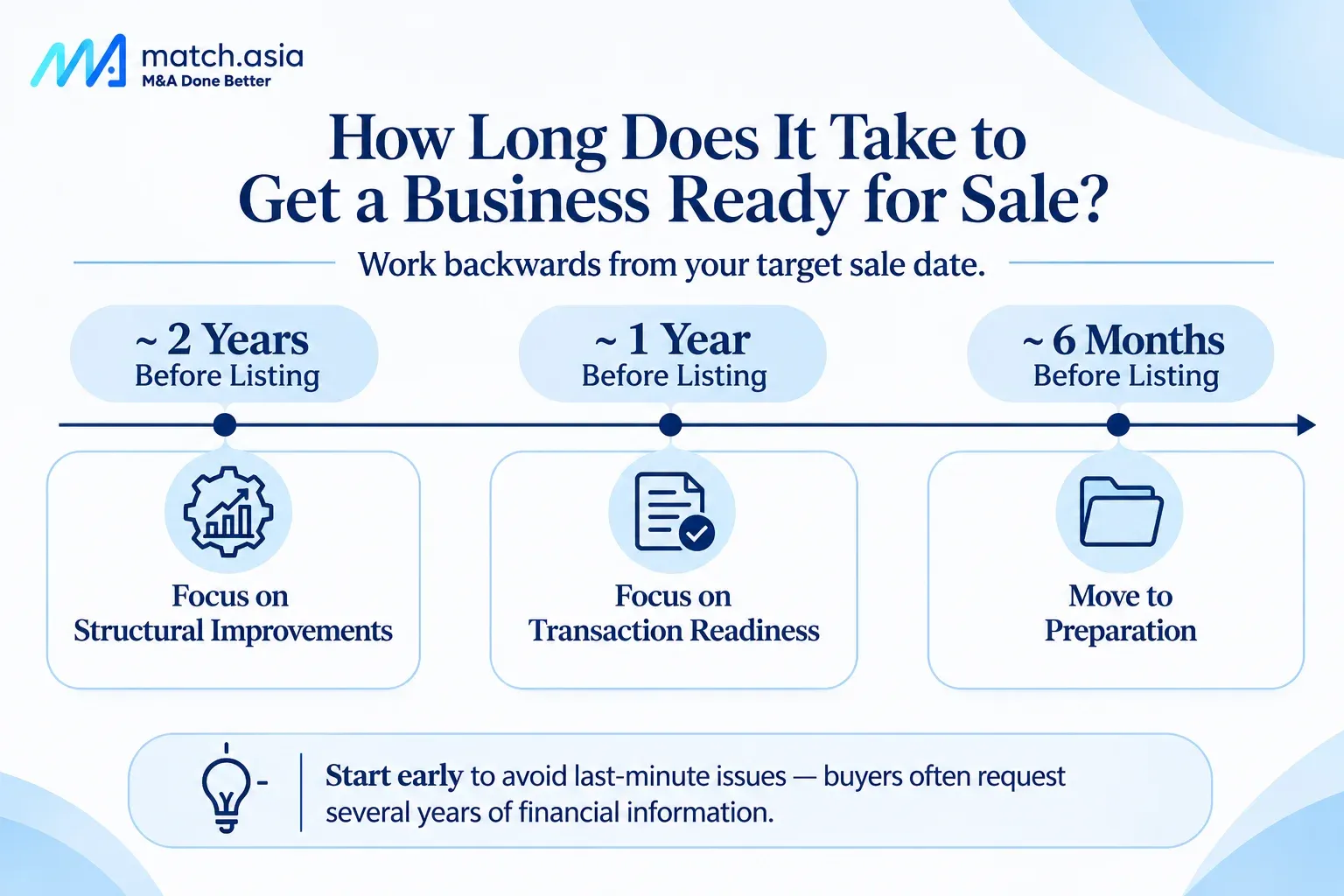
The timeline depends on the business, but a useful framework is to work backwards from your target sale date.
-
- Around two years before listing: focus on structural improvements. Review profitability, customer concentration, owner dependency, management strength, contracts, intellectual property and operational processes. Identify weaknesses that could affect valuation or create problems during due diligence. If the business needs meaningful improvements, this is the time to make them.
-
- Around one year before listing: focus on transaction readiness. Finalise accounting practices, review tax and legal records, strengthen the management team, renew important contracts where appropriate and obtain an initial view of business valuation. This is also a good point to begin working with specialist advisers who can identify issues before buyers do.
-
- Around six months before listing: move from improvement to preparation. Organise financial and legal records, prepare a secure data room, document key business information and confirm the sale strategy. At this stage, the business should continue operating normally while the owner and advisers prepare the materials required for buyer outreach.
Starting early also reduces the risk of rushing through financial, tax or legal work. Buyers commonly request several years of financial information, so records that are incomplete or inconsistent can slow the process and create avoidable questions.
2. Signs It is a Good Moment to Sell
A potentially attractive time to sell is when the business has a strong and credible performance story. Profit that is still growing, healthy margins, predictable revenue and a clear growth opportunity can make the company more compelling to buyers. Industry conditions matter too. Strong buyer demand, favourable financing conditions and active M&A activity can support a better sale environment. Conversely, selling during a period of declining revenue, weakening margins or significant uncertainty may reduce buyer confidence. The owner’s personal readiness should also be considered. A business may be financially attractive but still not be ready for sale if the owner is uncertain about stepping away or cannot agree with other shareholders on the exit plan.
How to Increase Business Value Before Selling?

Learning how to increase business value before selling starts with understanding what buyers are actually paying for. Revenue alone does not determine the value of a business. Buyers generally care about the quality and sustainability of earnings, future growth potential, business risk and how easily the company can continue operating without the current owner. An independent business valuation can help identify the factors supporting value as well as areas that may weaken it. A valuation is particularly useful before making major changes because it provides a baseline against which potential improvements can be assessed. For an initial indication of value, owners can use the business valuation calculator from match.asia. It should not replace professional transaction advice, but it can help owners understand the main factors that influence business value before entering the sale process.
1. Building Predictable Revenue
Predictability is valuable because buyers are purchasing future earnings, not simply historical sales. A company with regular payments, recurring revenue, repeat customers and long-term contracts can provide greater visibility into future performance. Where appropriate, focus on increasing customer retention, renewing important contracts and developing recurring or repeat revenue streams. Avoid creating artificial revenue spikes simply to improve the numbers before a sale. Buyers are likely to examine whether recent growth is sustainable. Customer concentration should also be reviewed. If one customer represents a large share of revenue, the loss of that relationship could materially affect future earnings and therefore increase perceived risk. Expanding the customer base can make revenue more resilient and reduce this concern.
2. Improving Margins
Improving profitability can have a direct effect on business value, particularly when buyers use earnings-based valuation methods. Review unnecessary costs, inefficient processes, supplier pricing and underperforming products or services. Pricing should also be reviewed to determine whether the business is appropriately charging for the value it provides. However, cost-cutting should not damage the business. Removing essential employees, reducing customer service or cutting productive marketing shortly before a sale may improve short-term profit while weakening the company’s future prospects. The goal is sustainable margin improvement. Buyers are more likely to value earnings that can continue after the transaction than a temporary increase created by last-minute cuts.
How to Make Your Business Sellable to Buyers?
A sellable business is one that a buyer can understand, verify and operate without inheriting unnecessary risks. Buyers may become concerned when too much knowledge sits with the owner, when customer relationships are personal rather than institutional, or when important agreements are informal. The preparation process should therefore focus on transferability. Ask a simple question: if the owner stepped away tomorrow, could another capable management team operate the business effectively?
1. Reducing Owner Dependency
Owner dependency is one of the clearest obstacles to a smooth business transfer. If the owner personally handles most sales, key customer relationships, operational decisions or specialist knowledge, a buyer may worry about what happens after closing. Start by documenting important processes and responsibilities. Written standard operating procedures, organised customer information and a reliable CRM can make knowledge easier to transfer. Build a second level of management so important decisions do not depend entirely on one person. Key employees should also be identified early. Where appropriate, retention bonuses or other incentives can help keep critical employees engaged through the transition. A buyer wants confidence that the people responsible for delivering the company’s value will remain available after the sale. The objective is not to remove the owner from the business overnight. It is to demonstrate that the company has systems, people and processes capable of continuing without constant owner involvement. This is a recurring theme in M&A preparation guidance because key-person dependency can become a significant buyer concern.
2. Spreading Customer and Supplier Risk
A business that depends heavily on one customer or supplier can appear more vulnerable than a diversified company. Review the percentage of revenue coming from major customers and identify suppliers that would be difficult to replace. Where possible, broaden the customer and supplier base before going to market. Review customer retention, contract renewal dates and the strength of important commercial relationships. Verbal arrangements should also be converted into written agreements where appropriate. Review whether important customer and supplier contracts can be transferred to a new owner. Leases, licences and other key agreements should be checked for change-of-control or assignment provisions. Buyers will want to know whether the commercial relationships supporting the business will remain intact after the transaction.
Getting Financial and Legal Records in Order
Good preparation makes due diligence faster and reduces the risk of unpleasant surprises. Buyers will typically want to examine financial, tax, legal, commercial, operational and ownership records before completing a transaction. The objective is not simply to collect documents. It is to ensure the information is accurate, consistent and easy for another party to understand.
1. Cleaning Up Financial Statements
Prepare at least three to five years of historical financial statements, along with current year-to-date results and appropriate forecasts. Buyers will want to understand revenue, margins, operating expenses, assets, liabilities, cash flow and the factors driving changes in performance. Review the accounts for personal expenses, unusual costs, one-off items and owner-specific expenses that may not continue after the transaction. These adjustments should be properly documented rather than used simply to inflate profitability. Financial statements should also be consistent with tax filings and supporting records. Buyers may investigate differences between management accounts, tax returns, bank records and other financial information. Clean and well-supported financials can reduce uncertainty during diligence.
2. Closing Tax, Legal and IP Gaps
Resolve tax, legal and regulatory issues before going to market wherever possible. Review outstanding tax filings, disputes, licences, permits, employment matters, leases, customer contracts and supplier agreements. Intellectual property requires particular attention. Trademarks, domains, software rights, patents, copyrights and other important IP should be properly documented and, where appropriate, registered in the company’s name. A buyer needs confidence that the business actually owns or has the right to use the assets that support its operations. Unresolved issues are more expensive when discovered late in a transaction because they can lead to delays, renegotiation, indemnities or reductions in value. The U.S. Chamber of Commerce similarly recommends reviewing tax history and resolving potential issues before buyers conduct diligence.
3. Setting Up a Data Room

A data room is a secure online location where transaction documents can be organised and shared with authorised parties. Setting one up early helps prevent a last-minute scramble when buyers begin requesting information. Organise folders logically, such as financials, tax, corporate records, contracts, employees, IP, assets, insurance and operational information. Keep documents current and use clear file names. A well-organised data room can make the buyer’s review more efficient and demonstrate that the business is professionally managed. It also allows the seller and advisers to control which information is shared and when.
Putting Together Your Advisory Team
Preparing a business for sale often requires expertise that goes beyond the owner’s normal accounting and legal relationships. The right advisory team can identify risks early, help establish realistic valuation expectations and prepare the company for negotiations.
-
- An accountant can clean up financial statements, review tax matters, prepare financial information and help identify unusual or owner-related expenses. Depending on the size and complexity of the transaction, a quality of earnings review may also be appropriate.
-
- An M&A lawyer can review contracts, ownership structures, employment matters, IP, regulatory issues and transaction documents. Bringing legal counsel in early gives the owner more time to resolve problems before buyers discover them.
-
- An M&A advisor or broker can help assess valuation, develop the sale strategy, prepare buyer materials, identify suitable buyers and manage the transaction process. The appropriate adviser depends on the size, complexity and objectives of the sale.
-
- A financial planner or wealth adviser can help the owner consider the personal financial consequences of the transaction, including how much capital is needed after the sale and how the proceeds fit into longer-term plans.
The advisory team should ideally be involved before the business is formally marketed. This is particularly important when the owner needs to consider ownership structure, tax implications or a management succession plan one or two years in advance.
Business Sale Preparation Checklist
Use the following checklist as a practical starting point. The exact timing will depend on the size, complexity and condition of the business.
| Area | What to Have Ready | When to Start |
|---|---|---|
| Sale objectives | Target price, preferred timing, transition role and priorities | 18–24+ months before |
| Business valuation | Initial valuation and key value drivers | 12–24 months before |
| Financials | 3–5 years of statements, current results and forecasts | 12–24 months before |
| Profitability | Sustainable margins and documented adjustments | 12–24 months before |
| Revenue | Recurring revenue, customer retention and concentration analysis | 12–24 months before |
| Management | Clear responsibilities and second-level leadership | 12–24 months before |
| Operations | Documented processes and CRM/customer records | 12–18 months before |
| Contracts | Customer, supplier, lease and employment agreements | 6–12 months before |
| Tax and legal | Filings, disputes, licences and compliance issues resolved | 6–12 months before |
| Intellectual property | Ownership and registration of trademarks, domains and software rights | 6–12 months before |
| Data room | Secure, organised transaction documents | 3–6 months before |
| Advisory team | Accountant, M&A adviser, lawyer and financial planner | 12–24 months before |
The most important point is that preparation should not become a checklist exercise. The purpose is to build a stronger, more transferable business. Buyers are likely to look beyond the documents and ask whether the company can maintain its performance after ownership changes.