How to Sell a Business Confidentially?
Published: November 24, 2026
Updated: November 24, 2026

Key Insights
- Protect business value by keeping sale discussions confidential.
- Use anonymous listings to attract potential buyers without revealing your identity.
- Screen buyers before sharing sensitive business information.
- Always secure an NDA before disclosing company details.
- Share information gradually as buyers progress through the deal.
- Apply stricter safeguards when engaging competitors.
- Plan stakeholder communication carefully to avoid premature disclosure.
Table of Contents
1.What a Leak Can Cost a Seller?2.Confidential Sale Versus an Open Listing3.The Confidential Sale Process Step by Step3.1.Decide Who Needs to Know3.2.Prepare an Anonymous Business Listing3.3.Screen Buyers Who Respond3.4.Get the NDA Signed First3.5.Share Details Gradually3.6.Announce the Sale on Your Terms4.What Goes Into a Business Sale Confidentiality Agreement?5.A Stricter NDA for Selling a Business to a Competitor6.Keeping Site Visits and Due Diligence Discreet7.Handling a Leak Before the Deal Closes8.Frequently Asked QuestionsSelling a business confidentially means finding and engaging serious buyers without revealing the company's identity to employees, customers, suppliers or competitors before the owner is ready. It allows the owner to explore acquisition opportunities while maintaining normal business operations and protecting relationships that contribute to the company's value. Confidentiality does not mean withholding all information from potential buyers. It means controlling who receives information, what they receive and when they receive it. A structured process typically begins with an anonymous business listing, followed by buyer screening, a non-disclosure agreement (NDA) and the gradual release of increasingly sensitive information. The objective is to reach the right buyer without creating unnecessary uncertainty around the business before a transaction is sufficiently advanced.
What a Leak Can Cost a Seller?
News that a business is for sale can create uncertainty among the people who keep it running. Employees may question their job security, customers may worry about service continuity, and suppliers may reconsider their commercial relationships. Competitors can also use the information to approach customers, recruit employees or gain insight into the company's financial position. The consequences can extend beyond temporary disruption. Key employees may start looking for other opportunities rather than waiting to find out what a new owner might mean for their roles. Customers may delay orders, reduce commitments or explore alternative suppliers. Competitors may contact the company's largest accounts with offers designed to take advantage of the uncertainty.
Lenders and suppliers may also review their terms if a potential ownership change affects existing agreements, credit arrangements or their assessment of business risk. This can create additional complications while the owner is already managing negotiations. The combined effect can weaken the company's performance at precisely the time when buyers are assessing its value. Lost customers, employee departures and reduced revenue can change the financial outlook and give buyers reasons to renegotiate. Even if the original leak does not prevent a transaction, it can reduce the seller's negotiating leverage and ultimately push down the sale price. Confidentiality is therefore not simply about keeping a potential sale private. It is about protecting the business's commercial stability and preserving its value until the transaction is ready to be announced.
Confidential Sale Versus an Open Listing
An open listing makes information about a business publicly available, while a confidential sale restricts access to approved potential buyers. The difference affects not only who discovers the opportunity but also how much information is exposed during the process.
| Factor | Open Listing | Confidential Sale |
|---|---|---|
| Who can see it | Publicly accessible to anyone | Only screened and authorised buyers |
| Type of buyers | Anyone who responds, including unqualified enquiries | Pre-qualified strategic and financial buyers |
| Risk for staff and customers | Higher risk of rumours and uncertainty | Information remains restricted until planned disclosure |
| What competitors learn | May discover the sale, financial details and market position | Receive limited information through staged disclosure |
| Negotiating position | Public availability may weaken the seller's leverage | Controlled outreach can support a more competitive process |
A confidential sale does not automatically guarantee a higher offer or a successful transaction. However, it gives the owner greater control over the process, reduces unnecessary exposure and allows serious buyers to be engaged without making the sale public. The focus should be on reaching suitable buyers rather than attracting the largest possible number of enquiries.
The Confidential Sale Process Step by Step
A confidential transaction requires a planned sequence of communication and information sharing. Each stage should establish whether the buyer is sufficiently credible and committed to receive more sensitive details.
1. Decide Who Needs to Know
Begin by creating a small circle of people who need to be involved from the start. This will generally include the owner, an M&A adviser or business broker, a lawyer and an accountant. Each person has a specific responsibility: the owner makes key decisions, the adviser manages buyer engagement, the lawyer protects legal interests, and the accountant supports financial preparation and verification. Everyone with access to sensitive information should understand their confidentiality obligations. Advisers and external professionals should sign appropriate confidentiality agreements before receiving information, even when confidentiality provisions are already included in their professional engagement terms. Avoid involving employees, customers, suppliers or other shareholders unnecessarily at the early stage. If additional people must participate, assess what information they actually need and put suitable protections in place.
2. Prepare an Anonymous Business Listing
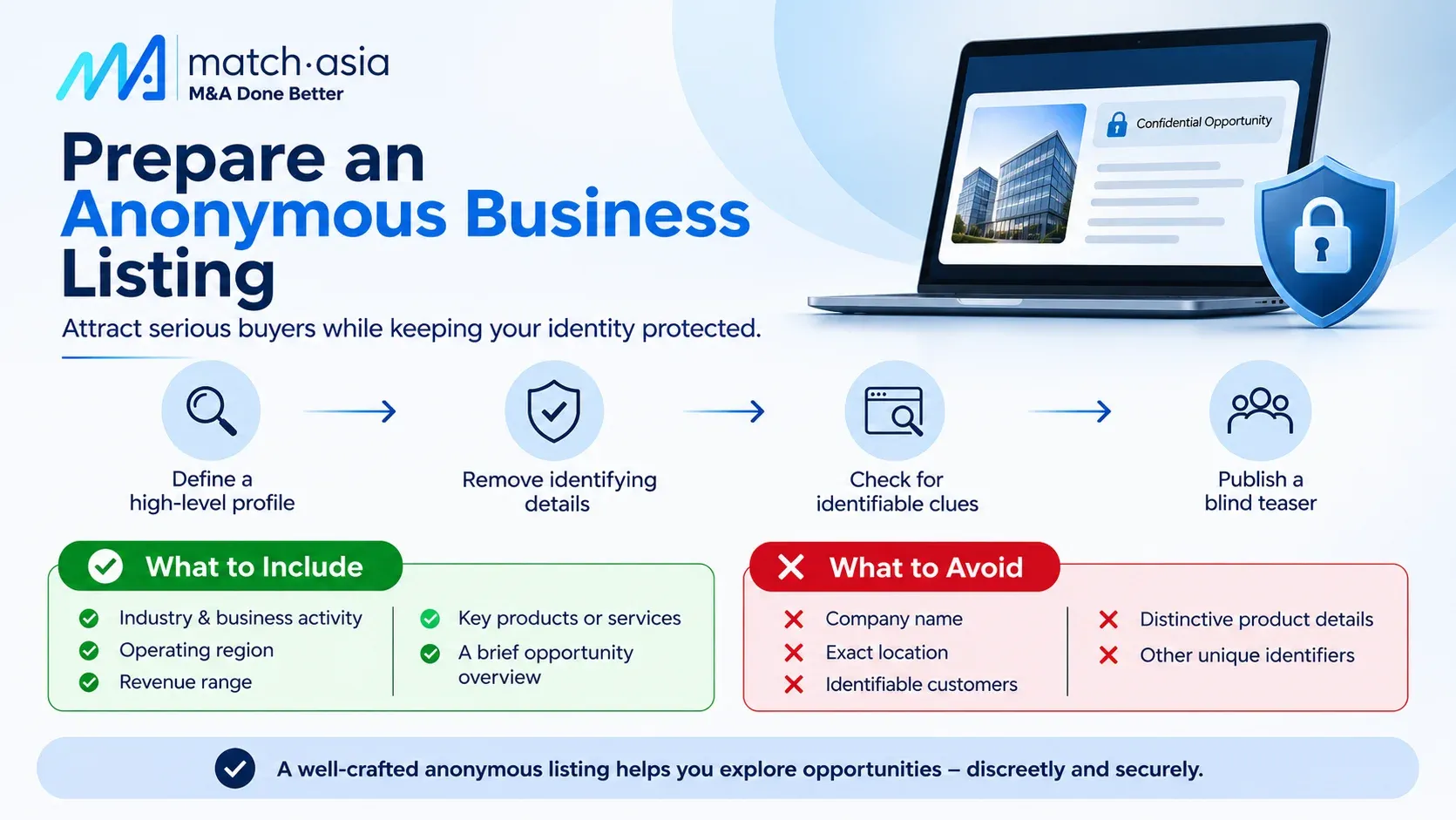
An anonymous business listing, sometimes called a blind teaser, introduces the opportunity without identifying the company. Its purpose is to attract relevant buyers while keeping the seller's identity protected. A short profile may include:
-
- The company's broad industry and business activity.
-
- Its general operating region.
-
- An approximate revenue or financial performance range.
-
- Its principal products, services or customer segments.
-
- A high-level description of the opportunity.
It should exclude the company name, exact location, identifiable customer names, distinctive product details and other information that could reveal its identity. Anonymity requires more than removing the business name. Before publishing or distributing the profile, search its distinctive phrases, industry description, financial figures and geographic references online. Consider whether a competitor, employee or existing customer could combine these details with publicly available information to identify the company. If the business is recognisable, generalise or remove the identifying details. A carefully prepared anonymous profile on a deal platform can help owners introduce their business to potential buyers while limiting the information disclosed at the initial stage.
3. Screen Buyers Who Respond
Not every enquiry represents a genuine acquisition opportunity. Before sharing further information, establish whether the prospective buyer has a credible reason to pursue the acquisition and the financial ability to complete it. Initial screening should cover:
-
- Acquisition objectives: What type of business or opportunity are they looking for?
-
- Timeline: When do they intend to acquire a business?
-
- Experience: Have they completed acquisitions or managed a similar business before?
-
- Financial capability: Do they have available funds, committed financing or a credible funding plan?
-
- Decision-making authority: Are they the actual buyer or acting on behalf of another party?
Also establish whether the buyer has any competitive relationship with the seller. A competitor, supplier or customer may have legitimate acquisition interests, but their access to information requires additional consideration.
4. Get the NDA Signed First
Before revealing the company's identity or sharing identifiable financial and operational information, require the buyer to sign a non-disclosure agreement. An NDA establishes how the information can be used, who can access it and what restrictions apply if discussions end. A buyer should understand that confidential information is being shared solely to evaluate a potential transaction. The agreement should also protect the fact that the business is for sale, not just the documents exchanged during discussions. A serious buyer should generally understand why these protections are necessary. A refusal to sign an appropriate NDA, or repeated attempts to obtain sensitive details without agreeing to confidentiality obligations, should be treated as a warning sign. The seller can decline to proceed until adequate protections are in place.
5. Share Details Gradually
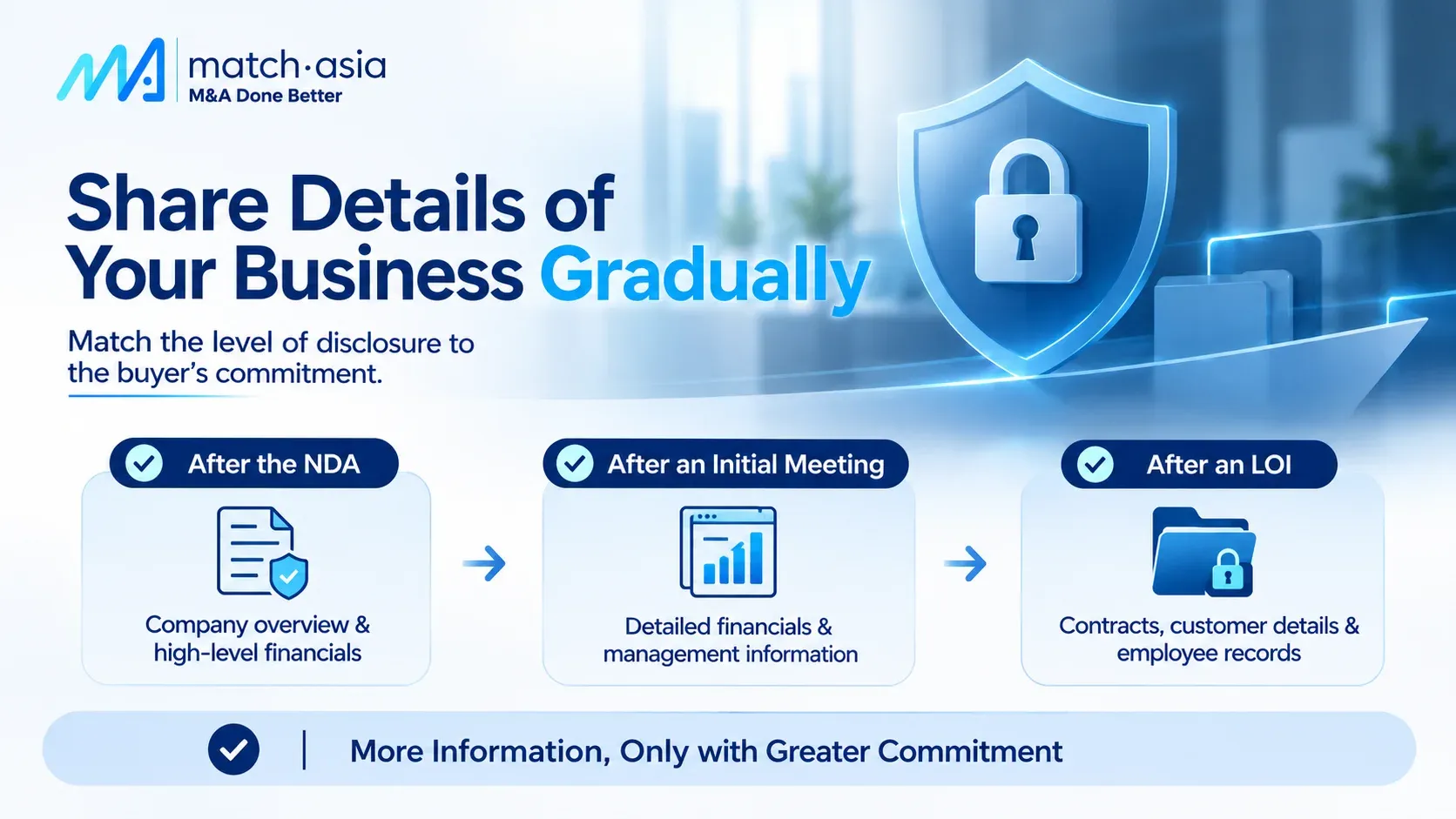
Once the NDA is signed, information should be released in stages rather than all at once. The level of disclosure should reflect the buyer's seriousness, progress in negotiations and legitimate information requirements.
-
- After the NDA: The buyer can receive the company's name, a business overview and high-level financial information. This allows them to understand the opportunity and decide whether to proceed.
-
- After an initial meeting: More detailed financial statements, management information and operational details can be shared with buyers who demonstrate genuine interest and a credible acquisition rationale.
-
- After a Letter of Intent (LOI): Subject to agreed terms and appropriate safeguards, the buyer may receive access to contracts, detailed customer information, employee records and other sensitive documents through a controlled data room.
Some particularly sensitive information may need to remain restricted or be shared only in anonymised form, even during due diligence. The seller and advisers should determine what is necessary for the buyer's review and what can reasonably be withheld until later.
6. Announce the Sale on Your Terms
Employees should be informed at a carefully planned stage rather than when discussions are still speculative. Many owners choose to communicate after an LOI has been signed or closer to closing, depending on the transaction structure, employee involvement and applicable legal requirements. The owner should ideally deliver the announcement in person, with a clear explanation of what is happening, why the transaction is being considered and what employees can expect next. Prepare answers about job continuity, management changes, reporting structures and the expected transition. The timing should be coordinated with the buyer so that both parties communicate consistently. Where key employees are essential to the transaction, their involvement and retention arrangements may need to be addressed earlier under appropriate confidentiality protections.
What Goes Into a Business Sale Confidentiality Agreement?
A business sale confidentiality agreement should be tailored to the transaction, the information being shared and the parties involved. A standard template may not cover the specific risks associated with selling an operating company. Important provisions commonly include:
-
- Definition of confidential information: Specify that financial statements, customer and supplier details, employee information, intellectual property, commercial strategies and the fact that the business is for sale are confidential.
-
- Restrictions on use and disclosure: Prohibit unauthorised copying, sharing, publication or use of information for purposes unrelated to evaluating the acquisition.
-
- Restrictions on contact: Prevent the buyer from independently approaching employees, customers, suppliers or other business relationships without the seller's written approval.
-
- Return or destruction of information: Require confidential documents and copies to be returned or securely destroyed if discussions end, subject to any legally required retention.
-
- No-poach and non-solicitation provisions: Where legally appropriate, restrict attempts to recruit key employees or solicit customers and suppliers using information obtained through the process.
-
- Buyer verification: Allow the seller to request reasonable evidence of the buyer's financial capability, identity and authority before providing sensitive information.
The agreement should also address who within the buyer's organisation may access the information, how long confidentiality obligations last and what remedies may apply if the agreement is breached. A lawyer should review the terms because enforceability and the permitted scope of restrictions vary by jurisdiction.
A Stricter NDA for Selling a Business to a Competitor
A competitor can be one of the most attractive potential buyers because it may understand the industry, recognise the company's market position and identify opportunities to combine operations. However, it can also be the riskiest buyer to approach because confidential information may reveal customer relationships, pricing, margins, suppliers, commercial strategies and competitive weaknesses. The seller should apply additional safeguards when engaging a direct competitor.
-
- First, make the initial approach through a lawyer or M&A adviser without identifying the company. This allows the competitor's interest and acquisition capability to be assessed before sensitive details are disclosed.
-
- Second, consider approaching lower-risk competitors or businesses in adjacent sectors before contacting direct rivals that compete for the same customers. This can help test market interest without immediately exposing the business to its closest competitors.
-
- Third, use a buyer-specific confidentiality agreement. It should address the competitor's existing commercial activities and restrict the use of information to the acquisition evaluation. Include carefully drafted provisions covering customer and employee solicitation, information access and contact with business relationships, subject to applicable law.
-
- Finally, keep client names, individual pricing arrangements, supplier terms and other commercially sensitive information restricted for as long as possible. Where the buyer needs to evaluate these areas, consider anonymised information or controlled access through advisers. Direct access to particularly sensitive information should be limited to the stage when it is genuinely necessary and properly protected.
Keeping Site Visits and Due Diligence Discreet
Site visits and due diligence create additional confidentiality challenges because buyers may need to observe operations, meet management or verify customer and supplier relationships. These activities should be arranged only when the buyer has progressed sufficiently through the process. Where possible, schedule visits outside normal operating hours or during quieter periods. Limit attendance to essential representatives and avoid unnecessary disruption to employees. If a neutral description of the visit is required to protect confidentiality, it should be truthful and agreed in advance rather than based on a misleading explanation.
Customer discussions should also be controlled. Buyers may request customer reference checks, but the seller should approve the timing, participants and information shared. Where appropriate, conversations can be presented accurately as reference discussions, without disclosing the proposed transaction until the seller has authorised it. A secure virtual data room can help manage the document review. Use access levels so each buyer sees only the information relevant to their stage of the process. Download restrictions, view-only permissions, watermarking, access logs and expiry dates can provide additional protection. Sensitive customer and employee information should be anonymised or withheld where possible. The seller should also maintain a record of information shared, who accessed it and when. Understanding the stages of an M&A deal helps owners plan when buyer meetings, site visits, negotiations and due diligence should take place.
Handling a Leak Before the Deal Closes
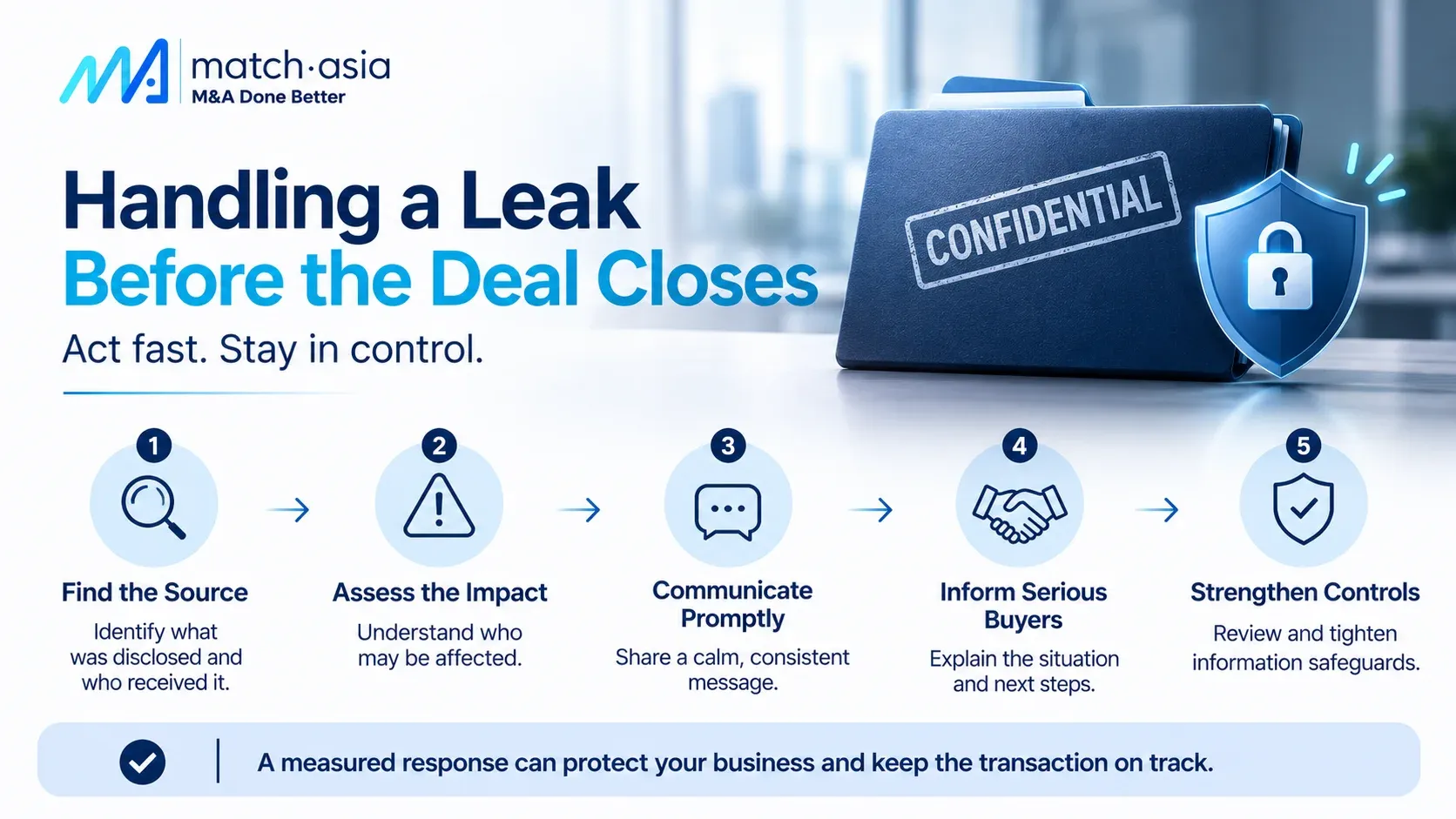
Even with careful controls, information can sometimes reach people outside the transaction. A buyer may disclose details unintentionally, an employee may notice unusual activity, or a third party may identify an anonymous listing. If a leak occurs, respond quickly and avoid making assumptions before understanding what happened.
- 1. Find the source: Establish what information was disclosed, who received it and whether the source was a buyer, employee, adviser or external party.
- 2. Assess the impact: Identify whether employees, customers, suppliers, lenders or competitors have been affected and whether sensitive commercial information has been exposed.
- 3. Communicate promptly: Speak to affected employees or customers where necessary. Use one calm, consistent message that explains what can be confirmed without revealing further confidential details.
- 4. Inform serious buyers: If the leak could affect negotiations or the transaction timeline, communicate the situation to active buyers and advisers. Explain what happened and what steps are being taken to contain it.
- 5. Strengthen controls: Review access permissions, confidentiality agreements and information-sharing procedures to prevent further disclosure.
If the leak involves a potential breach of an NDA, seek legal advice on the available remedies and appropriate next steps. A measured response can help preserve trust and prevent an isolated disclosure from becoming a wider commercial problem. Confidentiality should be managed throughout the entire transaction, not treated as a one-time requirement at the beginning. A controlled process allows owners to explore buyer interest, protect important relationships and disclose information only when the transaction reaches the appropriate stage.