How to Calculate the Value of a Business?
Published: November 6, 2026
Updated: November 6, 2026

Key Insights
- Business value depends on more than revenue—it is influenced by profitability, cash flow, growth, risk and market conditions.
- The three main valuation approaches are market, income and asset-based.
- EBITDA and SDE multiples can provide a practical starting point, but the appropriate multiple varies by business.
- Enterprise value, equity value and sale price are not the same thing.
- A valuation calculator can provide an initial estimate, but a reliable valuation requires accurate financial data and appropriate assumptions.
Table of Contents
1.Business Valuation Methods1.1.Market Approach1.2.Income Approach1.3.AssetBased Approach2.How to Calculate Business Value Using Multiples?2.1.SDE vs. EBITDA2.2.Revenue Multiples3.Business Valuation Example4.What Affects Business Valuation?4.1.Revenue and profitability4.2.Cash flow and financial stability4.3.Growth potential4.4.Customer concentration and recurring revenue4.5.Management and owner dependence4.6.Competitive position and industry conditions4.7.Financial transparency and business readiness4.8.Buyer demand and transaction terms5.Business Valuation Calculator6.How match.asia Can Help You Estimate Your Business Value?7.Conclusion8.Frequently Asked QuestionsKnowing how to calculate the value of a business is important when preparing to sell a company, considering an acquisition, attracting investors or planning for future growth. A realistic valuation helps business owners understand what their company may be worth and gives buyers a starting point for evaluating an investment. However, calculating business value is not as simple as adding up assets or multiplying annual revenue by a fixed number. A company's value depends on several factors, including its profitability, cash flow, growth potential, industry, competitive position and financial risks. Different business valuation methods can produce different results because each method measures value from a different perspective. Some focus on comparable businesses and transactions, while others consider future earnings or the value of a company's assets.
This guide explains how to value a business, the formulas commonly used, how EBITDA and revenue multiples work, and what can influence the final valuation. It also includes a practical example to help you understand how to calculate business value.
Business Valuation Methods
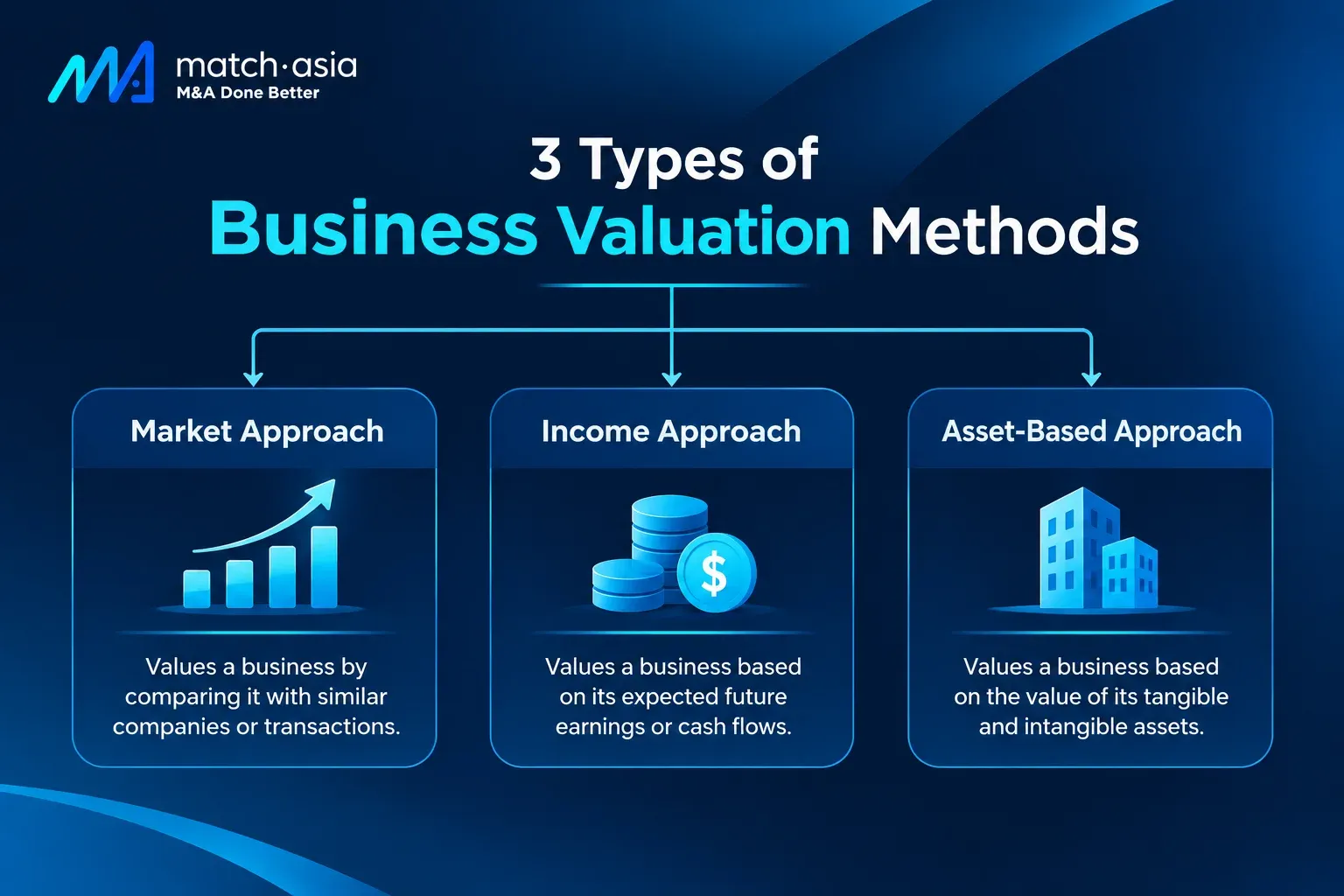
Business valuation is the process of estimating the economic value of a company. The appropriate method depends on the business's size, industry, financial performance, available information and purpose of the valuation. Three commonly used business valuation methods are the market approach, income approach and asset-based approach. In practice, a valuation may use more than one method to develop a reasonable estimate and understand the range of possible outcomes.
1. Market Approach
The market approach estimates a business's value by comparing it with similar businesses or completed transactions. The underlying principle is that a company may be worth a similar amount to comparable businesses, after accounting for differences in size, profitability, growth, risk and other relevant factors. There are two common ways to apply this approach.
a) Comparable company analysis
This method compares the business with similar companies for which financial and valuation information is available. For example, if you own a profitable business services company, you might examine comparable businesses in the same industry with similar revenue, earnings, customer profiles and growth prospects. The comparison may use valuation multiples such as:
-
- Enterprise value divided by EBITDA.
-
- Enterprise value divided by revenue.
-
- Price-to-earnings ratio, where appropriate.
The resulting multiples can provide a reference point for estimating your company's value. However, finding genuinely comparable companies can be difficult, particularly for privately owned SMEs. Public companies may be considerably larger, more diversified or more liquid than the business being valued.
b) Comparable transaction analysis
This method examines prices paid for similar businesses in completed acquisitions. For example, if comparable businesses in a particular sector have recently been acquired for approximately four to six times their annual EBITDA, that range may provide a starting point for evaluating another company in the same sector. The actual multiple depends on factors such as the company's profitability, market position, growth prospects, transaction structure and prevailing market conditions. Transaction data must also be interpreted carefully. The reported purchase price may include different assets, liabilities or deal terms, and the circumstances of one transaction may not apply to another.
c) When should you use the market approach?
It is particularly useful when reliable information about comparable companies or transactions is available. It helps business owners understand how buyers may assess their company relative to other opportunities in the market.
2. Income Approach
The income approach estimates a business's value based on the economic benefits it is expected to generate in the future. It is useful when a company has a reasonably predictable earnings or cash flow profile and reliable financial forecasts can be prepared. One commonly used method is discounted cash flow (DCF) analysis.
a) How discounted cash flow works?
The DCF method estimates the future cash flows a business is expected to generate and converts them into their present value using a discount rate. The reason for discounting is straightforward: money received in the future is generally worth less than the same amount received today, partly because of the time involved and the risks associated with future performance.
A simplified DCF formula is:
Business Value = Present Value of Forecast Cash Flows + Present Value of Terminal Value
The terminal value represents the estimated value of cash flows beyond the explicit forecast period. In a typical DCF valuation, the analyst forecasts future free cash flow, selects an appropriate discount rate and estimates the business's terminal value. These amounts are then discounted to the valuation date. For example, a company with stable recurring revenue, predictable operating costs and consistent cash generation may be suitable for DCF analysis. By contrast, a business with highly uncertain earnings or limited reliable financial information may require additional assumptions, sensitivity analysis or alternative valuation methods.
b) What affects a DCF valuation?
The result is particularly sensitive to:
-
- Forecast revenue growth.
-
- Future operating profit margins.
-
- Capital expenditure and working capital requirements.
-
- The discount rate.
-
- Long-term growth assumptions used to estimate terminal value.
Small changes in these assumptions can materially affect the estimated value. DCF analysis should therefore be treated as a reasoned estimate rather than an exact prediction of future worth.
3. Asset-Based Approach
The asset-based approach estimates a company's value by examining its assets and liabilities.
A simplified formula is:
Net Asset Value = Total Assets − Total Liabilities
Assets may include cash, equipment, property, inventory, receivables and certain intangible assets. Liabilities may include loans, unpaid obligations and other amounts the company owes. Depending on the purpose of the valuation, assets may be assessed at their book value or adjusted to reflect their estimated current market value. For example, a company may own equipment that is recorded in its accounts at a value significantly different from what it could fetch in the market. An adjusted asset valuation would account for that difference. This approach can be useful for asset-heavy businesses, holding companies or companies whose earnings do not adequately reflect the value of their underlying assets. However, it may not fully capture the value of a profitable operating business with strong customer relationships, an established brand, proprietary technology or significant future growth potential. An asset-based valuation should also distinguish between assets that are necessary for ongoing operations and those that could be sold separately.
a) Which valuation method is best?
There is no single method that works equally well for every business.
| Valuation Method | Best Suited For | Main Consideration |
|---|---|---|
| Market approach | Businesses with reliable comparable companies or transaction data | Comparable businesses may differ in important ways |
| Income approach | Businesses with reasonably predictable future cash flows | Results depend on forecasts and assumptions |
| Asset-based approach | Asset-heavy businesses or situations where underlying assets are central to value | May not capture the full value of future earnings or intangible assets |
For many operating businesses, comparing multiple methods can provide a more balanced understanding of business worth.
How to Calculate Business Value Using Multiples?
Valuation multiples are widely used because they provide a relatively straightforward way to estimate business value using a financial measure such as earnings or revenue. A multiple represents how many times a particular financial figure a buyer may be willing to pay. The appropriate multiple varies according to the industry, business size, growth prospects, risk, market conditions and transaction circumstances.
Two commonly discussed approaches are earnings multiples and revenue multiples.
1. SDE vs. EBITDA
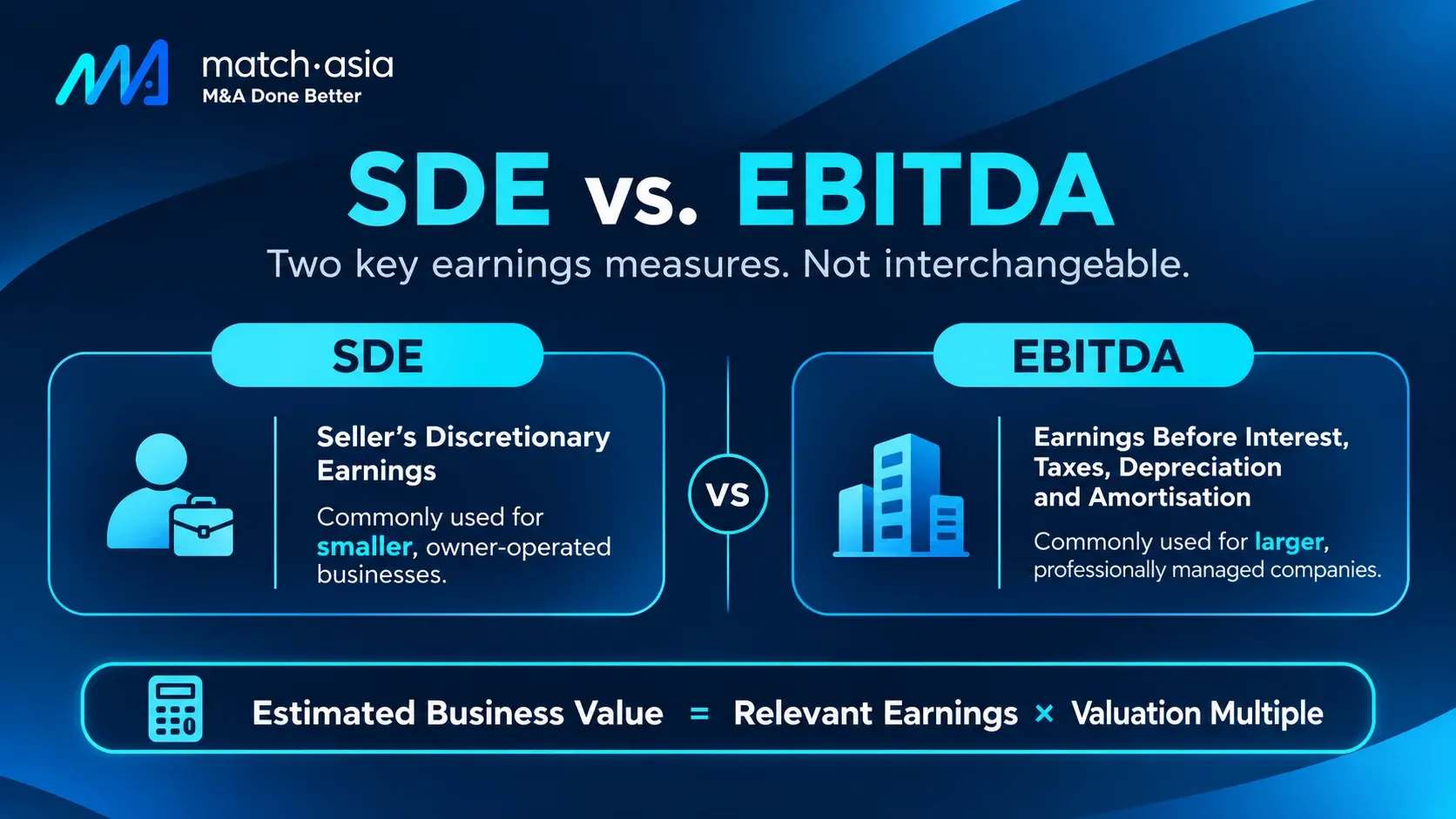
Seller's discretionary earnings (SDE) and earnings before interest, taxes, depreciation and amortisation (EBITDA) are two financial measures used in business valuation. They are related, but they are not interchangeable.
- A. Seller's discretionary earnings (SDE) is commonly used when valuing smaller, owner-operated businesses. It typically starts with the business's earnings and adds back certain expenses that may not continue under a new owner. These can include the current owner's compensation and certain discretionary or non-recurring expenses, provided the adjustments are justified. SDE is intended to help a buyer understand the economic benefit available to a single owner-operator before considering their personal compensation and certain other adjustments.
- B. EBITDA measures earnings before interest, taxes, depreciation and amortisation. It is commonly used to compare operating performance across businesses with different financing arrangements, tax situations and depreciation policies. EBITDA does not represent cash flow. It excludes capital expenditure and changes in working capital, among other cash movements, so further analysis is needed to understand the cash required to operate and grow a business. The distinction matters because smaller owner-operated businesses and larger professionally managed companies may be valued using different earnings measures. For example, a buyer acquiring a small business and planning to operate it personally may focus on SDE. A buyer acquiring a larger company with an established management team may focus more on EBITDA.
The basic earnings-multiple formula is:
Estimated Business Value = Relevant Earnings × Valuation Multiple
For example, if a business has annual EBITDA of $500,000 and an illustrative EBITDA multiple of 4, its estimated enterprise value would be:
$500,000 × 4 = $2 million
This is a simplified example, not an industry benchmark. The appropriate multiple must be supported by relevant market evidence and the specific characteristics of the business. It is also important to use a consistent earnings measure. If a multiple is based on adjusted EBITDA, the earnings figure should reflect appropriate adjustments rather than unverified add-backs.
2. Revenue Multiples
A revenue multiple estimates business value based on annual revenue.
The formula is:
Estimated Enterprise Value = Annual Revenue × Revenue Multiple
For example, a company generating $3 million in annual revenue valued at an illustrative revenue multiple of 0.8 would have an estimated enterprise value of $2.4 million. However, revenue multiples can be misleading when used in isolation. Two businesses may generate the same revenue but have very different profit margins, operating costs, customer retention and cash flow. A company with strong recurring revenue and healthy margins may justify a different valuation from one with thin margins and inconsistent earnings. Revenue multiples can be useful when earnings are temporarily depressed, when comparing businesses with similar business models, or when revenue is a meaningful industry-specific measure. They should generally be supported by additional financial analysis. Before applying any multiple, confirm that the financial measure and valuation figure are consistent. For example, enterprise value should be compared with an appropriate enterprise-level measure, such as EBITDA or revenue, rather than being confused with the value of shareholders' equity.
Business Valuation Example
Consider a hypothetical business services company with the following annual financial figures:
| Financial Measure | Amount |
|---|---|
| Annual revenue | $2,000,000 |
| Reported EBITDA | $350,000 |
| Verified adjustments to EBITDA | $50,000 |
| Adjusted EBITDA | $400,000 |
| Illustrative EBITDA multiple | 4.0× |
The first step is to calculate adjusted EBITDA.
Adjusted EBITDA = Reported EBITDA + Valid Adjustments
$350,000 + $50,000 = $400,000
The next step is to apply the illustrative EBITDA multiple.
Estimated Enterprise Value = Adjusted EBITDA × EBITDA Multiple
$400,000 × 4.0 = $1,600,000
Based on these assumptions, the company's estimated enterprise value is $1.6 million.
This is not necessarily the amount the owner would receive from a sale.
Enterprise value represents the value of the operating business before accounting for certain financing-related items. To estimate the value attributable to shareholders, the calculation may need to account for debt, cash and other agreed adjustments.
A simplified bridge is:
Estimated Equity Value = Enterprise Value − Debt + Cash ± Other Relevant Adjustments
Suppose the company has $300,000 in debt and $100,000 in cash, with no other adjustments for this example.
$1,600,000 − $300,000 + $100,000 = $1,400,000
The illustrative equity value would therefore be $1.4 million. The final transaction value could differ depending on working capital, the assets and liabilities included in the deal, the buyer's assessment of risk, negotiations and the agreed transaction structure. This example demonstrates why it is important to distinguish between enterprise value, equity value and the final sale price.
What Affects Business Valuation?
A business's value is influenced by more than its revenue or current profit. Buyers assess how reliably the company generates earnings, how it competes in the market and what risks they may inherit after the acquisition. Several factors can materially influence a valuation.
1. Revenue and profitability
Consistent revenue, healthy margins and sustainable earnings generally make a business easier to evaluate. Rapid revenue growth may be attractive, but buyers will also examine whether that growth translates into profit and cash flow.
2. Cash flow and financial stability
A company that consistently generates cash may be more attractive than one that reports profits but struggles to collect payments or fund operations. Working capital requirements, capital expenditure and debt obligations can affect the cash available to a future owner.
3. Growth potential
Buyers may place greater value on businesses with credible opportunities to expand into new markets, introduce additional products or serve existing customers more effectively. Growth assumptions should be supported by evidence rather than relying solely on optimistic forecasts.
4. Customer concentration and recurring revenue
A company that depends on one or two major customers may face greater risk if those relationships end. By contrast, diversified customer relationships and recurring revenue can provide greater visibility into future performance, although the quality and stability of those revenues still need to be assessed.
5. Management and owner dependence
If a company relies heavily on its founder for sales, operations or key customer relationships, a buyer may need to account for the cost and difficulty of replacing that contribution. A capable management team, documented processes and well-established operating systems can help reduce this dependence.
6. Competitive position and industry conditions
A strong market position, specialised expertise, established distribution channels or defensible intellectual property may support business value. Industry growth, competitive pressure, regulation and broader economic conditions can also affect buyer demand and valuation multiples.
7. Financial transparency and business readiness
Reliable financial statements, organised contracts, clear ownership records and documented business processes make it easier for buyers to assess a company. Incomplete records or unexplained financial adjustments can create uncertainty and delay a transaction. Business owners planning an exit can take practical steps to prepare your business for a sale by improving financial reporting, addressing operational weaknesses and organising key documentation before approaching potential buyers.
8. Buyer demand and transaction terms
Business value also depends on the pool of interested buyers and what they believe the company can contribute to their plans. A strategic buyer may see benefits from acquiring customers, technology or distribution capabilities that another buyer does not value as highly. Financing arrangements, seller financing, earn-outs and other deal terms can also affect the overall economics of a transaction. Ultimately, a valuation is an estimate based on evidence, assumptions and the purpose of the assessment. The amount a buyer is willing to pay depends on both the business itself and the circumstances of the transaction.
Business Valuation Calculator
A business valuation calculator can help owners develop an initial estimate of what their company might be worth. Depending on the tool, it may use financial information, earnings measures, industry data or other business characteristics to generate an indicative valuation. These tools are useful for exploring possible outcomes, understanding the factors that may influence value and preparing for a discussion with a buyer or adviser. To get a more meaningful estimate, gather the following information where available:
-
- Annual revenue and revenue growth.
-
- Net profit and operating earnings.
-
- EBITDA or SDE, where relevant.
-
- Adjustments for unusual or non-recurring expenses.
-
- Debt and cash balances.
-
- Industry and business model.
-
- Customer concentration and recurring revenue.
-
- Recent financial performance and growth expectations.
The quality of the output depends on the accuracy of the information entered and the assumptions used by the calculator. A calculator cannot independently verify financial statements, determine whether adjustments are justified, assess every business risk or predict what a specific buyer will offer. Its result should therefore be treated as an indicative estimate rather than a formal valuation or guaranteed sale price. For a starting point, use the business valuation calculator to explore your company's potential value. Business owners should also assess your business before selling to understand its readiness, identify areas that may require attention and prepare for discussions with potential buyers. For a significant transaction, a formal valuation or professional financial advice may be appropriate, particularly when the business has complex ownership arrangements, substantial assets, uncertain earnings or multiple potential valuation approaches.
How match.asia Can Help You Estimate Your Business Value?

match.asia can help business owners develop an initial understanding of what their business may be worth before entering the M&A process. Its business valuation calculator uses information about your company's financial performance and business characteristics to provide an indicative valuation range, helping you establish a starting point for further discussion. Beyond valuation, match.asia can help you assess your business's readiness for a potential sale, identify areas that may need attention and prepare for discussions with potential buyers. This can help you approach the M&A process with a clearer understanding of your business's value, strengths and areas for improvement.
Conclusion
Understanding how to calculate the value of a business helps owners make better-informed decisions about selling, raising investment or planning for future growth. The market approach provides a reference point through comparable businesses and transactions, the income approach estimates value from future cash flows, and the asset-based approach focuses on the company's underlying assets and liabilities. For many businesses, earnings multiples offer a practical starting point. However, the choice of earnings measure, the relevance of comparable transactions and the company's individual characteristics all influence the result. Revenue alone rarely tells the full story, and a valuation estimate should not be confused with the final sale price. A business valuation calculator can help you establish an initial reference point, but a more reliable assessment requires accurate financial information, realistic assumptions and a clear understanding of the company's strengths and risks. For business owners exploring a sale or acquisition in the region, match.asia provides an M&A platform for businesses in Asia. Combining valuation insights with careful preparation and an understanding of buyer expectations can help you approach the next stage with greater clarity.
Frequently Asked Questions
How Much Is My Business Worth?
Your business's value depends on its earnings, cash flow, assets, growth potential, industry, competitive position and perceived risks. Buyers may use comparable transactions, earnings multiples, discounted cash flow or asset-based methods to estimate value. The final sale price also depends on buyer demand, negotiations and transaction terms. To develop an initial estimate, gather your recent financial statements, calculate adjusted earnings where appropriate and compare your business with genuinely similar companies. A valuation calculator can provide a useful starting point, but a professional assessment may be needed for a significant transaction.
How Do I Calculate Business Value From Revenue?
A simplified revenue-based formula is:
Estimated Enterprise Value = Annual Revenue × Revenue Multiple
For example, a company with annual revenue of $2 million and an illustrative revenue multiple of 0.8 would have an estimated enterprise value of $1.6 million.
The multiple must be appropriate for the business and supported by relevant market evidence. Revenue alone does not account for profitability, cash flow, debt or other factors that can materially influence value.
What Is a Good EBITDA Multiple for a Business?
There is no single EBITDA multiple that is appropriate for every business. The multiple depends on the industry, company size, profitability, growth prospects, recurring revenue, customer concentration, management strength and prevailing market conditions.
Comparable company data and completed transactions can provide useful reference points. However, differences between businesses and deal structures must be considered before applying a multiple to your company.
Can I Value a Business Myself?
Yes. You can develop an initial estimate by reviewing financial statements, calculating adjusted earnings, researching comparable businesses and applying an appropriate valuation method.
For example, you could estimate enterprise value by multiplying adjusted EBITDA by a relevant market multiple. You could also review the company's assets and liabilities or use a discounted cash flow model if reliable forecasts are available. However, self-assessment has limitations. Complex ownership structures, unusual financial adjustments, uncertain forecasts or significant transaction risks may require professional support.