How to Find a Buyer for My Business?
公開日: November 16, 2026
更新日: November 16, 2026

Key Insights
- Finding the right buyer is more important than finding the largest number of buyers.
- Businesses can attract different types of buyers.
- Multiple channels can uncover potential buyers.
- An ideal buyer profile helps make outreach more focused.
- Buyer interest does not guarantee a completed transaction.
- Confidentiality is critical when approaching buyers.
- A strong business presentation should be credible and focused.
- The sale process continues well beyond buyer discovery.
- Preparation can improve the quality and efficiency of the process.
- The ultimate goal is a buyer who is both willing and able to close.
Table of Contents
1.What Types of Buyers Buy a Business?1.1.Strategic Buyers1.2.Financial Buyers1.3.Individual Entrepreneurs1.4.Management Buyouts1.5.Family or Existing Stakeholders2.Where to Find Buyers for Your Business?2.1.Your Own Network2.2.Management and Employees2.3.Competitors and Adjacent Companies2.4.Suppliers and Customers2.5.Industry Events and Trade Press2.6.Advisers and Brokers2.7.MA Marketplaces3.How to Build Your Ideal Buyer Profile?4.How to Check Whether a Buyer Can Complete the Deal?4.1.Proof of Funds4.2.Buyers Execution Capability4.3.Leadership and Strategy Changes4.4.Price Expectations4.5.PostClosing Plans4.6.Exclusivity5.How to Present Your Business to Potential Buyers?6.How to Approach Buyers Without Losing Confidentiality?7.What Happens After a Buyer Shows Interest?8.How match.asia Helps You Find the Right Buyer?9.Frequently Asked QuestionsSelling a business is not simply a matter of putting it on the market and waiting for someone to make an offer. The harder question is often: how do you find the right buyer for your business? The answer depends on what you are selling, who is likely to benefit from owning it, the size and sector of the business, your reasons for exiting, and how confidential you need the process to be. A local business may attract an individual entrepreneur or competitor. A growing technology company may be more relevant to a strategic acquirer or financial investor. A business with strong management may appeal to a buyer looking for an established platform rather than an owner-operated company. The goal is therefore not to find as many buyers as possible. It is to identify buyers who have the interest, strategic rationale, financial capacity and ability to complete the transaction.
What Types of Buyers Buy a Business?
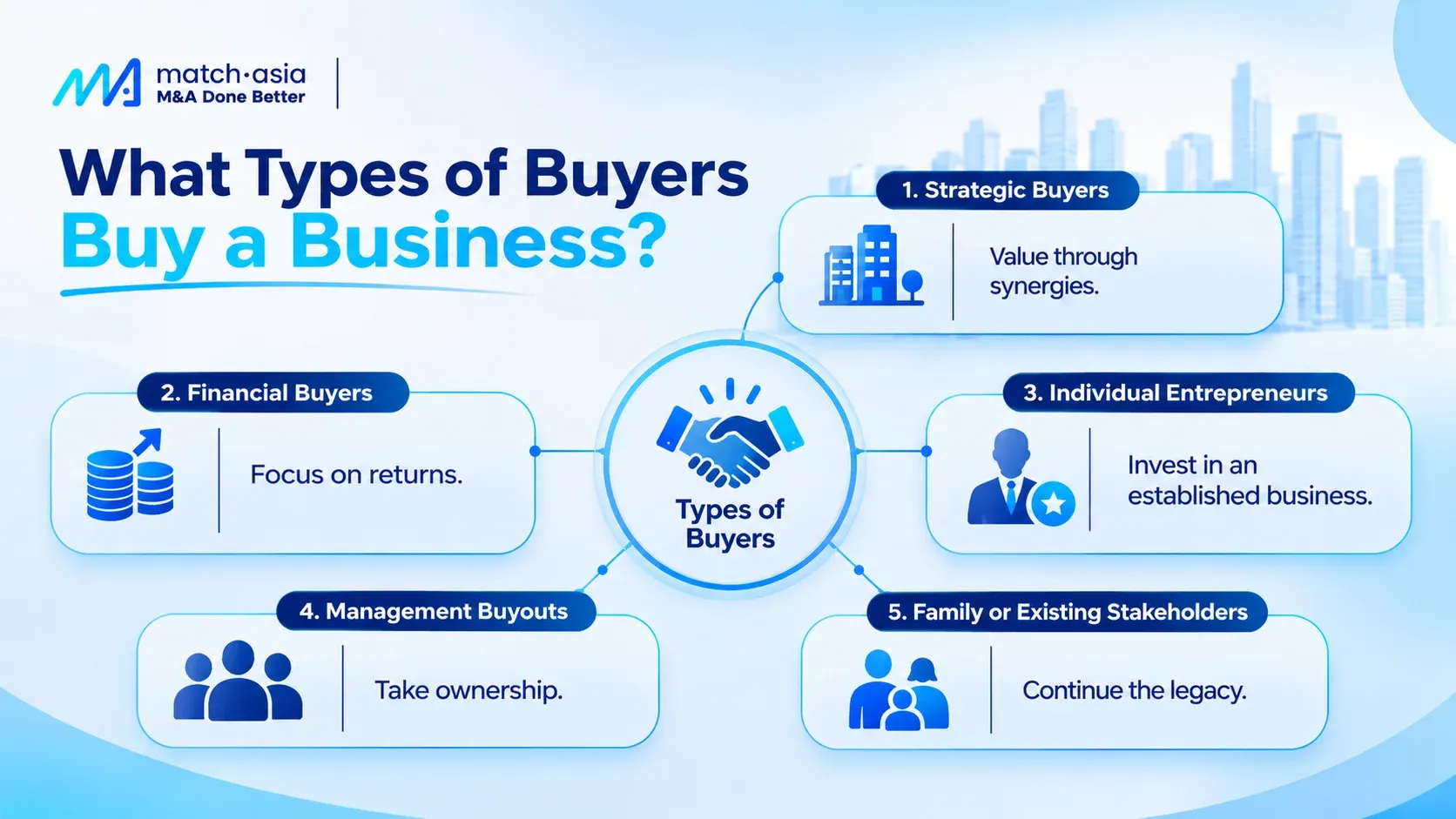
Before deciding where to look, it helps to understand who will buy a business.
1. Strategic Buyers
A strategic buyer is usually an existing company that sees value in acquiring your customers, capabilities, products, technology, market access, people or geographic presence. For example, a company operating in Malaysia may acquire a smaller business in Singapore because it wants an established customer base or local operating presence. Strategic buyers may be competitors, companies in adjacent sectors or businesses looking to expand into a new market. Their interest is often driven by synergies, not simply the standalone profitability of the target.
2. Financial Buyers
Financial buyers, including private equity firms and other investment groups, generally evaluate businesses based on their financial performance, growth potential, market position and ability to generate returns. They may be particularly interested in businesses with recurring revenue, strong margins, scalable operations and capable management teams. The size and maturity of the business will determine which financial buyers are realistic prospects.
3. Individual Entrepreneurs
An individual buyer may be looking to acquire an established business rather than build one from scratch. This can be particularly relevant for smaller businesses where the owner is still closely involved in day-to-day operations. An individual buyer may value an established customer base, brand, employees and operating model that would take years to build independently.
4. Management Buyouts
Existing management can sometimes become the buyer. A management buyout allows the people already running the business to take ownership. It can be attractive when continuity, employees and the company's existing relationships are important to the seller. The challenge is usually financing and ensuring that the management team has the capability and resources to complete the acquisition.
5. Family or Existing Stakeholders
In some businesses, the most natural buyer may already be close to the company. A family member, existing shareholder or business partner may have the interest and knowledge required to take over. The right buyer category ultimately depends on the owner's objectives. A seller looking for maximum strategic value may approach the market differently from one prioritising continuity for employees or customers. Different buyer types have different motivations and acquisition criteria.
Where to Find Buyers for Your Business?
There is no single place where every business buyer can be found. A strong search usually combines several channels.
1. Your Own Network
Start with people who already understand your industry. Former colleagues, business contacts, investors, advisers and other entrepreneurs may know someone looking to acquire a company. Your network can be useful because the initial introduction often comes with some context and credibility. However, do not assume that your existing contacts are enough. The buyer most suited to your business may operate in another market or sector.
2. Management and Employees
If your management team understands the business well and has the financial capacity to acquire it, a management buyout can be worth considering. Employees may also know external parties who could have an interest in the business. This route can support continuity, but it should still be evaluated like any other transaction. Familiarity does not automatically mean financial or strategic suitability.
3. Competitors and Adjacent Companies
Competitors are obvious potential buyers because they already understand your market. But do not limit the search to direct competitors. An adjacent company may see something in your business that a direct competitor does not. A technology company could value your customer base. A distributor could value your product portfolio. A regional company could value your market presence. Think about who could create more value from the business than you can on your own. That question often reveals potential strategic buyers outside your immediate industry.
4. Suppliers and Customers
Your supply chain can also reveal potential buyers. A supplier may want to move downstream, a customer may want to secure its supply, or a distribution partner may want to bring part of the business in-house. These relationships can create a natural strategic rationale for an acquisition, particularly when the buyer already understands the business, its market or its customers. Confidentiality is important, however, so customers and suppliers should not be told about a potential sale simply because they might be interested in buying.
5. Industry Events and Trade Press
Industry conferences, trade associations, trade publications and professional networks can help identify companies that are actively expanding. They are particularly useful when the business operates in a specialised sector where the pool of credible buyers may be relatively small. The objective is not to publicly announce that your company is for sale, but to use industry knowledge to identify potential buyers and approach them discreetly.
6. Advisers and Brokers
Accountants, corporate lawyers, investment bankers, M&A advisers and business brokers may have relationships with buyers looking for businesses. The right adviser can also help qualify potential buyers, manage communication and maintain confidentiality. For smaller transactions, a business broker may be appropriate, while larger or more complex transactions may benefit from an M&A adviser or investment banker with a more relevant buyer network and transaction capability. The important point is not simply to choose someone with a large contact list, but to look for someone who understands your sector, deal size, geography and likely buyer universe.
7. M&A Marketplaces
M&A marketplaces can give sellers access to buyers beyond their immediate network. They can be particularly useful when the business has a clear profile that can be communicated through financial and operational information without immediately revealing its identity. However, visibility alone does not guarantee a successful sale. The quality of the buyer pool, confidentiality process, qualification standards and ability to support the transaction all matter.
How to Build Your Ideal Buyer Profile?
Before approaching buyers, define what a good buyer looks like. An ideal buyer profile should go beyond simply finding someone who can afford the business. Consider the buyer's strategic fit and what they would gain from owning the business, their industry experience, geographic reach, financial capacity, typical deal size, management capability, growth plans and whether their objectives align with what matters to you after the sale. For example, if preserving the existing team is important, a buyer planning immediate restructuring may not be the right fit even if they offer an attractive price. Similarly, if your priority is expansion into another Asian market, a strategic buyer with an established regional presence may create more value than a purely financial buyer. A clear buyer profile makes outreach more focused and helps you assess opportunities consistently.
How to Check Whether a Buyer Can Complete the Deal?
Interest is not the same as ability to close. Before investing significant time in negotiations, sellers should establish whether a potential buyer has the financial resources, strategic rationale and execution capability to complete the acquisition.
1. Proof of Funds
Ask how the buyer intends to finance the acquisition. Depending on the transaction, this could involve cash, debt, investors or a combination of funding sources. Proof of funds or appropriate financing evidence can help distinguish serious buyers from those who are still exploring whether they can afford the transaction.
2. Buyer’s Execution Capability
A buyer may have sufficient capital but limited experience completing acquisitions. Consider whether they have previously acquired businesses, whether they have the advisers required for the transaction and whether they understand the due diligence and closing process. Execution matters because a transaction can lose momentum if the buyer is not prepared for the work required after an initial offer.
3. Leadership and Strategy Changes
Understand who is making the acquisition decision and why. A buyer's strategy can change, and a new CEO, board decision, investment mandate or change in priorities can affect whether the acquisition remains attractive. The more clearly you understand the buyer's strategic rationale, the easier it is to assess how durable their interest is.
4. Price Expectations
Price expectations should be discussed early enough to avoid wasting time. This does not mean negotiating the final purchase price before the buyer understands the business; it means establishing whether both sides are broadly operating within the same valuation range. A seller should also understand how the buyer is thinking about earnings, EBITDA, growth, working capital and other valuation factors.
5. Post-Closing Plans
Ask what the buyer expects to do after completion. Will they keep the existing management team, integrate the business, expand into new markets, change the brand or invest in new products? These questions matter because the buyer's plans may affect employees, customers and the seller's transition responsibilities.
6. Exclusivity
Be careful about granting exclusivity too early. An exclusivity period can prevent a seller from negotiating with other potential buyers while one buyer conducts due diligence. It may be reasonable once there is a credible offer and a clear path to completion, but the period should be structured carefully, with appropriate milestones and expectations.
How to Present Your Business to Potential Buyers?
A buyer needs enough information to understand the opportunity without receiving every sensitive detail immediately. The first presentation is often a confidential teaser or short business profile that communicates the key reasons the business may be attractive, including what the business does, its market and geography, key products or services, revenue or EBITDA range, growth characteristics, customer or market positioning, major strategic strengths and, where appropriate, the reason for considering a sale. The objective is not to tell the entire story in the first document. It is to give a credible buyer enough information to decide whether the opportunity fits their acquisition criteria. A strong presentation should also be accurate. Overstating growth, hiding weaknesses or presenting unsustainable earnings may generate initial interest, but it can create significant problems during due diligence.
How to Approach Buyers Without Losing Confidentiality?
Confidentiality is one of the most important considerations when finding a buyer. A public announcement can create uncertainty among employees, customers and suppliers, while also alerting competitors to the possibility of a sale before the owner is ready. A better approach is usually a controlled process in which potential buyers first receive limited information about the business and, once there is genuine interest, are asked to sign a non-disclosure agreement (NDA) before receiving more sensitive information. The seller can then progressively share information as the buyer moves through the process. This approach helps protect commercially sensitive information while still allowing serious buyers to evaluate the opportunity. Confidentiality is also important for maintaining negotiation leverage and avoiding unnecessary disruption to the business.
What Happens After a Buyer Shows Interest?

Finding a buyer is only the beginning of the transaction. Once a credible buyer expresses interest, the process may move through several stages:
Initial discussion → NDA → Information sharing → Indicative offer → Due diligence → Letter of Intent → Negotiation → Definitive agreement → Closing
The exact sequence can vary by transaction. The buyer will typically want to understand the financial performance, legal position, operations, customers, employees, assets, liabilities and other factors that affect the value and risk of the acquisition. This is where preparation becomes important. A buyer who receives clear answers and organised information can move through the process with greater confidence, while a buyer who repeatedly encounters missing records, unexplained financial differences or unexpected issues may reconsider the transaction. The seller should therefore continue running the business normally while keeping the transaction moving. Finding a buyer is not successful simply because someone makes an offer. The real outcome is a buyer who is both willing and able to close.
How match.asia Helps You Find the Right Buyer?

Finding a buyer for a business in Asia can be challenging because the right buyer may not be in the seller's immediate market. match.asia approaches the process as more than simply publishing a business for sale, with a focus on identifying potential buyer fit, understanding the opportunity and supporting the transaction process from buyer discovery through execution. For sellers, this can mean reaching beyond personal networks and identifying buyers based on factors such as sector, geography, business characteristics and acquisition rationale. The distinction matters: a business does not need hundreds of interested parties; it needs the right buyer—one whose objectives, financial capability and strategic rationale align with the opportunity. The seller's role is also easier when the business is prepared before buyer outreach begins. Clear financial information, realistic valuation expectations, organised documentation and a defined buyer profile can make the process more efficient. For owners considering a sale, the first step is therefore not simply asking "Where can I find buyers for my business?" It is asking "Who is most likely to value what I have built, and why?" That answer can shape where you search, how you present the business and which buyers you choose to pursue.