Complete Guide to Preparing Your Business for Sale
公開日: November 16, 2026
更新日: November 16, 2026
Key Insights
- Start preparing for a sale well before going to market.
- Align shareholders and build a strong internal transaction team.
- Assess the business from a buyer’s perspective before making improvements.
- Understand what drives business value and keep valuation expectations realistic.
- Prepare accurate, up-to-date financial, legal and operational documents.
- Reduce owner dependency and strengthen management, customers and processes.
- Build a clear investment story that aligns with the right buyer’s objectives.
- Use NDAs and controlled information sharing to manage confidentiality during due diligence.
- Choose a deal structure that matches your desired ownership, control and role after closing.
- Plan the closing and handover carefully, including legal, employee and non-compete considerations.
- Use professional M&A, financial and legal guidance to navigate a complex sale.
Table of Contents
1.When to Sell Your Business?2.Getting a Business Ready to Sell3.How to Value Your Business Before a Sale?4.What Documents Do You Need to Sell Your Business?5.How to Increase the Value of Your Business?6.How to Find the Right Buyer?7.How to Get Through Due Diligence?8.Choosing the Right Deal Structure9.Closing the Deal and Handing Over the Business10.Conclusion11.Frequently Asked QuestionsSelling a business can be one of the most significant decisions an owner makes. You may be considering a sale because there is no successor to take over the company or because you are planning to retire. Whatever the reason, selling all or part of a business through M&A is a complicated process that requires careful preparation, planning and understanding. A successful transaction depends on more than finding an interested buyer. The business needs to be ready for scrutiny, the financial and operational story needs to be clear, and the seller needs to understand what they want from the transaction. Preparation is therefore not something to leave until the business is formally put on the market. The earlier you identify potential weaknesses, organise information and align the people involved, the more time you have to address issues before they become obstacles during negotiations or due diligence.
When to Sell Your Business?
The right timing depends on three things: the performance of the business, market conditions and your personal plans as an owner. A business that is performing consistently, has a clear growth outlook and operates with manageable risks may be easier to position than one experiencing declining earnings or unresolved operational problems. Market conditions also matter. Buyer appetite, sector trends, interest rates, availability of capital and broader economic conditions can influence both the number of potential buyers and the terms they are willing to offer. However, waiting for a “perfect” market is rarely practical. Your personal circumstances, objectives and readiness should be considered alongside external conditions. Most importantly, preparation should begin well before you intend to approach buyers. This gives you time to strengthen performance, resolve outstanding issues, organise records and make the business less dependent on you. Buyers generally want evidence of how the company has performed over time, not a last-minute improvement made immediately before a sale.
Getting a Business Ready to Sell
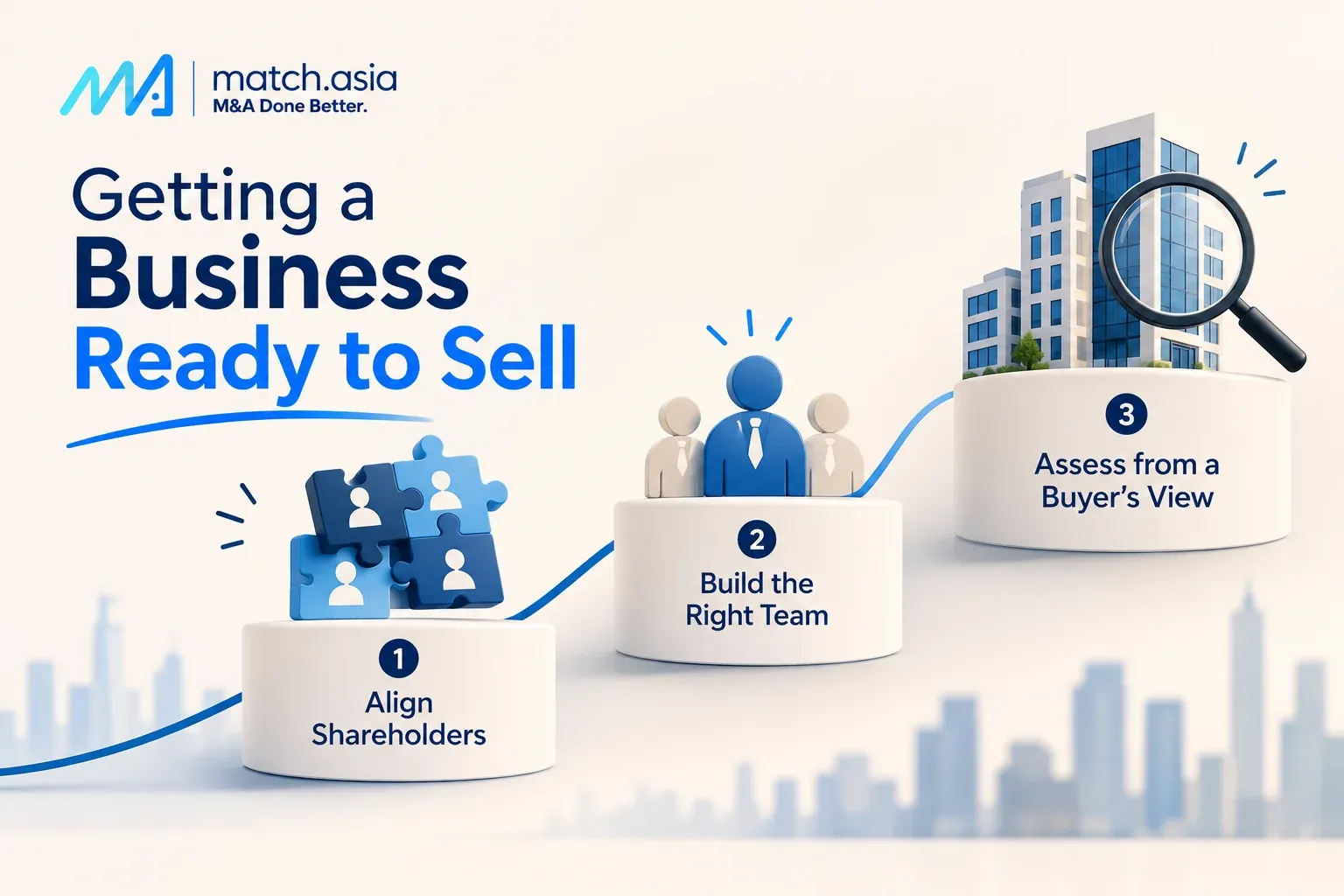
Start by aligning the shareholders. Everyone involved should agree on the objectives of the sale, the preferred deal structure, expected valuation, timeline and potential impact on the remaining business and employees. Shareholder disagreement can create delays or uncertainty later, so reaching consensus early is an important part of preparation. Next, build an internal team that can support the transaction. The CEO or business leader should be prepared to explain the company’s history, strategy and future direction to potential buyers. The CFO or finance lead should be able to explain the financial performance and answer detailed questions about the numbers. Other senior executives, such as the COO or CTO, can provide insight into operations, technology, people and their respective areas of responsibility.
You should also assess the business from a buyer’s perspective. One of the first questions a buyer may ask is whether the company can continue performing effectively without the owner. Strong management, documented processes, stable customer and supplier relationships and reliable operations can reduce this concern. The objective is to demonstrate that the business is an established organisation rather than an operation that depends heavily on one individual. An exit readiness assessment can help identify gaps across areas such as financial readiness, governance, operations, people, assets and overall deal readiness before the business enters the market.
How to Value Your Business Before a Sale?
A business’s value is influenced by more than its current revenue or profit. Buyers will consider the quality and sustainability of earnings, growth prospects, customer concentration, competitive position, management capability, recurring or predictable revenue, operational strength and the risks associated with the business. A company with strong financial performance but heavy owner dependency, weak documentation or concentrated customer relationships may face more questions than a similarly profitable business with a capable management team and well-established processes. Conversely, evidence of sustainable growth, strong margins, diversified customers and a clear path for future performance can strengthen the overall investment case.
It is important to be realistic about expectations. Your preferred price may not be the same as what buyers are prepared to pay, and valuation discussions are influenced by the evidence available to support the business’s future prospects. A realistic view of value can help you make better decisions about timing, improvements and the type of buyer to approach. You can use match.asia’s business valuation calculator as an initial way to understand the factors that may influence your business value before entering detailed discussions.
What Documents Do You Need to Sell Your Business?
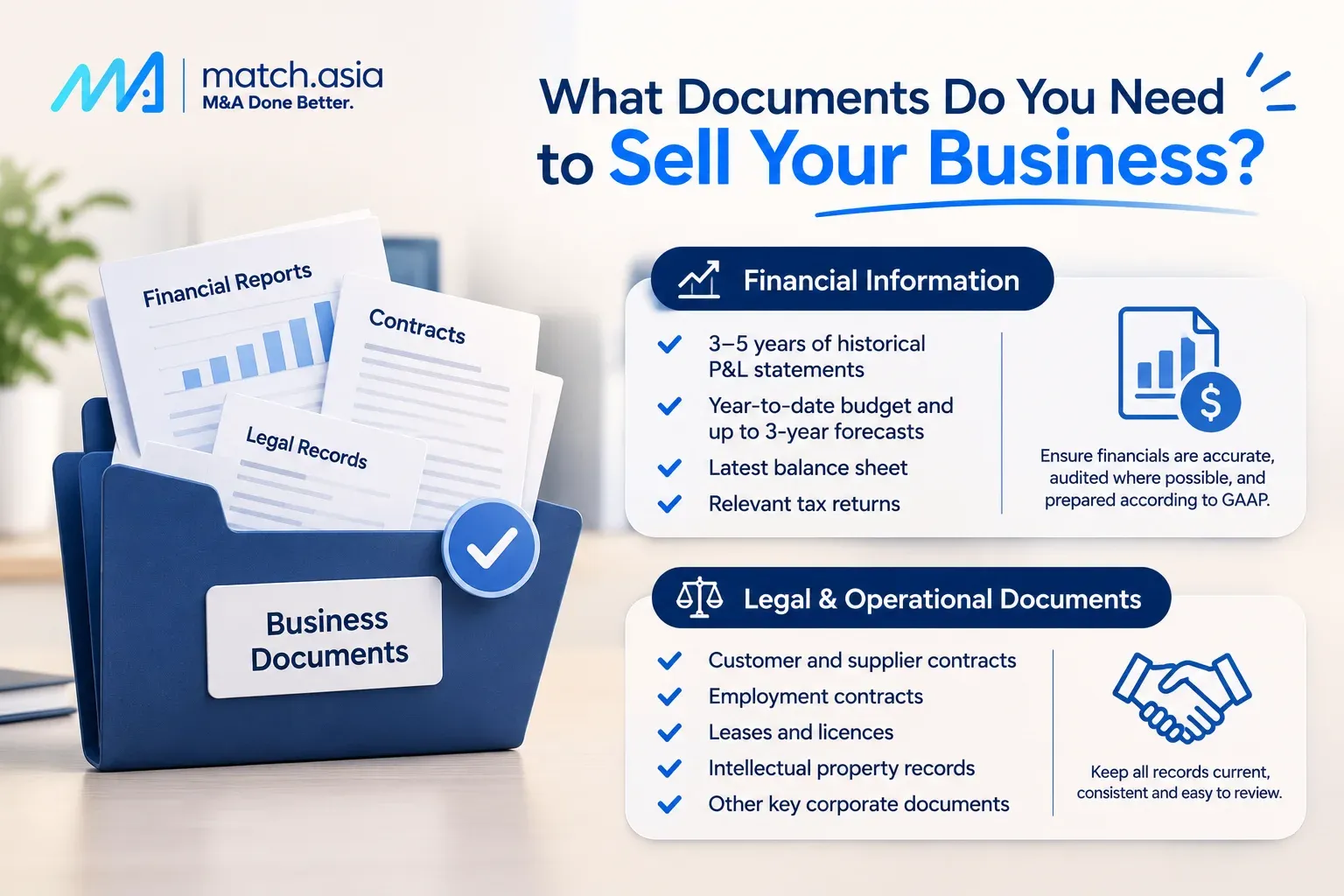
Financial information is one of the first areas buyers will examine. The core financial package should generally include:
-
- 3–5 years of historical P&L statements
-
- Year-to-date budget and up to 3-year forecasts
-
- Latest balance sheet
-
- Relevant tax returns
Financials should be prepared at the group or consolidated level where applicable, kept fully up to date and accurate, audited where possible, and prepared according to applicable GAAP standards as specified in the source guidance. Bringing accountants and financial advisers into the process can help ensure the numbers are properly prepared and consistent before buyers begin reviewing them.
Financial records are only part of the information buyers may request. You should also organise key legal and operational documents, including customer and supplier contracts, employment contracts, leases, licences, intellectual property records and other material corporate documents. Having these records readily available can make the business appear more organised and reduce unnecessary delays when questions arise during the transaction. The aim is not simply to collect documents. Information should be accurate, current, consistent and easy for advisers and potential buyers to understand. Missing or contradictory information can create additional questions and slow down the process.
How to Increase the Value of Your Business?
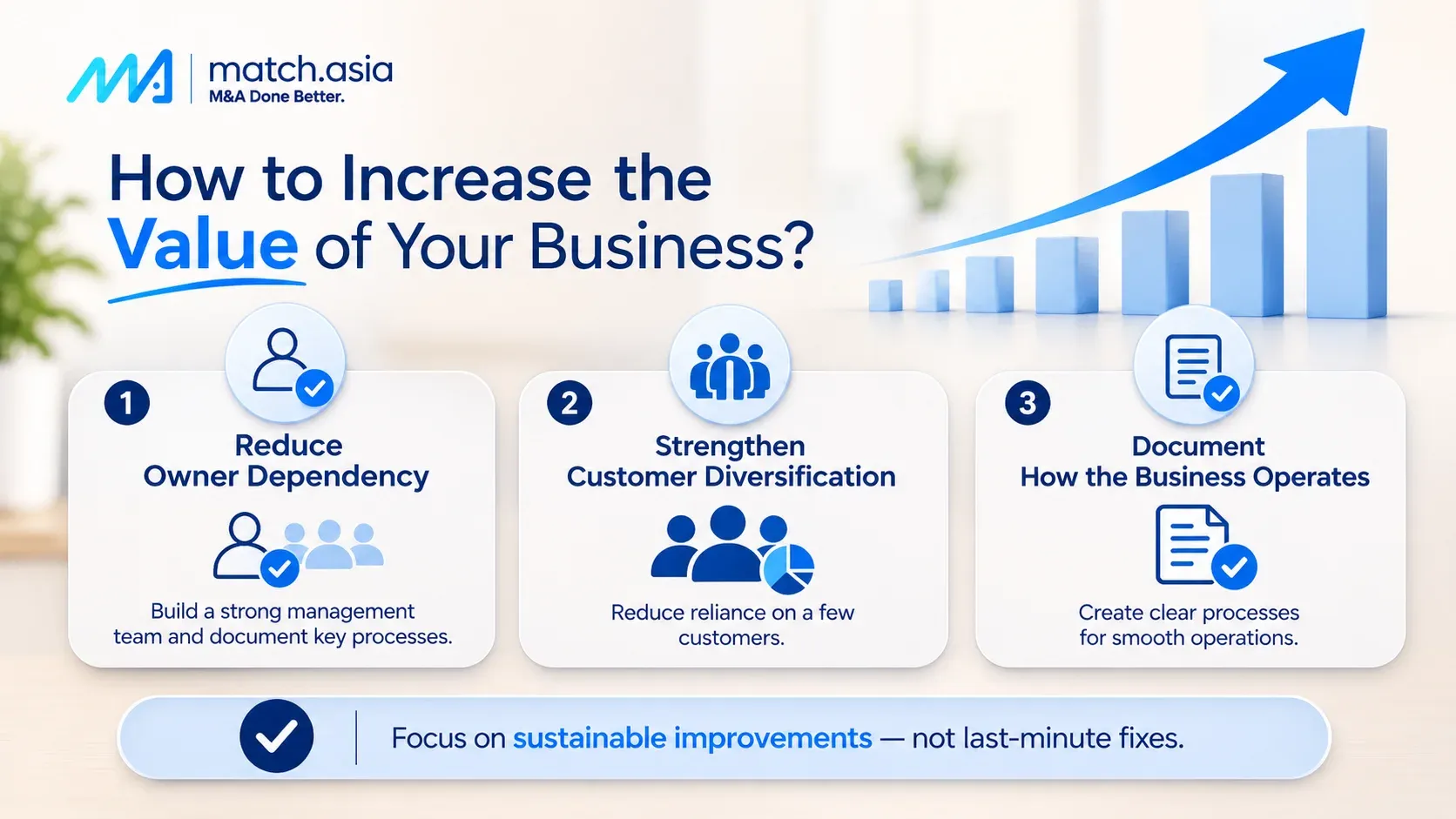
The strongest improvements are usually those that make the business more sustainable and less risky for a buyer. Buyers are likely to look closely at whether earnings can continue without the owner, whether customers are sufficiently diversified, whether the management team can operate the business independently and whether important processes are documented. Before going to market, consider practical improvements such as:
- 1. Reduce owner dependency. Delegate important responsibilities, strengthen the management team and document key decisions and processes so the business does not rely on one person for day-to-day operations.
- 2. Strengthen customer diversification. If a small number of customers account for a significant share of revenue, understand the risk and work towards a healthier spread of customers where commercially realistic.
- 3. Document how the business operates. Create clear processes for critical functions, responsibilities, reporting and operational workflows. This helps buyers understand how the company works and how it can continue after the transaction.
The goal is not to make cosmetic changes immediately before a sale. Sustainable improvements that are reflected in the company’s performance and operations over time are more credible than short-term changes designed purely to influence the sale.
How to Find the Right Buyer?
Finding a buyer is not simply about generating as much interest as possible. The objective is to identify potential buyers whose goals, capabilities and rationale align with the opportunity. Start by understanding the buyer. A strategic buyer may be interested in the company because of its customers, capabilities, products, technology or market presence. A financial buyer may focus more heavily on the company’s financial performance, growth prospects and potential returns. The important point is to understand what the buyer is looking for and explain why your business fits those objectives.
This becomes the basis of the investment story. Your business should be presented clearly, with a compelling explanation of its performance, market position, strengths, opportunities and future potential. An investment memorandum can provide a detailed overview for qualified buyers, while teasers can be used to introduce the opportunity without immediately disclosing every detail. The investment story should be supported by evidence rather than promotional language. Buyers need to understand not only what makes the business attractive today, but also why they could continue to create value after the transaction. match.asia’s guide on finding the right buyer provides further context on approaching buyer fit.
How to Get Through Due Diligence?
Once a potential buyer has demonstrated serious interest, confidentiality becomes particularly important. An NDA should generally be in place before sensitive business information is shared. Information can then be provided through a controlled virtual data room, allowing the seller and advisers to manage what is shared and when. The seller should maintain a structured flow of information and monitor buyer activity throughout the process. Presentations and management meetings may also be used to explain the business, answer questions and provide context around the information supplied. The principle is simple: be transparent, but remain controlled. Be upfront about both strengths and challenges rather than allowing issues to emerge unexpectedly later. Buyers will conduct their own assessment, so attempting to hide weaknesses can create more problems than addressing them directly. For a deeper overview, see match.asia’s due diligence guide.
Choosing the Right Deal Structure
The structure of the transaction determines how much ownership and control you retain and what your role may look like after closing. Three common structures are a 100% sale, majority sale and minority sale.
| Deal structure | Your control after the sale | Your role after closing | What to agree in advance |
|---|---|---|---|
| 100% sale | None | Usually exit, subject to agreed transition arrangements | Transition period, non-compete, employee considerations and handover |
| Majority sale | Limited or no control | May remain as shareholder or continue in an agreed role | Responsibilities, decision rights, remaining shares and future exit |
| Minority sale | Retained | Usually continues as controlling owner | Buyer’s rights, decision-making authority and future share arrangements |
The right structure depends on your objectives. If you want a clean exit, a 100% sale may be appropriate. If you want to retain an ownership position or remain involved in the business, a majority or minority transaction may provide more flexibility. Before agreeing to a structure, clarify your ownership, control, role, future shareholding and decision-making rights. For more detail, see match.asia’s guide to deal structures.
Closing the Deal and Handing Over the Business
Closing is the final stage, but it still requires careful coordination. All transaction elements need to be completed according to the agreed terms, including the necessary legal documents, conditions, payments, ownership transfers and other closing requirements. The handover should also be planned rather than treated as an afterthought. Depending on the transaction, this may involve a defined transition period, continued involvement from the seller or the transfer of relationships, responsibilities and operational knowledge to the buyer.
Non-compete agreements may also need to be addressed, particularly where the seller is exiting the business and could otherwise compete directly afterwards. Employee interests should also be considered so that the transition is managed responsibly and disruption is minimised. Professional advisers can be particularly valuable at this stage. Financial and legal advisers can help ensure that the transaction documentation, financial matters and closing requirements are properly handled. Preparation does not end when a buyer is identified; the final objective is to complete the transaction and hand over the business in an orderly way.
Conclusion
Preparing a business for sale is a process rather than a single event. From aligning shareholders and strengthening the management team to organising financials, understanding value, preparing documents, identifying the right buyer and managing due diligence, each stage contributes to the credibility of the overall transaction. M&A requires commitment from sellers because the process can be complex and time-consuming. Starting early gives owners more time to address weaknesses, strengthen the business and make informed decisions about their objectives. With preparation, planning and expert guidance, owners can approach the market with greater clarity and confidence.
match.asia combines M&A expertise and technology to guide sellers through the broader transaction journey, from preparation and buyer matching through to execution. Sellers can explore the sell your business process to understand how match.asia supports businesses through an M&A transaction.