How to Find the Right Buyer for Your Business in Southeast Asia?
公開日: November 4, 2026
更新日: November 6, 2026

Key Insights
- Define your exit goals first: Clarify your financial expectations, preferred ownership structure, and plans for the business after the sale.
- Understand different types of buyers: Strategic buyers, private equity firms, family offices, and individual buyers have different acquisition objectives and investment criteria.
- Look beyond geography: Local, regional, and international buyers may offer different opportunities depending on your industry, market position, and growth potential.
- Prioritise buyer fit over the highest offer: Evaluate payment certainty, transaction terms, financing, and post-sale obligations alongside the proposed price.
- Prepare your business for sale: Reliable financial records, capable management, sustainable earnings, and reduced founder dependency can strengthen buyer confidence.
- Protect confidentiality throughout the process: Screen potential buyers, verify their acquisition rationale, and share sensitive information progressively under appropriate confidentiality arrangements.
- Use the right channels to find buyers: Professional networks, strategic acquirers, financial investors, M&A advisers, and M&A platforms can help identify relevant acquisition opportunities.
Table of Contents
1.Why the Highest Offer Rarely Delivers the Best Exit?2.Define Your Exit Goals Before Approaching Buyers2.1.What do you want to achieve financially?2.2.How much of the business do you want to sell?2.3.What should happen after completion?2.4.What matters beyond price?2.5.Is the business ready to be transferred?3.Types of Business Buyers and What Each Means for Your Exit3.1.Strategic buyers3.2.Private equity firms3.3.Family offices and holding companies3.4.Individual buyers4.Why Geography and Industry Experience Matter in Southeast Asia?5.What a Corporate Acquirer Looks for in a Target Business6.Private Equity vs Strategic Buyer Price Is Only One Difference7.How to Find Potential Buyers Through the Right Channels?7.1.Start with the existing network7.2.Research strategic acquirers7.3.Identify relevant financial investors7.4.Consider MA advisers7.5.Consider an MA platform8.Running a Confidential Sale Process and Screening Serious Buyers9.How to Compare Offers Beyond the Headline Price?10.How match.asia Can Help You Find the Right Buyer?11.Conclusion12.Frequently Asked QuestionsFinding a buyer is an important step when selling a business in Southeast Asia. However, identifying an interested party is only part of the process. The more important question is whether the business is ready for the buyers it wants to attract. An owner may have built a profitable company, established a loyal customer base and developed a strong market position. Yet a potential acquirer may still struggle to justify the asking price, understand how the business will operate after the founder leaves, or identify a clear reason to acquire it rather than develop the same capabilities independently.
These gaps matter. Buyers need a credible reason to invest, confidence in the company's financial and operational information, and a clear understanding of how its value can be sustained under new ownership. For business owners in Southeast Asia, finding a suitable buyer involves three related tasks: understanding what the business offers, identifying buyers whose objectives align with that proposition, and preparing the company for a transaction. The process also requires an understanding of local market conditions, cross-border opportunities and the practical considerations that can influence a buyer's decision. This article explains how to identify potential acquirers, understand the different types of business buyers, evaluate offers and prepare for a confidential sale.
Why the Highest Offer Rarely Delivers the Best Exit?
A business owner may measure value through years of work, revenue growth, customer relationships and the effort required to build the company. A buyer evaluates the business differently. The buyer is investing in earnings, capabilities and future opportunities that can be transferred to new ownership. The purchase price must make sense against the risks involved, the capital required and the returns the buyer expects to generate. This difference in perspective is one reason business sales can stall. Consider a company whose owner expects a premium valuation because it has grown consistently. A potential acquirer may recognise the growth but discover that most customer relationships depend on the founder, financial reporting is inconsistent, or the management team cannot operate independently. The business may be attractive, but the buyer has additional work and risk to account for.
In Southeast Asia, these considerations can become more significant when a buyer is entering a new market. For example, a Malaysian company considering the acquisition of an Indonesian distributor may need to assess local customer relationships, distribution arrangements, management capabilities and the requirements for operating across both markets. Strong financial performance alone may not resolve these questions. The problem is not necessarily that the buyer fails to recognise what the owner has built. The business may simply need to demonstrate more clearly how its value will continue under new ownership.
Price is also only one part of an offer. Sellers should examine payment certainty, financing, completion conditions, deferred consideration and any obligations that continue after the sale. A higher offer with a substantial earn-out may produce a different outcome from a lower offer with more certain payment terms. Neither is automatically preferable; the decision depends on the seller's objectives and the risks involved. The practical lesson is to understand what a buyer is paying for and what must happen for that value to be realised. This creates a stronger basis for negotiation than relying on an asking price alone.
Define Your Exit Goals Before Approaching Buyers
The search for a buyer should begin with the seller's objectives, not a list of companies to contact. Some owners want to sell their entire stake and leave the business. Others want to bring in a strategic partner, realise part of their investment or remain involved while a new owner supports the next phase of growth. These are different transaction objectives and may attract different buyers. Before approaching the market, clarify five things.
1. What do you want to achieve financially?
An indicative business valuation can help establish a starting point. However, the eventual transaction price depends on financial performance, growth prospects, buyer demand, due diligence and the terms negotiated. A valuation should inform the discussion, not be treated as a guaranteed sale price. Sellers can estimate their business value to develop an initial understanding of the factors that may influence what a buyer is willing to pay.
2. How much of the business do you want to sell?
A full sale, majority sale and minority investment have different implications for ownership and control. The structure should reflect the owner's financial requirements and willingness to remain involved.
3. What should happen after completion?
Consider whether you want to leave immediately, support a transition or retain a role in the company. The answer may influence which buyers are appropriate. For example, a founder who wants to retire may prefer a buyer with the management resources to operate independently. An owner who wants to continue expanding the business may prefer an investor or strategic partner willing to support further growth.
4. What matters beyond price?
Business continuity, employees, the company's brand and its future direction may be important considerations. These priorities should be identified before competing offers arrive.
5. Is the business ready to be transferred?
Review the quality of financial reporting, management depth, customer concentration, operating processes, corporate records and dependence on the founder. A company may be performing well but still require preparation before it can be transferred with confidence. Valuation and exit readiness are related but distinct questions. One concerns what the business may be worth; the other concerns how prepared it is for a transaction. M&A is not something an owner needs to consider only when ready to sell. Preparing early can preserve more options, whether the eventual decision is a sale, a partnership or a transfer to the next generation.
Types of Business Buyers and What Each Means for Your Exit
Understanding the different types of business buyers helps owners identify where their company may fit and what questions to ask before progressing a discussion. Not every buyer sees the same opportunity in a business.
| Buyer type | Primary objective | Potential source of value | Considerations for sellers |
|---|---|---|---|
| Strategic buyer | Commercial growth and synergies | Market access, complementary products, capabilities or customers | Integration plans and business continuity |
| Private equity firm | Investment returns and business growth | Earnings growth, operational improvements and future exit opportunities | Ownership structure, investment horizon and management expectations |
| Family office or holding company | Long-term ownership, income or diversification | Sustainable cash flow and long-term value creation | Investment mandate and approach to management |
| Individual buyer | Business ownership and operation | Earnings, cash flow and opportunities to operate the business | Funding capacity, operating experience and transition requirements |
These categories are useful starting points, not guarantees of behaviour. Buyers within the same category can have different strategies, financial resources and expectations.
1. Strategic buyers
A strategic buyer is usually an existing company that sees a commercial reason to acquire another business. It may be a competitor, a company in an adjacent sector or an organisation looking to enter a new market. The acquisition may provide customers, distribution, technology, products, intellectual property or capabilities that would take time to build independently. For an SME in Southeast Asia, an established local operation may be relevant to a regional or international company seeking market access. A Singapore-based group, for example, may consider acquiring a business in Malaysia or Thailand to establish a local presence, expand distribution or strengthen an existing product offering. However, geographic presence alone does not make a business an attractive acquisition. The buyer still needs to see a credible commercial benefit and understand the costs and challenges of operating the acquired business.
2. Private equity firms
Private equity firms invest in businesses to generate returns for their investors. They may seek to improve operations, expand into new markets, strengthen management or pursue further acquisitions before eventually exiting the investment. Their criteria vary by fund, sector, company size and investment strategy. Some seek controlling stakes, while others may consider different ownership arrangements. A business with sustainable earnings, reliable reporting and opportunities for growth may be relevant to certain private equity investors. For example, a profitable Malaysian manufacturing company with repeat customers and opportunities to expand regionally may appeal to an investor pursuing a broader industrial platform strategy. The seller needs to understand the investor's expectations regarding performance, governance, ownership and the eventual exit.
3. Family offices and holding companies
Family offices and holding companies may invest with longer-term objectives, although their strategies vary considerably. Some prefer stable cash-generating businesses. Others pursue expansion, consolidation or active operational involvement. For example, a family office looking to build a regional portfolio of consumer businesses may be interested in a company with established operations in Thailand or the Philippines. Its interest will depend on the investment mandate, the quality of the business and the potential to create value over time. The important question is whether the buyer's investment approach fits the business and the seller's objectives.
4. Individual buyers
Individual buyers may include entrepreneurs, experienced executives or managers seeking to acquire and operate a business. They may be relevant for companies with established operations and a clear opportunity for an owner-operator. However, the seller should assess the buyer's funding, experience and ability to manage the business after completion. A buyer with experience in the same industry may understand the company's operating requirements better than someone entering the sector for the first time. Nevertheless, industry familiarity does not replace the need to verify funding and the ability to complete the transaction. In every case, the buyer category narrows the search. The specific acquisition rationale determines whether the discussion is worth pursuing.
Why Geography and Industry Experience Matter in Southeast Asia?

Finding a suitable buyer requires more than identifying investors with sufficient capital. The country in which the business operates, the buyer's geographical reach and the buyer's experience in the industry can all influence the attractiveness and feasibility of an acquisition.
1. The business's home market matters. A company operating in Singapore may have a different cost structure, customer base and operating model from a similar business in Indonesia or the Philippines. Buyers need to understand the market in which the company generates revenue, how it serves customers and what factors support its profitability.
2. The buyer's geographical reach matters. A local buyer may already understand the market, have established relationships and be able to integrate the business more easily. A regional or international buyer may offer access to additional capital, distribution channels, technology or overseas customers. However, cross-border expansion can introduce additional complexity.
3. Industry experience matters. Buyers familiar with a sector may better understand its operating economics, customer requirements, supply chains and growth opportunities. They may also identify synergies that a generalist investor would overlook. That does not mean an industry specialist will always offer more, but it can strengthen the commercial rationale for an acquisition.
Consider three illustrative scenarios:
- Singapore and Malaysia: A business services company with customers in both markets may interest a regional group seeking to consolidate complementary services. The buyer will need to assess customer overlap, contract arrangements, management responsibilities and the benefits of combining the operations.
- Indonesia and Thailand: A consumer goods manufacturer may attract a regional distributor seeking to expand its product portfolio. The buyer's understanding of local distribution networks, supplier relationships and customer demand can influence its assessment of the opportunity.
- The Philippines and Singapore: A technology-enabled services company serving international clients may attract a buyer seeking an established delivery team or access to a new customer segment. The buyer will need to assess the transferability of client contracts, workforce capabilities and the company's ability to maintain service quality after completion.
These examples illustrate possible acquisition rationales rather than guaranteed sources of demand. The appropriate buyer depends on the specific company's financial profile, market position and transaction objectives. Cross-border transactions also require careful attention to local legal, tax, regulatory and corporate requirements. Depending on the sector and transaction structure, foreign ownership rules, licences, approvals, employment arrangements and the transfer of contracts or assets may need to be reviewed by qualified advisers. The objective is not to prioritise local buyers over international ones. It is to identify buyers whose geography, industry experience and resources give them a credible reason to acquire the business.
What a Corporate Acquirer Looks for in a Target Business
A corporate acquirer does not necessarily value a business for the same reasons its founder does. The buyer is looking for something that strengthens its existing operations or creates a new opportunity. That may include an established customer base, complementary products, specialist expertise, technology, distribution capabilities or access to a market it wants to enter. The acquisition rationale should be specific enough to explain why buying the company makes commercial sense. For example, a buyer may already have strong distribution in a country but lack a particular product category. Another may have the products but need an established local team and customer relationships to expand into a new market. In both cases, the target business offers something beyond its standalone financial performance.
For a Southeast Asian business, the proposition may include established relationships with local customers, an experienced management team, regional distribution rights, specialist manufacturing capabilities or a proven route into a particular market. The strength of these advantages depends on how well they are documented and whether they can continue after a change in ownership. However, sellers should not assume that every strategic buyer will pay a premium. The buyer must still assess the acquisition cost, the risks involved and the practical difficulty of integrating the business. Owners can improve the buyer proposition by documenting what the company does well, demonstrating the quality of its earnings, identifying realistic growth opportunities and explaining how its capabilities can continue under new ownership. The objective is to make the commercial case clear enough for the right buyer to assess.
Private Equity vs Strategic Buyer: Price Is Only One Difference
The comparison between private equity and strategic buyers is often framed as a question of which will pay more. That is too narrow a starting point. A strategic buyer evaluates the acquisition partly through the value it may create for its existing business. A private equity firm generally evaluates the investment through its expected financial returns and the opportunities to grow and eventually exit the investment. These different objectives can affect the offer, ownership structure and post-transaction plans. They do not determine the outcome in advance. A strategic buyer may recognise substantial synergies but intend to integrate the target into its existing operations. A private equity investor may see a strong growth opportunity and compete actively for the business. Either may offer an attractive proposal, depending on the circumstances.
Geography can also influence the comparison. A strategic buyer already operating in the same Southeast Asian market may be able to identify immediate commercial benefits. A regional private equity firm may instead see an opportunity to combine several businesses into a larger group. The seller should assess the actual proposal rather than assume that one type of buyer is inherently more suitable. The seller should compare the actual terms: consideration payable at completion, deferred payments, financing, conditions, management expectations and any continuing equity or obligations. The seller's own objectives matter just as much. Someone seeking a complete exit may prioritise certainty and a clean transition. Someone seeking a partner for further growth may consider a structure that allows continued ownership. There is no universal winner in the strategic buyer versus private equity comparison. The relevant question is which buyer has a credible reason to acquire the business and can offer terms that meet the seller's objectives.
How to Find Potential Buyers Through the Right Channels?

Once the business proposition and exit objectives are clear, the next step is to identify relevant potential acquirers. A disciplined approach starts by defining the buyer criteria and then selecting channels that can reach those buyers.
1. Start with the existing network
Industry contacts, suppliers, customers and professional advisers may know companies or investors interested in acquisitions. These introductions can be useful, but they may not reach buyers outside the owner's immediate network. In Southeast Asia, existing relationships can be particularly useful when they provide knowledge of a local market or sector. However, sellers should avoid relying exclusively on informal introductions if their ideal buyer may be based in another country or operate in an adjacent industry.
2. Research strategic acquirers
Look for companies whose products, customers, geographic footprint or operating capabilities complement the business. Previous acquisitions, regional expansion plans and product development priorities may help explain whether a company has a credible acquisition rationale. For example, a Singapore-based logistics group expanding into Malaysia may be worth researching if the seller operates an established Malaysian logistics business with complementary customers and capabilities. The potential fit should be based on evidence of strategic alignment, not simply geographic proximity. A similar company is not necessarily a suitable buyer. The objective is to identify a reason for the acquisition.
3. Identify relevant financial investors
Review the investment criteria of private equity firms, family offices and holding companies. Sector interest alone is insufficient if the business falls outside the investor's preferred size, geography or financial profile. Some investors focus on particular industries, while others pursue regional expansion or buy-and-build strategies. Understanding these preferences helps sellers prioritise relevant prospects. When comparing a financial sponsor with a strategic buyer, consider whether an investor's return objectives or a corporate buyer's commercial priorities better align with the company's strengths and the seller's preferred transaction structure.
4. Consider M&A advisers
Advisers can support buyer research, transaction positioning, negotiations and execution. Their sector expertise, geographic coverage, buyer relationships, fees and engagement terms should be assessed before appointment. For a cross-border transaction, experience in both the company's home market and the buyer's likely market can be particularly useful. An adviser familiar with the relevant industry may also be better positioned to explain the acquisition rationale to prospective buyers.
5. Consider an M&A platform
An M&A platform can extend the search beyond existing relationships by organising buyer and seller information and identifying potential matches against relevant criteria. For SMEs, this can help connect the company's sector, size, geography and transaction objectives with buyers whose acquisition mandates align with the opportunity. The value comes from reaching buyers whose requirements fit the business, not simply increasing the number of contacts. Business owners considering a sale can find the right buyer for their business through match.asia, where preparation, buyer matching and transaction support are brought together in an end-to-end process. Each channel has limitations. The right approach depends on the company's characteristics, the available buyer universe and the seller's objectives. Combining channels may be appropriate in some situations. The practical priority is to build a relevant buyer universe before beginning outreach. This helps focus effort on parties with a credible reason to pursue the opportunity.
Running a Confidential Sale Process and Screening Serious Buyers
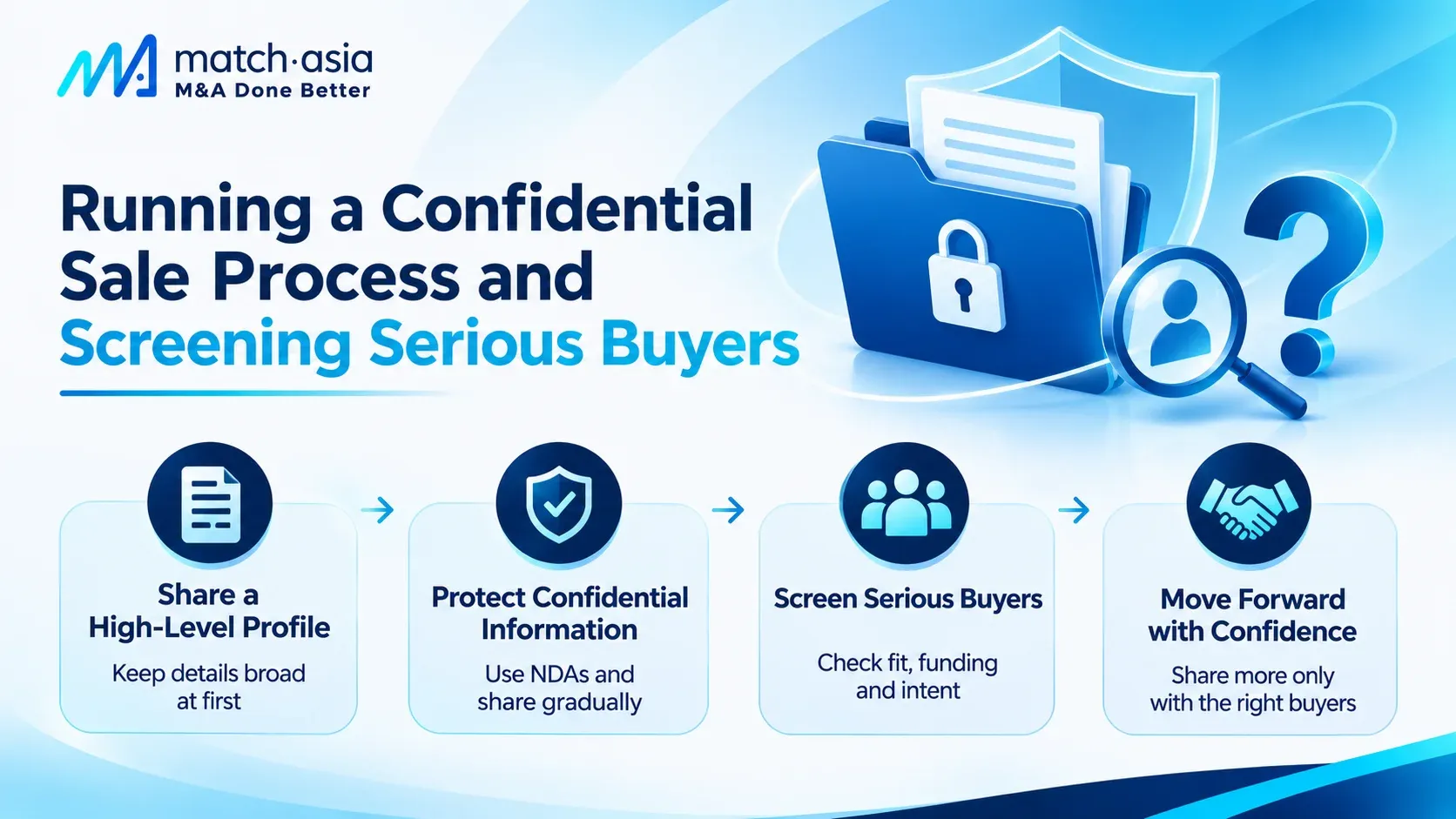
A business sale creates an information challenge. Buyers need enough detail to evaluate the opportunity, while sellers need to protect sensitive information and maintain normal operations. A structured process allows information to be shared progressively. The initial profile may describe the company's sector, geography, scale and broad financial characteristics without immediately identifying the business. More detailed information can be shared as the buyer demonstrates credible interest and appropriate confidentiality arrangements are in place.
In Southeast Asia, confidentiality can be particularly important when approaching competitors, suppliers or companies operating in the same relatively concentrated industry. An unsuccessful sale process should not unnecessarily expose customer relationships, pricing arrangements, employee information or expansion plans. Before releasing sensitive financial or operational information, sellers should consider the buyer's identity, acquisition rationale, funding capacity and decision-making process. A non-disclosure agreement can establish confidentiality obligations, but it does not replace buyer screening or careful information management. Sellers should also distinguish interest from readiness to transact. A prospective buyer may like the business but lack funding, internal approval or a clear path to completion.
Useful screening questions include:
- Why does the business fit the buyer's acquisition strategy?
- Does the buyer have a credible funding plan?
- Who is responsible for approving the transaction?
- What due diligence and approval steps remain?
- Is the buyer willing to follow an orderly process for confidential information?
- Does the buyer understand the market and operating requirements of the country in which the business operates?
For cross-border transactions, sellers should also understand whether the buyer has the resources and experience to evaluate the business in its local context. Where relevant, the process should account for local advisers, regulatory approvals and the transfer of key commercial relationships. The answers help determine whether to progress the discussion and what information to provide next. A disciplined process protects the seller's commercial position while giving credible buyers a clearer path to evaluate the opportunity.
How to Compare Offers Beyond the Headline Price?
When offers arrive, the seller needs to understand the complete transaction rather than focus on a single number. Consider how much of the consideration is payable at completion and whether any portion depends on future performance, financing, regulatory approvals or other conditions. An earn-out, for example, may make part of the purchase price conditional on agreed performance targets after completion. Such a structure may help bridge differences in valuation expectations, but the seller should understand the measurement criteria, decision-making arrangements and conditions governing payment.
Other terms can be equally important.
- Financing: Is the buyer's funding credible, and what conditions remain?
- Due diligence: What information and verification will be required?
- Exclusivity: Is the buyer asking the seller to suspend discussions with others, and for how long?
- Transition: How long will the seller be expected to remain involved?
- Continuing obligations: What warranties, indemnities or restrictive covenants may apply?
- Completion conditions: What could prevent or delay the transaction from closing?
For Southeast Asian transactions, sellers should also consider whether the buyer's proposed structure creates additional legal, tax, foreign ownership or regulatory requirements in the relevant jurisdiction. These matters depend on the country, sector and transaction structure and should be reviewed with qualified professional advisers. These factors influence the certainty, timing and practical outcome of the sale. A seller should also consider how the offer aligns with personal and business objectives. A transaction that delivers the expected financial outcome but requires an unwanted extended operating role may not be the right fit. It can also be useful to compare offers against the assumptions used to establish the business's indicative valuation. If a buyer's offer differs significantly from expectations, understanding the reasons behind the gap can help inform negotiations. The objective is to compare offers on a consistent basis and understand the trade-offs before committing to a transaction. Professional legal, tax and financial advice can help the seller understand the implications of the proposed terms.
How match.asia Can Help You Find the Right Buyer?
Finding a buyer is not simply a matter of making a business visible to more people. It requires identifying buyers with a credible reason to acquire the company, aligning expectations and preparing both sides for a structured transaction process. match.asia is an end-to-end deal platform for SMEs in Asia. It combines technology with experienced M&A professionals to support sellers and credible buyers through preparation, matching, outreach, due diligence and transaction execution. The process starts with understanding the business and the seller's objectives. Its financial profile, sector, size, growth opportunities, geography and preferred transaction structure help establish which types of buyers may be relevant. The next question is whether the business is ready to approach those buyers. Valuation expectations, financial reporting, management depth and the clarity of the buyer proposition can affect whether a discussion progresses.
Buyer identification then focuses on relevance. Strategic and financial buyers have different acquisition mandates, and a business should be matched against those requirements rather than presented indiscriminately to a broad list of contacts. For businesses operating across Southeast Asia, this includes considering the buyer's geographical reach, sector experience and potential to operate or integrate the business successfully. For sellers, this approach connects preparation with buyer matching and the subsequent stages of a transaction. It is not a guarantee of a particular valuation, buyer response or completed deal. The objective is to create a more structured process in which the business proposition, buyer requirements and transaction expectations are better aligned. match.asia operates on a success-fee-only basis for its qualifying transaction facilitation service, without a seller retainer. The service is offered selectively to committed sellers with viable businesses and credible buyers with defined acquisition mandates. Business owners can learn more about the business sale process to understand the stages involved, from initial preparation and buyer matching to negotiations and completion.
Conclusion
Finding the right buyer for a business in Southeast Asia requires more than identifying companies or investors that can afford to acquire it. Sellers need to understand their exit objectives, prepare the business for scrutiny and identify buyers whose acquisition strategies align with the company's strengths and future opportunities. The country in which the business operates, the buyer's geographical reach and their industry experience can all influence the suitability of a potential acquirer. These factors are particularly relevant when a transaction involves different markets, operating environments or regulatory requirements. Understanding the different types of business buyers, evaluating the differences between strategic buyers and private equity firms, and using appropriate channels to identify potential acquirers can help owners approach the market more effectively. A confidential, structured sale process and careful comparison of offers can further support informed decisions. Ultimately, the goal is not simply to find a buyer for your business, but to find the right buyer on terms that reflect your financial goals, priorities and plans for the company's future. Preparing early and focusing on buyer relevance can help create a stronger foundation for a successful transaction.
Frequently Asked Questions
How do I find a buyer for my business?
Start by defining your exit objectives, understanding your business's value and identifying buyers with a credible acquisition rationale. Depending on the business, relevant channels may include your professional network, strategic acquirers, financial investors, M&A advisers and an M&A platform. Buyer relevance and transaction readiness matter more than the number of enquiries.
How long does it take to find a buyer for a business?
There is no standard timeline. The process depends on the business's financial performance, sector, readiness, buyer criteria and transaction complexity. Cross-border deals in Southeast Asia may require additional coordination, due diligence and regulatory work. Preparing the business and establishing realistic expectations can help, but cannot guarantee a particular timeline.
Should I sell my business to a competitor?
A competitor may be a suitable buyer if the acquisition creates commercial value. However, sharing information with a competitor carries risks if the transaction does not proceed. Assess the acquisition rationale, manage confidentiality and seek appropriate advice before disclosing sensitive information.
Is a strategic buyer better than private equity?
Neither is inherently better. A strategic buyer may value commercial synergies, while a private equity firm may focus on earnings, growth and investment returns. The appropriate buyer depends on the company's characteristics, the actual offer and the seller's priorities regarding price, control and future involvement.
Does the buyer need to be based in the same country as my business?
No. A local buyer may understand the market, customer relationships and operating environment, while an international buyer may offer access to capital, distribution or regional expansion opportunities. The suitability of a cross-border buyer depends on its acquisition rationale, industry experience, ability to operate in the relevant market and capacity to complete the transaction.
Should I value my business before looking for buyers?
An indicative valuation can help establish expectations and identify factors that influence business value. It is not a guaranteed transaction price. Actual offers depend on buyer demand, due diligence, negotiation and the terms of the transaction. Assessing exit readiness alongside valuation can help identify areas to address before approaching buyers.
How can I sell my business confidentially?
A confidential sale process typically uses an anonymised initial profile, buyer screening, appropriate confidentiality agreements and progressive disclosure of sensitive information. Sellers should also maintain control over information access and obtain appropriate professional advice.