Businesses for Sale in Singapore
公開日: November 11, 2026
更新日: November 11, 2026

Key Insights
- Singapore offers business acquisition opportunities across diverse sectors and business models.
- Buyers should look beyond asking price and assess financials, customers, management, assets and growth potential.
- Acquisition costs vary based on profitability, valuation multiples, industry, assets and transaction structure.
- Due diligence is essential, including checks on ACRA records, tax, contracts, licences, IP and liabilities.
- Buyers must understand the difference between share and asset purchases, especially regarding liabilities and transferred assets.
- Foreign buyers should separately consider ownership, residency and work-pass requirements.
Table of Contents
1.What Singapore Businesses for Acquisition Look Like?2.Where to Find a Singapore Business for Sale?3.What Does It Cost to Buy a Business in Singapore?4.What to Check in Companies for Sale in Singapore?5.Choosing Between a Share and Asset Purchase6.Business Acquisition Opportunities Singapore Offers Foreign Buyers7.How Ownership Is Transferred After the Sale?8.How match.asia Supports Buyers in Singapore?9.Conclusion10.Frequently Asked QuestionsBusinesses for sale in Singapore can range from small owner-operated companies to established SMEs with recurring revenue, experienced management teams and regional operations. For buyers, the attraction is not simply the opportunity to acquire an existing business rather than starting from zero. An established company may already have customers, employees, suppliers, operating processes, licences, intellectual property and a proven business model. However, buying a business in Singapore still requires careful assessment. An attractive asking price does not necessarily mean an attractive acquisition. Buyers need to understand how the business makes money, whether its financial performance is sustainable, what liabilities may transfer with the business, and whether the proposed ownership structure works for them. Singapore's regulatory environment also means that buyers should consider matters such as ACRA records, tax obligations, employment requirements, licences and, where relevant, foreign ownership and work-pass rules. This guide explains what companies for sale in Singapore typically look like, where buyers can find them, what affects the cost of an acquisition, and the key steps involved in completing a business purchase.
What Singapore Businesses for Acquisition Look Like?
Singapore businesses for acquisition cover a broad range of sectors and business models. Opportunities can include professional services firms, technology companies, food and beverage businesses, education providers, logistics companies, manufacturing businesses, healthcare-related businesses, retail operations and other established SMEs. The size and structure of a business can vary significantly. Some businesses are closely managed by their founders and may be suitable for an owner-operator. Others have management teams, established reporting systems and recurring contracts, making them potentially more suitable for a strategic or financial buyer. When reviewing a Singapore business for sale, buyers should look beyond revenue. Several characteristics can materially affect the quality of an opportunity:
-
- Revenue quality: recurring versus one-off revenue, customer retention and contract visibility.
-
- Profitability: gross margins, operating profit, EBITDA or SDE, depending on the business.
-
- Owner dependence: how much the business relies on the founder for customers, operations or decision-making.
-
- Customer concentration: whether a small number of customers account for a large proportion of revenue.
-
- Management depth: whether the existing team can continue operating the business after the transaction.
-
- Assets and intellectual property: what the buyer is actually acquiring and whether ownership is properly documented.
-
- Growth potential: whether future growth is supported by evidence rather than projections alone.
The strongest acquisition opportunities are not necessarily the businesses with the highest revenue. A smaller company with reliable earnings, transferable operations and a diversified customer base may present a more attractive acquisition than a larger business with significant operational or financial risks.
Where to Find a Singapore Business for Sale?
Buyers can find Singapore businesses for sale through business-for-sale platforms, M&A advisers, corporate networks, professional advisers and direct approaches to business owners. Public listings can be useful for understanding the range of businesses currently seeking buyers, but they should be treated as an initial screening tool rather than a substitute for due diligence. The information available in a listing may be limited, and asking prices may not provide enough context to determine whether an opportunity is fairly valued. match.asia provides access to current SME deals, allowing buyers to explore businesses that may be available for acquisition and consider opportunities based on their sector, geography and investment requirements. Buyers can also work with an M&A advisor when they require support with sourcing, valuation, negotiation, due diligence or transaction execution. The right approach depends on the complexity of the acquisition and the buyer's experience.
What Does It Cost to Buy a Business in Singapore?
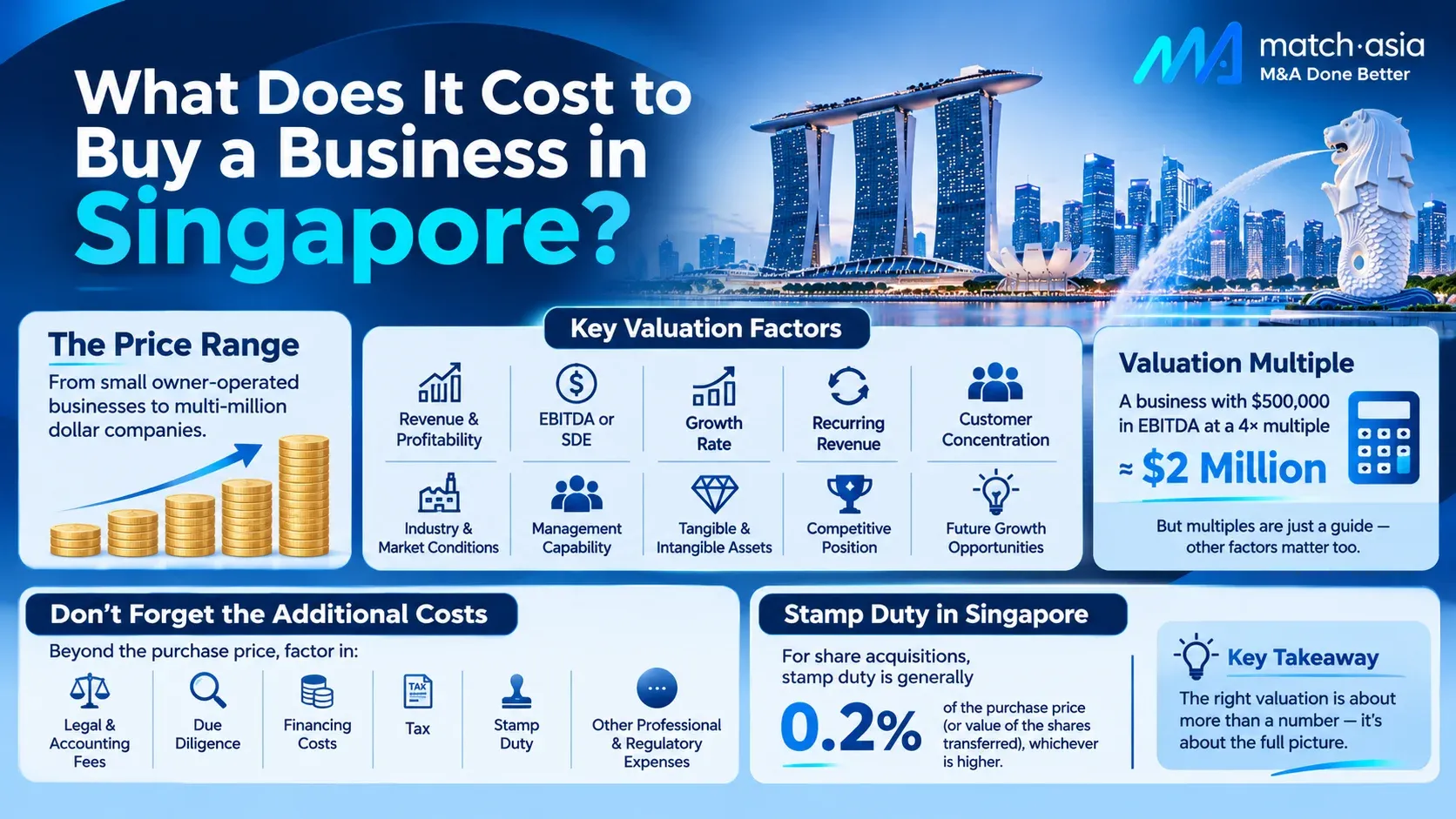
There is no standard price for buying a business in Singapore. The cost can range from a relatively small amount for a micro-business or owner-operated company to millions of dollars for an established company with significant earnings, assets or strategic value. The asking price is usually influenced by factors such as:
-
- Revenue and profitability
-
- EBITDA or SDE
-
- Growth rate
-
- Recurring revenue
-
- Customer concentration
-
- Industry and market conditions
-
- Management capability
-
- Tangible and intangible assets
-
- Competitive position
-
- Future growth opportunities
-
- Transaction structure
Buyers often use a valuation multiple to assess whether an asking price is reasonable. For example, a business generating $500,000 in adjusted EBITDA with an illustrative 4× EBITDA multiple would imply an enterprise value of $2 million. However, a multiple should not be treated as a universal benchmark. Two businesses with identical EBITDA can justify very different valuations if one has stronger recurring revenue, lower customer concentration, better management and greater growth visibility. Buyers should also budget for costs beyond the purchase price. Depending on the transaction, these may include legal and accounting fees, due diligence, financing costs, tax, stamp duty and other professional or regulatory expenses. For share acquisitions in Singapore, IRAS states that stamp duty on the transfer of shares is generally 0.2% of the purchase price or value of the shares transferred, whichever is higher, subject to the applicable rules.
What to Check in Companies for Sale in Singapore?
Before making a binding offer, buyers should verify the information presented by the seller and understand the risks attached to the business. A practical review should include:
| Area | What to examine |
|---|---|
| Financials | Revenue, margins, EBITDA/SDE, cash flow, debt and working capital |
| ACRA records | Company structure, shareholders, directors and corporate information |
| Tax | Tax filings, outstanding liabilities and relevant IRAS matters |
| Customers | Concentration, retention, contracts and recurring revenue |
| Employees | Key personnel, employment terms and management dependency |
| Contracts | Customer, supplier, lease and financing agreements |
| Licences | Required licences and whether they can continue after the transaction |
| IP | Trademarks, software, domains and other intellectual property |
| Assets | Equipment, inventory, property and other assets included in the deal |
| Liabilities | Loans, claims, disputes, obligations and contingent liabilities |
| Operations | Processes, systems and the level of founder dependence |
Financial records deserve particular attention. Buyers should understand not only the reported profit but also how that profit is generated and whether proposed adjustments are reasonable and supported by evidence. Legal and commercial due diligence is equally important. A business may appear profitable while having unresolved contractual, employment, regulatory or ownership issues that could affect the transaction.
Choosing Between a Share and Asset Purchase
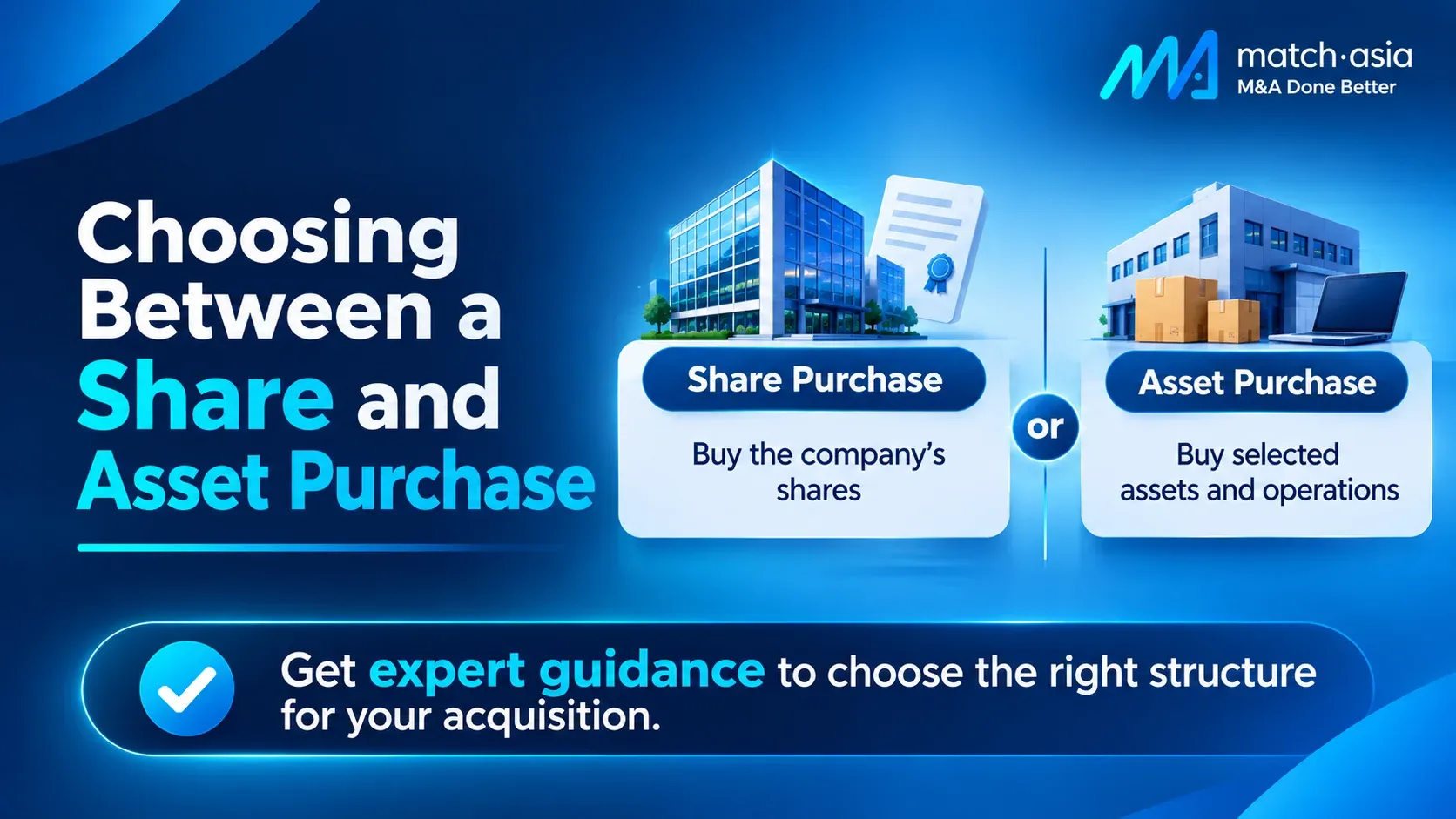
One of the key decisions in a Singapore business acquisition is whether to buy the company's shares or acquire selected business assets.
-
- In a share purchase, the buyer acquires shares in the existing company. The company itself continues to exist, together with its existing assets, contracts and liabilities, subject to the transaction terms and applicable law.
-
- In an asset purchase, the buyer acquires specified assets and business operations rather than buying the company itself. The assets transferred may include equipment, inventory, intellectual property, customer relationships or other specified items.
| Share purchase | Asset purchase |
|---|---|
| Buyer acquires ownership of the company | Buyer acquires specified assets/business operations |
| Existing company continues | Seller's company may remain with excluded assets or liabilities |
| Existing contracts may continue, subject to their terms | Contracts may need to be assigned or replaced |
| Existing liabilities may remain within the company | Buyer can potentially define what is acquired |
| Corporate history and structure are retained | Transaction can be more selective |
Neither structure is automatically better. The right approach depends on the business, liabilities, contracts, tax considerations, licences and the buyer's objectives. Professional legal and tax advice is important before deciding on the transaction structure.
Business Acquisition Opportunities Singapore Offers Foreign Buyers
Singapore is open to international business and investment, but foreign buyers should not assume that buying a Singapore company automatically gives them the right to live in Singapore and operate it personally. A Singapore company must have at least one ordinarily resident director, and foreign individuals may need to meet specific residency and work-pass requirements if they intend to work in Singapore. MOM also states that foreigners who intend to work in Singapore need a valid work pass. The appropriate pass depends on the individual's circumstances and the nature of the business. This distinction matters for overseas buyers. Owning shares in a Singapore company and working in Singapore are separate questions. A buyer may be able to acquire an interest in a business while needing a separate immigration or work arrangement to take an active operating role. Foreign buyers should also check whether the target operates in a regulated sector or requires specific licences. The relevant requirements can depend on the company's activities rather than simply its incorporation status. For an overseas buyer considering an acquisition, the key questions include:
-
- Can the proposed ownership structure be used?
-
- Does the business operate in a regulated sector?
-
- Can the buyer legally take an operating role in Singapore?
-
- Is a resident director required?
-
- What licences and approvals must remain in place?
-
- What tax and employment obligations will apply?
These questions should be resolved before the transaction is finalised rather than after completion.
How Ownership Is Transferred After the Sale?
The mechanics of transferring ownership depend on the transaction structure. For a share purchase, the seller transfers the relevant shares to the buyer in accordance with the company's constitution and the transaction documents. ACRA requires the transfer of shares to be filed, and for private companies the transfer takes effect only after ACRA updates the Electronic Register of Members. The transaction will normally involve legal documentation such as a sale and purchase agreement, which sets out the agreed price, conditions, warranties, indemnities, completion requirements and other terms. For an asset purchase, the buyer and seller need to identify precisely which assets and liabilities are being transferred. Certain contracts, leases, licences or other rights may require consent or separate documentation before they can move to the buyer. A typical transaction may therefore involve:
- 1. Agreeing commercial terms.
- 2. Signing a letter of intent, where appropriate.
- 3. Conducting financial, legal and commercial due diligence.
- 4. Agreeing the transaction structure.
- 5. Negotiating and signing the sale and purchase agreement.
- 6. Satisfying completion conditions.
- 7. Completing the share or asset transfer.
- 8. Updating corporate records and completing required filings.
- 9. Managing the transition to the new owner.
The exact process varies according to the transaction and the business.
How match.asia Supports Buyers in Singapore?
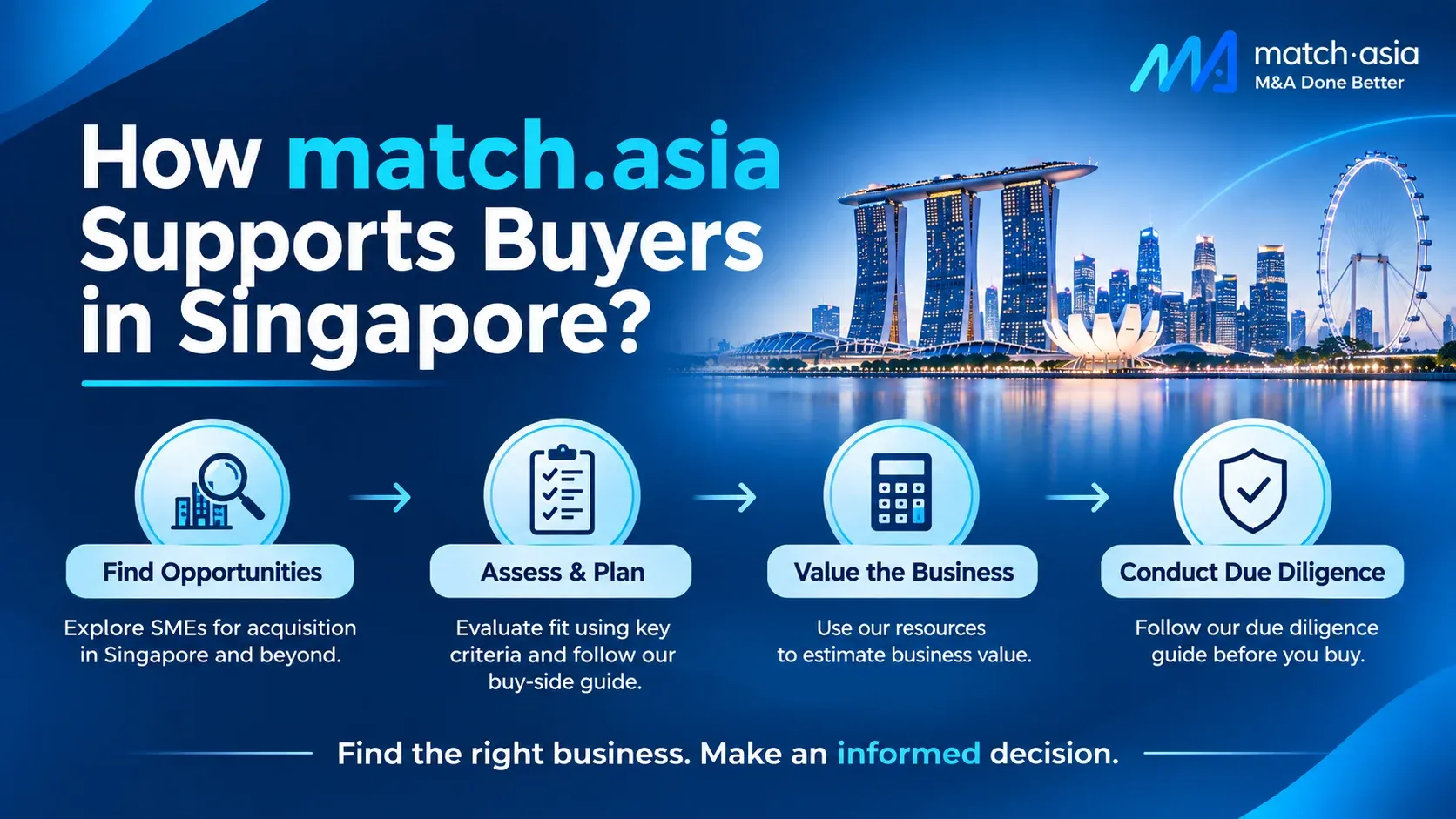
Finding the right business is only the beginning of an acquisition. Buyers also need to determine whether the opportunity fits their objectives and whether the business can withstand financial, commercial and legal scrutiny. match.asia connects buyers with SME M&A opportunities in Asia, including businesses that may be suitable for acquisition in Singapore and across the region. Buyers can use the platform to identify relevant opportunities, then apply their own investment criteria to assess factors such as sector, geography, financial performance, size and strategic fit. match.asia also provides resources covering the buy-side process, helping buyers understand the key stages involved in moving from an initial opportunity towards a transaction. Valuation is another important part of the process. Buyers can use match.asia's resources for estimating business value and then consider the resulting valuation alongside earnings quality, market conditions, growth prospects and transaction risks. Before committing to a deal, buyers should conduct appropriate due diligence. match.asia's guide to the due diligence process provides a structured starting point for understanding what should be verified before proceeding. The objective is not simply to find a Singapore business for sale. It is to identify a business that fits the buyer's objectives and can support a well-informed acquisition decision.
Conclusion
Businesses for sale in Singapore offer buyers the opportunity to acquire established operations, customers, employees, assets and proven business models rather than building everything from the beginning. But an existing business still needs to be examined carefully. Buyers should look beyond the asking price and assess the company's financial performance, customer base, management structure, contracts, liabilities, licences and ability to operate after the ownership transition. The choice between a share purchase and an asset purchase can also materially affect what the buyer acquires and which liabilities remain with the seller. Foreign buyers need to consider ownership, residency and work-pass requirements separately from the commercial decision to acquire the business. A disciplined acquisition process starts with finding the right opportunity, followed by valuation, due diligence, negotiation and careful transaction execution. For buyers considering a Singapore acquisition, preparation is often what separates an interesting listing from a transaction worth pursuing.