Businesses for Sale in Asia
公開日: November 11, 2026
更新日: November 11, 2026

Key Insights
- Explore opportunities across Asia — from SMEs to established regional businesses.
- Know the market — regulations, ownership rules and transaction conditions vary by country.
- Look beyond the asking price — assess earnings, cash flow, assets and valuation.
- Do your due diligence — review customers, operations, legal position and management.
- Buying from abroad? — check foreign ownership, tax, currency and local requirements.
- Focus on strategic fit — the right acquisition is about value, risk and long-term potential.
Table of Contents
1.How Asian Businesses for Sale Differ by Country2.What Companies for Sale in Asia Have in Common3.Where Foreign Ownership Limits Apply?4.Which Sectors Draw the Most Buyers in Asia?5.How to Evaluate Business Listings for Sale in Asia?6.How to Buy a Business for Sale in Asia from Abroad?7.How match.asia Helps Buyers Find the Right Business?8.Conclusion9.Frequently Asked QuestionsBusinesses for sale in Asia range from small owner-operated companies to established regional businesses with significant revenue, assets and management teams. For buyers, the region offers opportunities across manufacturing, technology, professional services, consumer businesses, logistics, hospitality, healthcare and other sectors. However, buying a business in Asia is not simply a matter of finding an attractive listing and agreeing on an asking price. Each market has its own regulations, ownership rules, business practices, tax considerations and transaction environment. The right acquisition therefore requires more than comparing financial figures. Buyers need to understand the country where the business operates, the sector-specific rules that apply, the quality of the company's financial records, the reasons for the sale and the risks that may affect the transfer of ownership. This guide explains how businesses for sale in Asia differ by market, what buyers should look for in a listing, where foreign ownership restrictions may apply, and how to approach a business acquisition from abroad.
How Asian Businesses for Sale Differ by Country
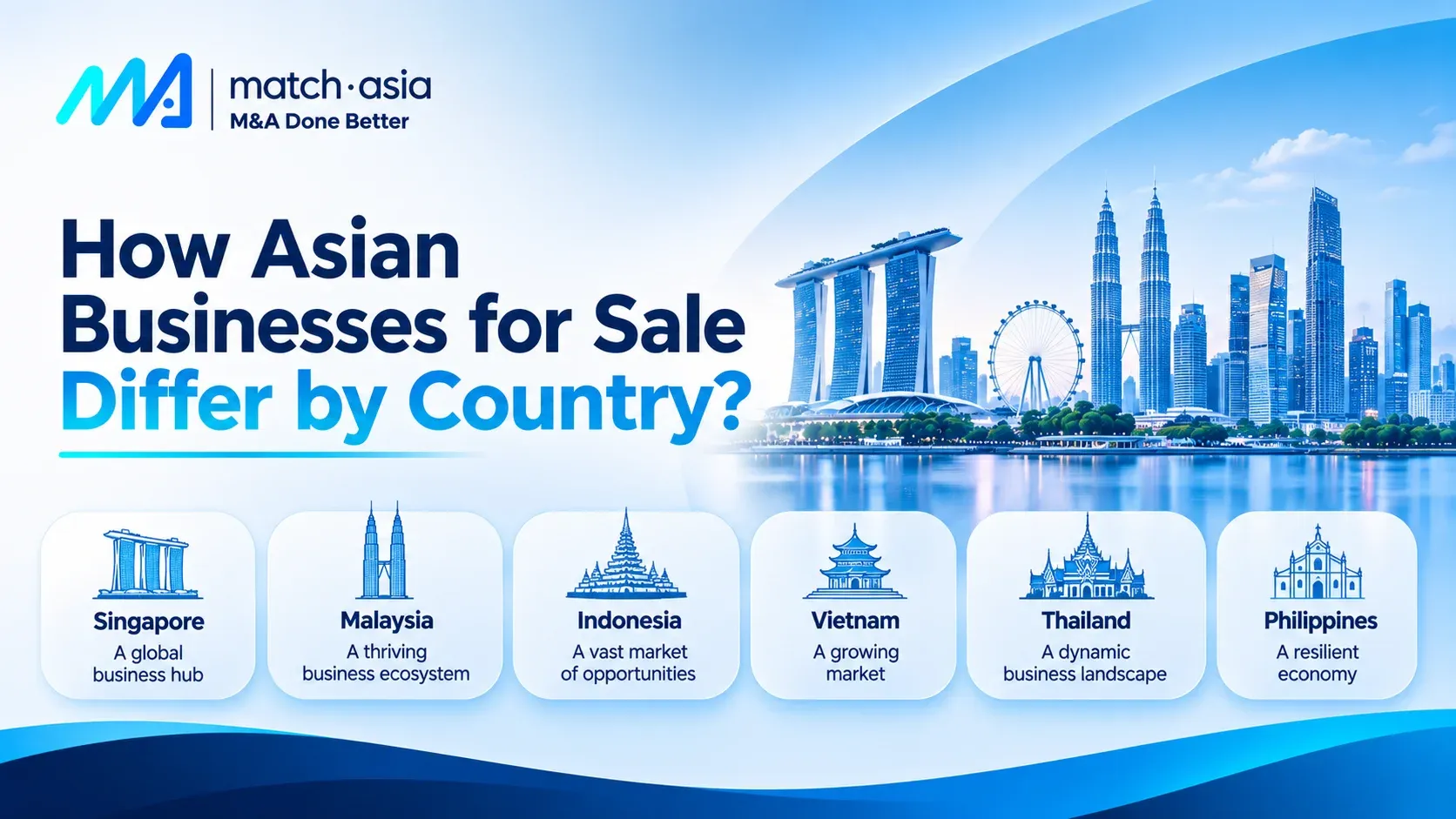
Asia is a diverse collection of markets rather than a single business environment. A company for sale in Singapore may have a very different regulatory framework, cost structure and buyer profile from a business operating in Indonesia, Vietnam, Thailand, Malaysia or the Philippines.
-
- Singapore is often considered attractive for regional or internationally oriented acquisitions because of its developed corporate and financial environment. Listings can include established professional services companies, technology businesses, logistics companies, food and beverage businesses and other SMEs. Current market listings also show opportunities ranging from smaller operating businesses to substantially larger regional companies.
-
- Malaysia offers opportunities across manufacturing, services, food and beverage, logistics, technology and other sectors. Foreign ownership rules can differ by activity, although Malaysia's manufacturing sector, for example, permits 100% foreign equity in new projects under the country's stated equity policy.
-
- Indonesia has a large domestic market and a broad range of acquisition opportunities, but buyers need to examine the specific business activity and applicable foreign investment requirements. Indonesia states that most business activities are open to 100% foreign ownership, subject to specified exceptions and conditions.
-
- Vietnam has also become an important market for cross-border investment. Foreign investors acquiring shares or stakes in Vietnamese companies need to consider market-access conditions, including restrictions or requirements that may apply to particular sectors and ownership structures.
-
- Thailand and the Philippines similarly require buyers to assess sector-specific restrictions before completing an acquisition. In the Philippines, for example, certain areas are reserved to Filipino nationals or subject to foreign ownership limits under constitutional or statutory rules.
The practical lesson is simple: a business may be available for sale without every potential buyer being legally able to acquire it on the same terms. Country, sector, ownership structure and transaction type all matter.
What Companies for Sale in Asia Have in Common
Despite differences between markets, many Asian businesses for sale share several characteristics that buyers should examine before making an offer.
- 1. First, the quality of financial information matters. Buyers should review revenue, gross margins, operating expenses, EBITDA or other relevant earnings measures, cash flow, debt and working capital. A profitable business with reliable records may present a very different risk profile from a business with similar revenue but inconsistent financial reporting.
- 2. Second, owner dependence is important, particularly for SMEs. In an owner-operated company, the founder may control customer relationships, supplier negotiations, hiring and key operational decisions. Buyers should determine how much of the company's performance depends on the owner and whether the business can continue operating effectively after the transfer.
- 3. Third, customers and revenue should be examined for stability. Recurring revenue, diversified customers, long-term contracts and repeat purchasing can provide greater visibility into future performance. Heavy dependence on a small number of customers can create additional risk.
Finally, buyers should understand what is actually being sold. A transaction may involve the shares of a company, selected business assets, a subsidiary, a business division or another structure. The assets, liabilities, contracts, employees, licences and intellectual property included in the transaction can differ substantially.
Where Foreign Ownership Limits Apply?
Foreign ownership is one of the first issues an international buyer should investigate when reviewing Asian businesses for sale. There is no single foreign ownership rule across Asia. Restrictions may apply to specific industries, forms of investment, land ownership, licences, strategic assets or particular business activities. Some markets have liberalised foreign investment in many sectors while retaining restrictions in areas considered sensitive or important to domestic participation.
For example, the Philippines maintains restrictions in areas including land ownership and certain businesses reserved to Filipinos or subject to minority foreign ownership. Vietnam requires foreign investors acquiring shares or stakes to comply with applicable market-access conditions, including rules relating to foreign ownership proportions and sectors open to foreign investment. Malaysia's rules also vary by sector, with manufacturing generally allowing full foreign equity while selected services may be subject to different requirements.
The structure of the acquisition can also matter. A share purchase may transfer ownership of the existing company, while an asset purchase may involve acquiring selected assets and operations instead. Licensing, regulatory approvals, employment arrangements and contractual consent requirements may differ between these structures. Foreign buyers should therefore obtain country-specific legal and tax advice before signing a binding agreement. Ownership rules can change, and the correct answer depends on the target company's precise activities and structure.
Which Sectors Draw the Most Buyers in Asia?

The types of business opportunities for sale in Asia vary considerably, but several sectors appear regularly across regional listings.
-
- Technology and digital businesses can attract buyers looking for scalable products, recurring revenue, intellectual property or access to established customer bases. Current listings include software, AI, fintech and digital services businesses across markets such as Singapore, Malaysia and Indonesia.
-
- Manufacturing remains another important category, particularly where a company has established production capabilities, specialised expertise, customer relationships or export markets. Listings include industrial manufacturing, packaging, electronics and other specialised production businesses.
-
- Professional and business services can also be attractive because buyers may acquire established client relationships, recurring contracts and specialised teams without taking on the capital requirements of an asset-heavy business.
Other common categories include logistics, hospitality, food and beverage, healthcare, consumer businesses, education and financial services. The most attractive sector for a particular buyer will depend on strategic fit, market conditions, available capital and the buyer's ability to operate or scale the business.
How to Evaluate Business Listings for Sale in Asia?
A listing is a starting point, not a valuation. Before progressing with a business acquisition, buyers should evaluate several areas:
| Area | What to examine |
|---|---|
| Financial performance | Revenue, margins, EBITDA or SDE, cash flow, debt and working capital |
| Asking price | Implied valuation multiple and assumptions behind the seller's price |
| Customers | Concentration, retention, recurring revenue and key contracts |
| Operations | Processes, suppliers, employees, systems and owner dependence |
| Legal position | Licences, contracts, disputes, corporate records and regulatory obligations |
| Assets | Property, equipment, inventory, technology and intellectual property |
| Management | Capability of the existing team and transition requirements |
| Transaction structure | Share purchase, asset purchase and liabilities included |
| Growth potential | Expansion opportunities and evidence supporting future growth |
The asking price should be considered alongside the company's underlying earnings and risks. For example, an EBITDA multiple can provide a useful reference point, but a multiple should not be applied mechanically. Businesses with different growth rates, margins, customer concentration, management strength and risk profiles may justify different valuations. Buyers should also be cautious about unverified add-backs or adjustments to earnings. A seller may present adjusted EBITDA, but each adjustment should be examined and supported by evidence. Most importantly, the listing should lead to questions rather than conclusions. A strong opportunity is one where the financial performance, operating model, ownership structure and transaction rationale can be understood and tested.
How to Buy a Business for Sale in Asia from Abroad?
Buying a business in Asia from abroad is possible, but the process requires more preparation than a domestic acquisition. Start by identifying the market and sector that fit your investment objectives. Then confirm whether foreign investors can own and operate the relevant business and whether any local partner, licence or regulatory approval is required. Once a potential target has been identified, buyers typically move through several stages:
- 1. Initial screening: Review the business model, financial performance, asking price, location, sector and reason for sale.
- 2. Initial discussions: Speak with the seller or adviser to understand the opportunity and clarify key commercial questions.
- 3. Valuation: Assess the business using relevant earnings measures, comparable transactions or other appropriate methods.
- 4. Letter of intent: Where appropriate, submit a non-binding indication of interest or letter of intent setting out the proposed commercial terms.
- 5. Due diligence: Verify financial, legal, commercial, operational and tax information.
- 6. Transaction structure: Determine whether a share purchase, asset purchase or another structure is appropriate.
- 7. Purchase agreement: Negotiate the definitive agreement, including price, conditions, warranties, indemnities and transition arrangements.
- 8. Completion and transfer: Satisfy closing conditions, transfer ownership and implement the agreed transition plan.
Cross-border buyers should also consider currency exposure, tax, financing, employment requirements and post-acquisition management. The transaction may be negotiated in one currency while the business generates revenue and incurs costs in another. The process can vary significantly depending on the country and complexity of the target. Professional legal, tax and financial advisers can help identify issues that may not be obvious from a business listing.
How match.asia Helps Buyers Find the Right Business?

Finding the right acquisition opportunity is not simply about finding more businesses. It is about identifying businesses that fit the buyer's investment objectives, sector interests, geography, financial expectations and strategic requirements. match.asia provides access to SME M&A opportunities in Asia, connecting buyers with businesses that may be suitable for acquisition across the region. Buyers can review businesses currently on the market and assess opportunities based on the information available about each business.
Once a potential target has been identified, buyers can use financial and commercial analysis to determine whether the opportunity warrants further investigation. match.asia also provides guidance on the acquisition process for buyers, helping buyers understand the stages involved in progressing from an initial opportunity towards a transaction. Valuation should be approached as part of the wider assessment rather than as a standalone number. Buyers can use match.asia's business valuation resources to develop an initial understanding of how business value may be assessed. Further investigation should then consider the company's financial performance, risks, growth prospects and transaction structure.
Due diligence remains essential before committing to a transaction. Buyers can use a structured due diligence process to verify the information provided by the seller and identify issues that may affect valuation, deal terms or the decision to proceed. The objective is not simply to find a business that is for sale. It is to find a business that makes sense for the buyer and can withstand closer commercial, financial and legal scrutiny.
Conclusion
Businesses for sale in Asia offer opportunities across a wide range of markets and sectors, from established SMEs and family-owned businesses to technology companies and regional operating businesses. However, Asia should not be treated as a single acquisition market. Country-specific regulations, foreign ownership requirements, sector restrictions, financial practices and transaction structures can all affect the feasibility and value of an acquisition. Buyers therefore need to look beyond the listing and understand the business behind it. A disciplined approach starts with identifying the right market and sector, evaluating the financial and operational fundamentals, checking foreign ownership requirements and understanding the proposed transaction structure. From there, valuation, due diligence, negotiation and legal documentation become critical steps in determining whether the opportunity is worth pursuing. For buyers considering an acquisition in Asia, the strongest opportunities are not necessarily the businesses with the lowest asking prices. They are the businesses where the underlying economics, risks, strategic fit and path to ownership can be understood clearly.