What Is Exit Readiness?
公開日: November 6, 2026
更新日: November 6, 2026
Key Insights
- Exit readiness measures how prepared a business is for a sale, ownership transition or acquisition.
- Being exit-ready goes beyond profitability—it includes financial, operational, management, customer and legal readiness.
- Reducing founder dependency can make a business more transferable to a new owner.
- Clear financial records, documented processes and organised due diligence materials can improve buyer confidence.
- Customer concentration and revenue stability are important factors buyers may examine.
- Starting preparation early gives owners more time to address weaknesses before entering a transaction.
Table of Contents
1.What Exit Readiness Actually Covers?1.1.Financial Readiness1.2.Operational Readiness1.3.Owner Independence and Management1.4.Customer and Revenue Stability2.How to Assess Exit Readiness?3.How to Prepare a Business for Exit?4.Why Exit Readiness Matters to Buyers?5.How match.asia Can Help You Assess Your Exit Readiness?6.Conclusion7.Frequently Asked QuestionsMany business owners assume that preparing to sell a business begins when they decide to put it on the market. In reality, the work often starts years earlier. Exit readiness is the extent to which a business is prepared for a sale, ownership transition, or acquisition. It reflects how well the company can demonstrate its financial performance, operate without excessive dependence on its owner, withstand buyer due diligence, and transfer smoothly to new ownership. Understanding what exit readiness means is important for owners considering succession, retirement, a strategic sale, or another business transition. A company may be profitable and growing but still face challenges during a sale if its financial records are incomplete, key relationships depend on the founder, or important processes exist only in people's heads. The goal of business exit readiness is to identify and address these weaknesses before they become obstacles during a transaction. It helps owners understand what buyers may question, where the business can improve, and which actions could strengthen its position before entering the market.
What Exit Readiness Actually Covers?
Exit readiness extends beyond revenue and profitability. Buyers want evidence that a business is financially sound, operationally reliable, and capable of continuing to perform after ownership changes. Four areas are particularly important.
1. Financial Readiness
Financial readiness means having reliable financial records that clearly explain how the business earns money, manages costs, and generates profit. Buyers typically review historical financial statements, management accounts, cash flow, debt, working capital, and revenue trends. They may also examine whether reported earnings accurately reflect the business's underlying performance. This is where normalized earnings become important. Normalization involves adjusting reported earnings for items that do not reflect the business's ongoing operations, such as certain one-off expenses or unusual owner-related costs. Any adjustments need to be reasonable, clearly documented, and supported by evidence. To strengthen financial readiness:
-
- Maintain accurate, up-to-date financial statements.
-
- Reconcile bank accounts and investigate unexplained differences.
-
- Separate personal and business expenses.
-
- Track revenue, gross margins, operating costs, and cash flow.
-
- Document significant one-off expenses and proposed earnings adjustments.
-
- Prepare realistic forecasts and explain the assumptions behind them.
A clear financial picture helps buyers assess the company's performance and reduces the risk of unexpected questions during due diligence.
2. Operational Readiness
Operational readiness means the business has the systems, processes, and resources needed to operate consistently without relying on informal arrangements or individual knowledge. A company can perform well while its operations remain difficult to transfer. For example, if only the founder knows how suppliers are managed, how prices are approved, or how customer complaints are resolved, a new owner may struggle to maintain performance. Documented processes make the business easier to understand and manage. Buyers may examine operating procedures, supplier agreements, technology systems, inventory controls, reporting processes, and business continuity arrangements. Owners can improve operational readiness by documenting essential workflows, clarifying responsibilities, strengthening internal controls, and identifying operational risks. The objective is not to create unnecessary paperwork. It is to show that the business can deliver its products or services reliably under new ownership.
3. Owner Independence and Management
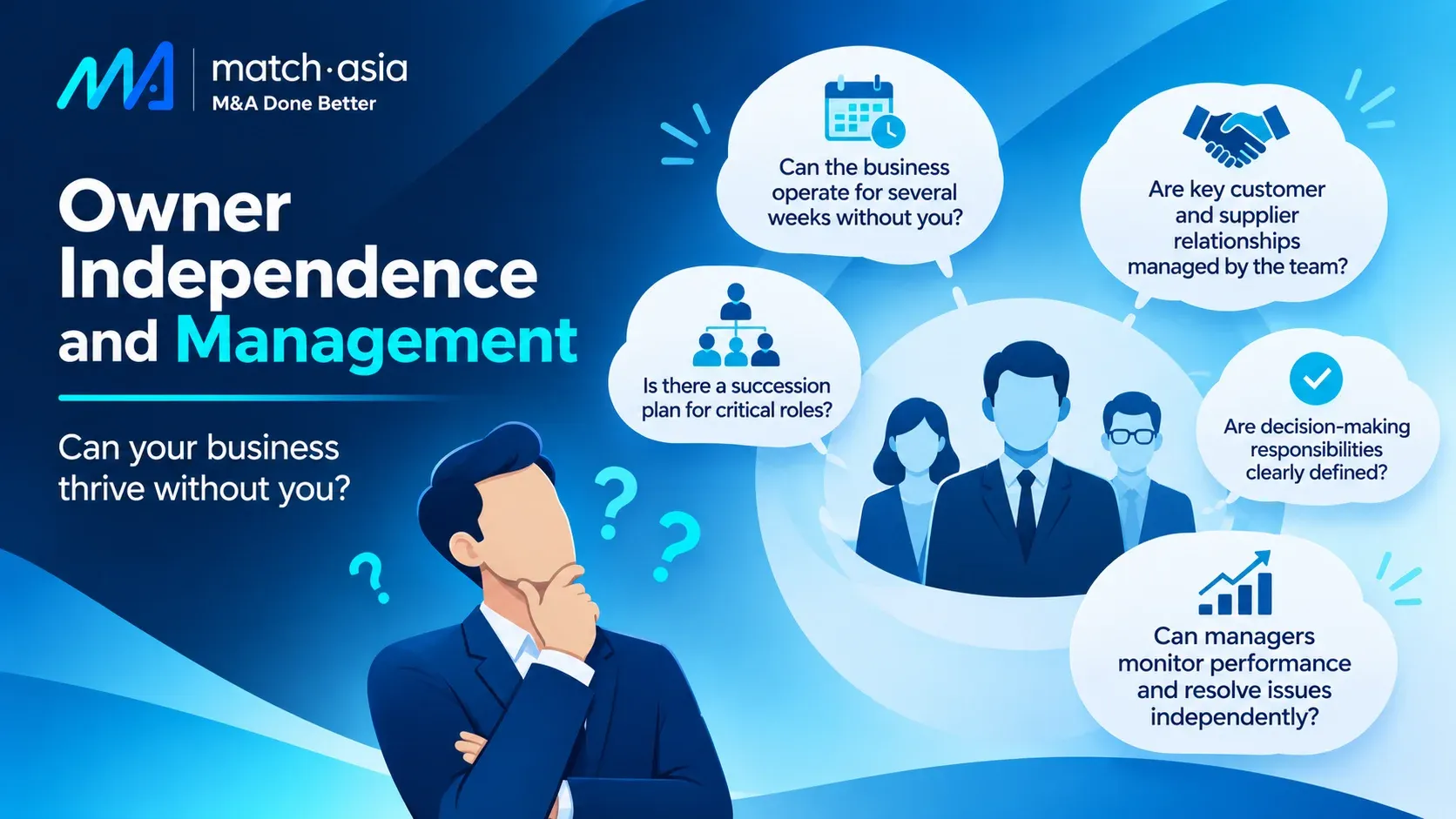
Owner independence measures how effectively a business can function without the founder managing every important decision. In many SMEs, owners remain closely involved in sales, customer relationships, hiring, supplier negotiations, and daily problem-solving. This involvement may have helped the business grow, but it can create a transferability risk when the owner leaves. Buyers want to understand whether the management team has the experience and authority to maintain operations after the transaction. Consider these questions:
-
- Can the business operate for several weeks without the owner being involved in daily decisions?
-
- Are key customer and supplier relationships managed by the wider team?
-
- Are decision-making responsibilities clearly defined?
-
- Can managers monitor performance and resolve problems independently?
-
- Is there a succession plan for critical roles?
Reducing founder dependency does not mean removing the owner's contribution entirely. It means building a business where responsibilities, knowledge, and relationships are not concentrated in one person.
4. Customer and Revenue Stability
Customer and revenue stability help buyers understand how predictable the business's future income may be. A company with a broad customer base, repeat business, long-term contracts, and a reliable sales pipeline may be easier to evaluate than one dependent on a small number of customers or occasional large projects. One important factor is customer concentration. If a significant share of revenue comes from one customer, losing that relationship could materially affect the company's performance. Buyers may also examine customer retention, contract renewal rates, pricing trends, sales pipeline quality, and the diversity of revenue sources. Owners should understand how much revenue each major customer contributes, whether important contracts can continue after a change of ownership, and what drives repeat purchases. No single customer concentration threshold applies to every business. The level of risk depends on the sector, contract terms, customer relationships, and the availability of alternative customers.
How to Assess Exit Readiness?
Knowing how to assess exit readiness begins with reviewing the business from a potential buyer's perspective. Instead of asking only whether the company is profitable, consider whether its performance can be demonstrated, its risks explained, and its operations transferred. An initial assessment can cover the following areas:
| Assessment area | Questions to consider |
|---|---|
| Financial readiness | Are financial records accurate, complete, and consistent? Can earnings and cash flow be explained? |
| Operational readiness | Are key processes documented? Can the business maintain service quality without constant owner involvement? |
| Management | Can the management team lead the business after the founder exits? |
| Customers and revenue | Is revenue reasonably diversified? Are important customer relationships and contracts secure? |
| Legal readiness | Are contracts, licences, registrations, intellectual property rights, and corporate records in order? |
| Due diligence preparation | Can key documents be located quickly and supported by reliable evidence? |
| Exit objectives | Does the owner understand their preferred timing, financial expectations, and role after the transaction? |
Use this review to identify gaps and classify them by urgency, potential impact, and the time required to address them. For example, missing financial records may require immediate attention, while developing a stronger second layer of management may take considerably longer. Prioritising these issues turns a general concern about readiness into a practical improvement plan. An initial self-assessment can reveal obvious weaknesses, but it is not a guarantee that a buyer will proceed or that a particular sale price will be achieved. Professional advice may be useful for complex financial, legal, tax, or transaction-related questions.
How to Prepare a Business for Exit?
Understanding how to prepare a business for exit is about making deliberate improvements while there is still time to demonstrate their impact. The following steps provide a practical starting point.
1. Establish a clear financial baseline. Review historical financial statements, profitability, cash flow, debt, and working capital. Investigate unusual movements and ensure the numbers tell a consistent story. You can also check your business valuation to develop an initial understanding of the factors that may influence its value.
2. Address legal and governance gaps. Organise company records, shareholder agreements, customer and supplier contracts, employment documentation, licences, and intellectual property records. Identify unresolved disputes or compliance issues that could complicate a transaction.
3. Reduce dependence on the owner. Delegate operational responsibilities, document critical knowledge, strengthen the management team, and establish clear decision-making authority. Test whether important activities can continue when the owner is unavailable.
4. Improve revenue quality and visibility. Review customer concentration, retention, margins, contract terms, and the sales pipeline. Where practical, reduce overdependence on individual customers and strengthen repeatable sources of revenue.
5. Organise due diligence documents. Create a secure, well-organised repository for financial, legal, operational, commercial, and people-related records. Ensure that documents are current, consistent, and accessible to authorised advisers when needed.
6. Build a realistic exit plan. Define your preferred exit route, approximate timeline, financial objectives, and expectations for the transition period. Consider whether a buyer would need you to remain involved after completion and, if so, for how long.
7. Review progress regularly. Track improvements against specific actions and deadlines. Some changes can be completed quickly, while others need time to produce a reliable record of performance.
For a structured starting point, owners can assess your exit readiness and identify areas that may need further attention. The appropriate preparation period depends on the business's size, complexity, current condition, and intended exit route. Starting early gives owners more flexibility to improve the business rather than trying to resolve every issue during an active sale process.
Why Exit Readiness Matters to Buyers?
Buyers are not simply purchasing a company's historical revenue or assets. They are evaluating its ability to generate future earnings and the risks involved in taking ownership. A business with reliable financial records, documented processes, a capable management team, and stable customer relationships can give buyers greater confidence in its future performance. By contrast, unresolved financial discrepancies, unclear legal ownership, heavy founder dependence, or concentrated revenue may lead buyers to ask more questions, request additional protections, reconsider their offer, or withdraw from a transaction. Exit readiness can influence several aspects of a deal:
-
- Valuation: Buyers may adjust their expectations when they identify risks that could affect future earnings.
-
- Due diligence: Well-organised information can make it easier to verify the business's performance and identify issues early.
-
- Negotiation: Clear records and credible explanations help sellers respond to buyer questions with evidence.
-
- Deal certainty: Resolving important issues before a sale can reduce the risk of late-stage surprises.
-
- Transition planning: Strong processes and management reduce uncertainty about how the company will operate after completion.
Exit readiness does not guarantee a higher valuation or a completed transaction. Market conditions, buyer demand, strategic fit, financing, and negotiation also matter. However, preparation helps owners understand their weaknesses, explain their strengths, and make more informed decisions.
How match.asia Can Help You Assess Your Exit Readiness?
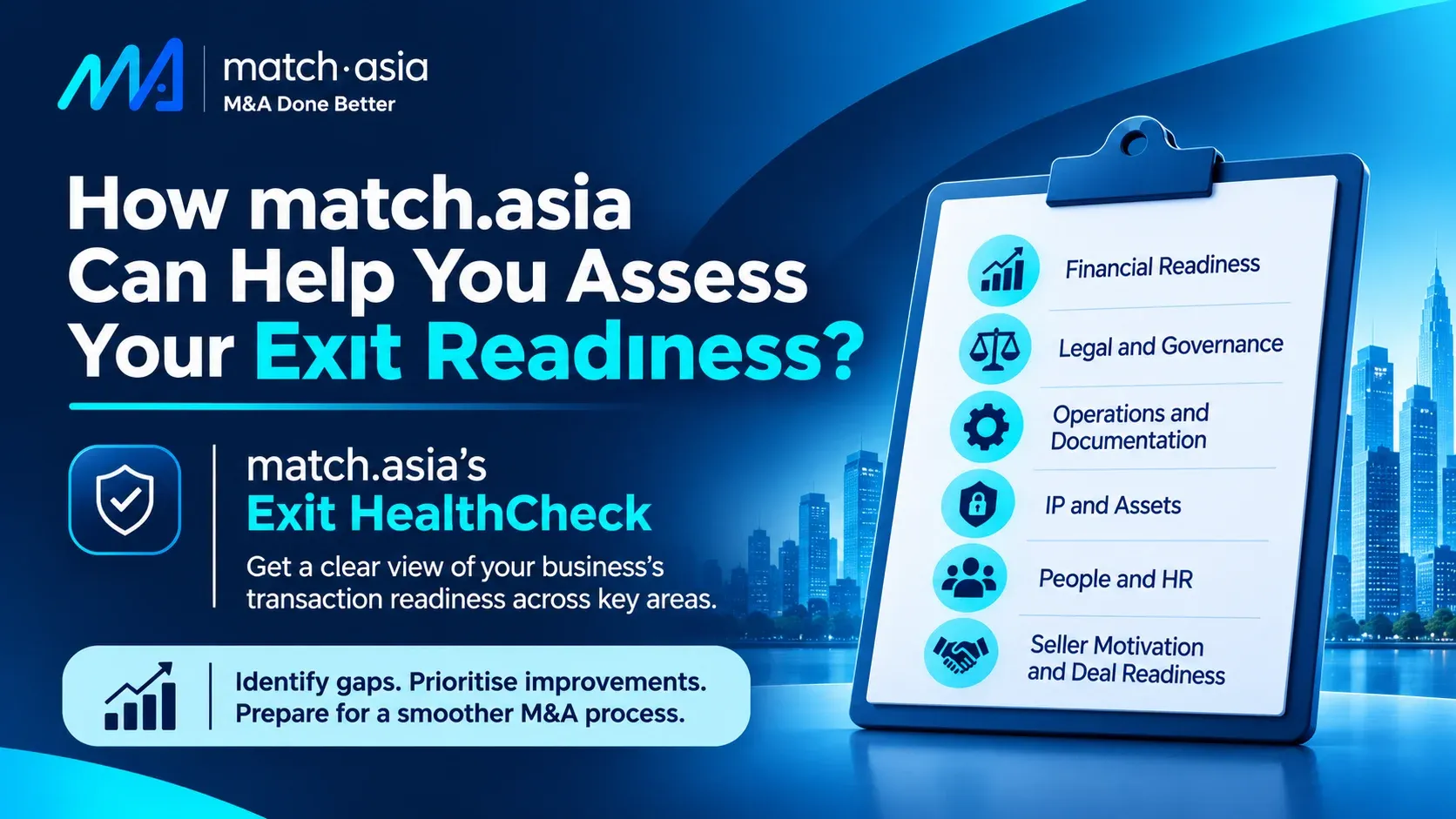
match.asia helps business owners understand how prepared their business is for a potential sale through its Exit HealthCheck. The assessment looks at key areas that can affect transaction readiness, including financial readiness, legal and governance, operations and documentation, IP and assets, people and HR, and seller motivation and deal readiness. It can help owners identify areas that may need attention before approaching buyers and provide a clearer picture of where the business stands today. For owners planning an eventual exit, this provides a practical starting point for prioritising improvements and preparing for a smoother M&A process.
Conclusion
Exit readiness is about building a business that can withstand buyer scrutiny, demonstrate its financial performance, and continue operating successfully after ownership changes.
For SME owners, the most important areas include financial readiness, operational readiness, owner independence, customer stability, legal documentation, and due diligence preparation. Weaknesses in these areas do not necessarily prevent a sale, but identifying them early gives owners more time to address them.
The best approach is to assess the business honestly, prioritise the most important gaps, and track improvements over time. Exit planning is not just about preparing documents for a transaction. It is about making the business stronger, more transferable, and better prepared for its next stage of ownership.
Frequently Asked Questions
When Should You Start Preparing for a Business Exit?
Ideally, begin exit planning several years before you expect to sell. Starting early gives you time to improve financial performance, strengthen management, reduce owner dependency, and resolve issues that could affect a transaction. If you are already considering a sale, an assessment can help identify the most urgent priorities.
What Is Included in an Exit Readiness Checklist?
An exit readiness checklist typically covers financial records, normalized earnings, cash flow, legal documents, contracts, operational processes, management capability, customer concentration, intellectual property, and due diligence preparation. It should also include the owner's objectives, preferred timeline, and expectations for the transition.
How Long Does It Take to Prepare a Business for Exit?
The timeline varies according to the company's condition and complexity. Some documentation gaps can be resolved within weeks or months, while reducing founder dependency, diversifying revenue, or demonstrating consistent performance may take considerably longer. The earlier preparation begins, the more options the owner generally has.