How to Find Acquisition Targets?
公開日: November 6, 2026
更新日: November 6, 2026

Key Insights
- Understand your SME’s value — Learn what buyers consider when assessing a business and setting a realistic valuation.
- Prepare before selling — Organise financial, legal and operational records and strengthen areas that may concern buyers.
- Choose the right exit strategy — Compare strategic buyers, financial buyers, management buyouts and individual entrepreneurs.
- Find the right buyers — Identify and qualify buyers based on strategic fit, financial capacity and acquisition objectives.
- Protect confidential information — Screen potential buyers and control when sensitive business information is disclosed.
- Manage negotiations carefully — Evaluate price, deal structure, liabilities, completion conditions and seller responsibilities.
- Prepare for due diligence — Be ready to provide accurate financial, legal, commercial and operational information.
- Complete the deal properly — Understand the final agreements, payment arrangements, ownership transfer and relevant legal, tax and regulatory requirements.
Table of Contents
1.Define Your Acquisition Criteria1.1.Establish Your Acquisition Criteria2.Where to Find Potential Acquisition Targets?2.1.Industry Databases and Market Research2.2.MA Advisors and Deal Networks2.3.Direct Outreach and Professional Networks3.How to Evaluate Potential Acquisition Targets3.1.Assess Financial Performance3.2.Evaluate Strategic Fit3.3.Review Operational Fit3.4.Estimate Synergy Potential3.5.Consider Valuation and Key Risks4.Build a Systematic Target Sourcing Process4.1.Step 1 Create a Target List4.2.Step 2 Rank Targets by Suitability4.3.Step 3 Track Outreach and FollowUps4.4.Step 4 Review Pipeline Performance4.5.Step 5 Coordinate the Acquisition Team5.How to Find OffMarket Acquisition Targets?5.1.Identify Businesses That Fit Your Strategy5.2.Build Relationships Before a Sale Process Begins5.3.Make Confidentiality a Priority5.4.Be Prepared to Move at the Right Pace6.Conclusion7.Frequently Asked Questions About Selling a BusinessFinding the right business to acquire takes more than searching for companies that are available for sale. Buyers need to identify businesses that align with their growth plans, financial requirements, operational capabilities and long-term objectives. A company may look attractive on paper but still be the wrong acquisition if its customers, management structure or market position do not fit the buyer's strategy. A structured approach to acquisition target sourcing helps businesses identify suitable companies, compare opportunities and focus their time on the targets with the greatest potential. It also allows buyers to look beyond publicly advertised deals and discover businesses that may be open to an acquisition conversation in the future. Whether you are a business owner planning expansion, a corporate development professional, a private equity investor or an entrepreneur looking to acquire a company, understanding how to find acquisition targets can make your search more focused and effective. This guide explains how to define your acquisition criteria, find potential targets, evaluate their suitability and build a repeatable sourcing process.
Define Your Acquisition Criteria

Before searching for businesses, establish what you want an acquisition to achieve. Clear acquisition criteria help you avoid spending time on companies that do not support your strategy. Start by identifying the main reason for pursuing an acquisition. Your objective will influence the type of business you should target. Common acquisition objectives include:
-
- Entering a new market: Acquiring a business with an established customer base, local knowledge and existing distribution channels.
-
- Expanding your product or service offering: Purchasing a company that provides complementary products, services or capabilities.
-
- Increasing market share: Acquiring a competitor to strengthen your position within an industry, subject to applicable competition laws.
-
- Strengthening the supply chain: Buying a supplier, distributor or another business that plays an important role in your operations.
-
- Acquiring technology or expertise: Gaining access to intellectual property, specialist knowledge, skilled employees or technology that would take time to develop internally.
-
- Expanding geographically: Entering a new country or region through an established business rather than building operations from scratch.
Once your objective is clear, translate it into a practical set of acquisition criteria.
Establish Your Acquisition Criteria
Your criteria should explain which businesses qualify for consideration and which ones should be excluded from the search.
| Criterion | Questions to Consider |
|---|---|
| Industry | Which sectors align with your expertise and growth strategy? |
| Geography | Are you targeting a particular country, region or cross-border opportunity? |
| Business size | What revenue, earnings or employee range is suitable? |
| Financial performance | Do you require consistent profitability, revenue growth or predictable cash flow? |
| Customer base | Are customer relationships diversified, recurring or concentrated among a few large accounts? |
| Products and services | Does the business complement your existing offering? |
| Ownership | Are you interested in founder-owned businesses, family businesses or corporate divestments? |
| Management | Can the business operate independently, or does it depend heavily on its owner? |
| Valuation | What purchase price and financing structure can you realistically support? |
| Risk | What levels of debt, regulatory exposure or operational complexity are acceptable? |
Your criteria should be specific enough to guide research without being so restrictive that you overlook attractive opportunities. For example, a company looking to expand into Southeast Asia might target established manufacturing or business services companies with a recurring customer base, experienced management and operations in countries where the buyer wants to grow. It is also important to distinguish between essential requirements and preferences. A minimum financial threshold may be non-negotiable, while a target's exact location or product mix may be flexible. Document these requirements in a short acquisition brief. This gives your team a consistent reference point and helps M&A advisors understand the opportunities you want to review.
Where to Find Potential Acquisition Targets?
There is no single best source for acquisition opportunities. Different channels provide access to different types of businesses, and a strong buy-side M&A strategy usually combines several sources. Public databases can help you discover companies and understand their markets. M&A advisors may introduce businesses already considering a sale, while direct outreach can help you establish relationships with owners who have not formally entered the market. The right combination depends on your acquisition criteria, available resources, preferred transaction size and timeline.
1. Industry Databases and Market Research

Industry databases and market research are useful starting points for identifying companies that fit your acquisition strategy. Company directories, commercial databases, industry reports, trade publications and business association websites can help you build an initial list of potential targets. Useful information may include:
-
- Company names, locations and operating history.
-
- Products, services and industry specialisations.
-
- Estimated company size and financial information, where available.
-
- Ownership details and leadership contacts.
-
- Geographic reach and customer segments.
-
- Recent investments, acquisitions, expansions or other business developments.
Industry research also helps you understand the wider market. You can identify fragmented sectors, growing customer segments, regional expansion opportunities and businesses with capabilities that complement your own. For example, a regional distributor may be a suitable target for a manufacturer looking to gain direct access to customers in a new market. Similarly, an established service provider may offer an acquisition opportunity for a larger company seeking to expand its service portfolio. Use this research to create an initial target list, then verify the information before investing significant time in any individual company.
A useful tip:
Do not rely on company size or industry alone. Two businesses in the same sector may have very different customer bases, growth prospects, ownership structures and operational requirements.
2. M&A Advisors and Deal Networks
M&A advisors, investment bankers and business brokers can introduce buyers to companies whose owners are exploring a sale. These professionals often maintain relationships with business owners, investors and other intermediaries. They may share acquisition opportunities through formal sale processes or introduce buyers to businesses that match their requirements. Deal networks and M&A-focused platforms can also help buyers discover businesses, connect with relevant participants and explore opportunities across industries or geographical markets. When working with advisors and deal networks, provide a clear acquisition brief covering:
-
- Your preferred industries and locations.
-
- Target business size and financial requirements.
-
- Your strategic rationale for acquiring a business.
-
- Available funding and likely transaction structure.
-
- Your decision-making process and expected timeline.
Clear criteria make it easier for intermediaries to identify relevant opportunities instead of sending you every business that comes to market. Build relationships with professionals who understand your target sector and transaction requirements. Respond promptly to suitable opportunities, explain your decisions and maintain professional communication even when a deal is not right for you. For buyers exploring M&A opportunities in Asia, an M&A-focused platform can provide another route to discovering businesses and connecting with potential sellers.
3. Direct Outreach and Professional Networks
Direct outreach involves approaching businesses that fit your criteria, even when their owners have not publicly indicated that they want to sell. This approach is particularly useful when you are targeting a narrow industry, a specific geography or companies with distinctive capabilities. Potential targets can be identified through industry research, supplier and customer networks, professional associations, trade events and referrals from trusted contacts. Your existing relationships may be especially valuable. Employees, customers, suppliers, accountants, lawyers and industry specialists may know business owners who are considering retirement, succession or a change in ownership.
When contacting a potential target, focus on the business rationale rather than immediately asking whether the owner wants to sell. For example, explain why the company's capabilities, products or market position could complement your business. Introduce your organisation, describe your acquisition interests and invite a conversation if the owner is open to exploring future opportunities. Keep initial communication professional and discreet. Avoid making assumptions about an owner's intentions, and respect their decision if they are not interested. Direct outreach requires patience. Some owners may not be ready to consider a transaction for months or years. Maintaining appropriate contact over time can help you build relationships before an acquisition opportunity formally emerges.
How to Evaluate Potential Acquisition Targets
Finding a company that matches your initial criteria is only the first step. You must then assess whether the business is financially sound, strategically relevant and realistically capable of delivering the expected benefits. A structured evaluation process helps you compare opportunities consistently and identify concerns before committing significant resources.
1. Assess Financial Performance
Begin by reviewing the company's financial performance over several years, where reliable information is available. Important areas include:
-
- Revenue growth and the stability of earnings.
-
- Gross profit and operating profit margins.
-
- Cash flow generation and working capital requirements.
-
- Existing debt and other financial obligations.
-
- Capital expenditure requirements.
-
- Customer concentration and recurring revenue.
-
- Financial forecasts and the assumptions behind them.
Look beyond headline revenue. A business with rising sales but weak cash flow may require more funding than expected. Similarly, strong reported profits may not tell the whole story if the company depends on significant future investment or a small number of customers. At the initial screening stage, use available information to decide whether the company merits further investigation. Detailed financial verification should follow as the process advances.
2. Evaluate Strategic Fit
Strategic fit measures how well the target supports your acquisition objectives. Ask whether the company gives you access to new customers, products, markets, technology or capabilities. Consider whether its strengths would complement your existing operations or create opportunities that neither business could achieve as effectively alone. For example, acquiring a regional service provider may help a larger company expand its geographical reach. Acquiring a complementary product business may allow an organisation to serve existing customers more effectively. However, a compelling strategic story is not enough. The expected benefits must be realistic and supported by evidence.
3. Review Operational Fit
Operational fit concerns how effectively the two businesses could work together after an acquisition. Consider differences in technology, processes, distribution, supplier relationships, management practices and company culture. Also assess how dependent the target is on its founder or a small group of key employees. If essential customer relationships, technical knowledge or daily decisions depend on the owner, the buyer needs a realistic plan for retaining that knowledge during the transition. Some operational differences can create opportunities for improvement. Others may require substantial investment, management attention or restructuring. Identify these requirements early rather than assuming integration will be straightforward.
4. Estimate Synergy Potential
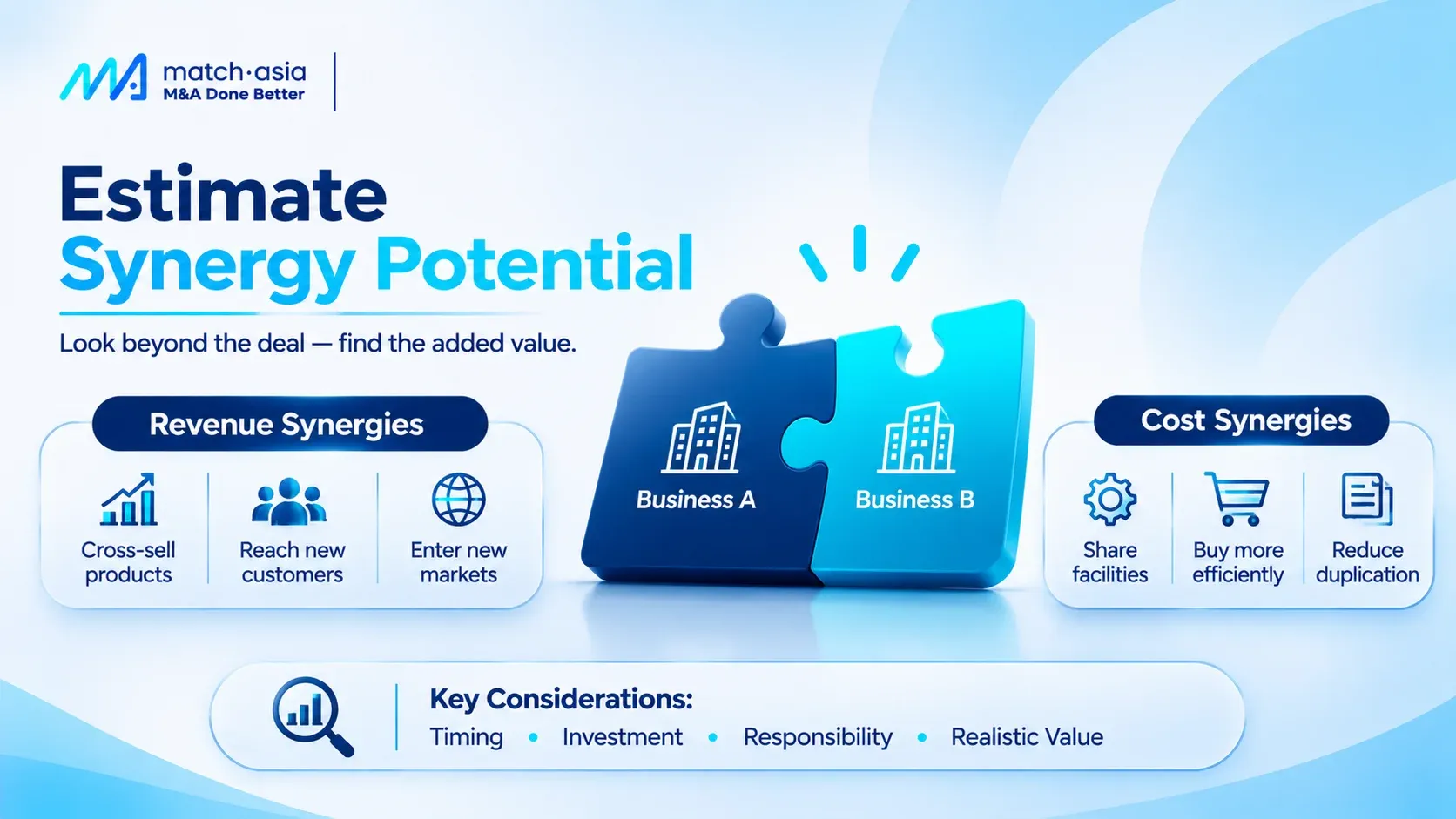
Synergies are the additional benefits a buyer expects from combining two businesses.
-
- Revenue synergies may come from cross-selling products, reaching new customer groups, entering new markets or combining complementary services.
-
- Cost synergies may result from shared facilities, more efficient purchasing, reduced duplication or streamlined processes.
Estimate these benefits carefully. Consider how long they will take to achieve, what investment will be required and who will be responsible for delivering them. Do not justify an acquisition using optimistic assumptions alone. The business should make commercial sense at a reasonable purchase price, with synergies treated as potential additional value rather than guaranteed returns.
5. Consider Valuation and Key Risks
An attractive company is not automatically an attractive acquisition at every price. Assess the likely purchase price against the target's financial performance, growth prospects, assets, market position and comparable transactions where relevant. A preliminary estimate can help you decide whether an opportunity is worth pursuing. A business valuation calculator can provide an initial reference point, although it cannot replace detailed financial analysis or a transaction-specific valuation. Also identify potential legal, regulatory, commercial and operational risks. These may include unresolved disputes, customer concentration, outdated technology, significant debt, compliance issues or dependence on a small number of suppliers. A preliminary assessment should help you decide whether to proceed, investigate further or reject the opportunity. Formal due diligence is required before completing a transaction.
Build a Systematic Target Sourcing Process
Acquisition target sourcing is more effective when it operates as a repeatable process rather than a series of unrelated searches. A systematic approach helps you maintain visibility over potential deals, prioritise promising companies and understand which sourcing channels produce the best results.
Step 1: Create a Target List
Build a central list of companies that meet your acquisition criteria. Record the available information for each business, including its sector, location, size, ownership, strategic relevance and potential reason for acquisition. Separate high-priority targets from companies that need further research. Your target list should be a working document, not a static database. Update it as new information becomes available and remove businesses that no longer fit your strategy.
Step 2: Rank Targets by Suitability
Use a simple scoring system to compare companies consistently. For example, rate each target from one to five across these categories:
| Evaluation Area | What to Assess |
|---|---|
| Strategic fit | How closely the business supports your acquisition objectives |
| Financial performance | Revenue quality, profitability and cash flow |
| Market position | Customer relationships, competitive strengths and growth prospects |
| Operational fit | Compatibility with your existing business |
| Valuation | Whether the expected purchase price appears realistic |
| Accessibility | Whether a credible route exists to contact the owner or decision-maker |
Assign greater importance to the factors that matter most to your acquisition strategy. A buyer seeking new technology, for example, may place more weight on intellectual property and technical capabilities than on immediate cost savings. Use the score to prioritise research, not to replace professional judgement. A company with incomplete information should not automatically receive the same assessment as a company that has been properly evaluated.
Step 3: Track Outreach and Follow-Ups
Maintain a record of every interaction with advisors, intermediaries and potential sellers. Track when contact was made, who responded, what was discussed, the owner's level of interest and the agreed next step. This prevents opportunities from being overlooked and helps your team maintain consistent communication. Follow-ups should be relevant and appropriately spaced. Avoid sending repeated generic messages to owners who have not expressed interest.
Step 4: Review Pipeline Performance
Monitor the number of targets identified, initial contacts made, meaningful conversations held, opportunities qualified and transactions progressing to due diligence. These measures help you understand whether your sourcing activity is producing useful opportunities. If many companies are being identified but few match your requirements, revisit your criteria or research sources. If suitable targets are found but rarely respond, improve your outreach approach and the relevance of your message. Review results regularly and adjust your process based on evidence.
Step 5: Coordinate the Acquisition Team
Target sourcing should involve the people who understand your business and the market you want to enter. Corporate development, finance, operations, commercial teams and senior management may each identify different opportunities or risks. Establish a clear process for reviewing targets and deciding which ones deserve further attention. This reduces duplicated effort and helps the organisation make timely decisions.
How to Find Off-Market Acquisition Targets?
Off-market acquisition targets are businesses that are not being openly marketed for sale through a formal sale process. These companies may not appear in public listings, but their owners could be willing to discuss a future transaction if the right opportunity arises. Off-market sourcing can be valuable because it allows buyers to explore businesses that competitors may not be actively pursuing. It can also create opportunities to build a relationship before the owner decides to sell. However, off-market does not automatically mean cheaper, easier or more attractive. The owner may have no interest in selling, the business may be difficult to value, or the transaction may take considerable time to develop.
1. Identify Businesses That Fit Your Strategy
Start with a carefully defined target list. Focus on companies with capabilities, customer relationships or market positions that support your acquisition objectives. Research their ownership, business performance, competitive position and likely reasons for considering a partnership or sale in the future. Avoid making assumptions about an owner's willingness to sell based on age, business performance or other limited information.
2. Build Relationships Before a Sale Process Begins
Professional networks can help you establish contact with business owners and understand their long-term plans. Attend relevant industry events, seek introductions from trusted contacts and develop relationships with advisors who know your target market. When approaching owners, communicate your strategic rationale clearly. Explain what interests you about the business and how an acquisition could support its future development. Some owners may be interested in exploring a transaction immediately. Others may prefer to remain independent or revisit the conversation at a later stage. Respect their preferences and maintain contact only when it is appropriate.
3. Make Confidentiality a Priority
Off-market conversations may involve sensitive information about ownership, financial performance, employees and customers.Share information on a need-to-know basis and use appropriate confidentiality arrangements before exchanging sensitive business details. Be clear about who you represent and how information will be handled. If an owner expresses interest, agree on a suitable process for sharing information and evaluating the opportunity.
Be Prepared to Move at the Right Pace
A potential seller may want to understand your acquisition plans, financial capacity and approach to running the business before progressing further. Be prepared to explain your objectives, demonstrate that you can make decisions efficiently and outline how you would manage a possible transition. At the same time, avoid rushing into a transaction simply because an opportunity is not publicly available. Financial analysis, negotiation and due diligence remain essential.
The key to successful off-market sourcing is consistency. Building relationships with suitable businesses over time creates more opportunities to start meaningful conversations when ownership circumstances or strategic priorities change.
Conclusion
Finding the right acquisition targets requires a clear strategy, reliable research and a consistent approach to building relationships. By defining your acquisition criteria, exploring multiple sourcing channels and evaluating each business against financial and strategic requirements, you can focus on opportunities that are more likely to support your long-term goals. A systematic sourcing process also helps you look beyond businesses that are already for sale. Direct outreach and professional networks can introduce you to potential sellers before a formal sale process begins, while structured evaluation helps you distinguish promising opportunities from unsuitable ones. For buyers exploring opportunities across Asia, match.asia provides an M&A-focused platform to discover potential businesses and connect with opportunities that align with their acquisition objectives. Combining disciplined research with thoughtful outreach and careful evaluation can help you build a stronger acquisition pipeline and make more informed decisions.