How to Sell a Small Business?
公開日: November 5, 2026
更新日: November 6, 2026
Key Insights
- Know your business value — Understand the key valuation methods and what influences your final sale price.
- Prepare before selling — Get your finances, operations, documents and business processes in order.
- Choose the right selling route — Compare platforms, brokers, M&A advisors, direct sales and professional networks.
- Find the right buyers — Identify, target and qualify buyers based on fit, interest and financial capability.
- Negotiate beyond price — Consider payment terms, liabilities, seller financing, transition obligations and deal conditions.
- Be ready for due diligence — Organise accurate information and prepare for financial, legal, operational and regulatory reviews.
- Plan the handover — Prepare for the transfer of operations, relationships, responsibilities and your post-sale role.
- Understand the Asia context — Consider additional legal, tax and regulatory factors when selling across Asian markets.
Table of Contents
1.Determine What Your Small Business is Worth1.1.Understand the Main Business Valuation Methods2.Prepare Your Business for Sale2.1.Improve Financial and Operational Readiness2.2.Prepare the Information Buyers Will Need3.Choose the Right Way to Sell Your Business4.Find and Qualify the Right Buyers4.1.Market Your Business to Potential Buyers4.2.Find Strategic Buyers and Investors5.Negotiate the Price and Terms of the Sale6.Navigate Due Diligence and Finalize the Deal7.Plan the Transition After the Sale8.Conclusion9.Frequently Asked QuestionsSelling a small business is a major decision. After investing years of time, money and effort into building your company, you want to make sure you receive fair value and find a buyer who can take the business forward. However, selling a business involves more than agreeing on a price. You need to prepare your financial records, understand what your company is worth, identify suitable buyers, negotiate the terms and complete the necessary legal and financial checks. If you are researching how to sell a small business, the process may initially seem complicated. The good news is that breaking it into manageable steps can make it easier to understand and plan.
For small and medium-sized enterprises (SMEs), preparation is particularly important. Buyers want to understand how the business generates revenue, whether its operations can continue without the current owner and what opportunities exist for future growth. This guide explains the small business sale process, from valuation and preparation to finding buyers, negotiating an agreement and completing the transition. It also covers important considerations for owners planning to sell a small business in Asia.
Determine What Your Small Business is Worth
Before approaching buyers, develop a realistic understanding of your business's value. A reasonable valuation helps you set expectations, assess offers and explain why your company is worth acquiring. However, there is no single formula that determines the value of every small business. Buyers consider financial performance, industry conditions, business risks, assets and future growth potential.
Understand the Main Business Valuation Methods
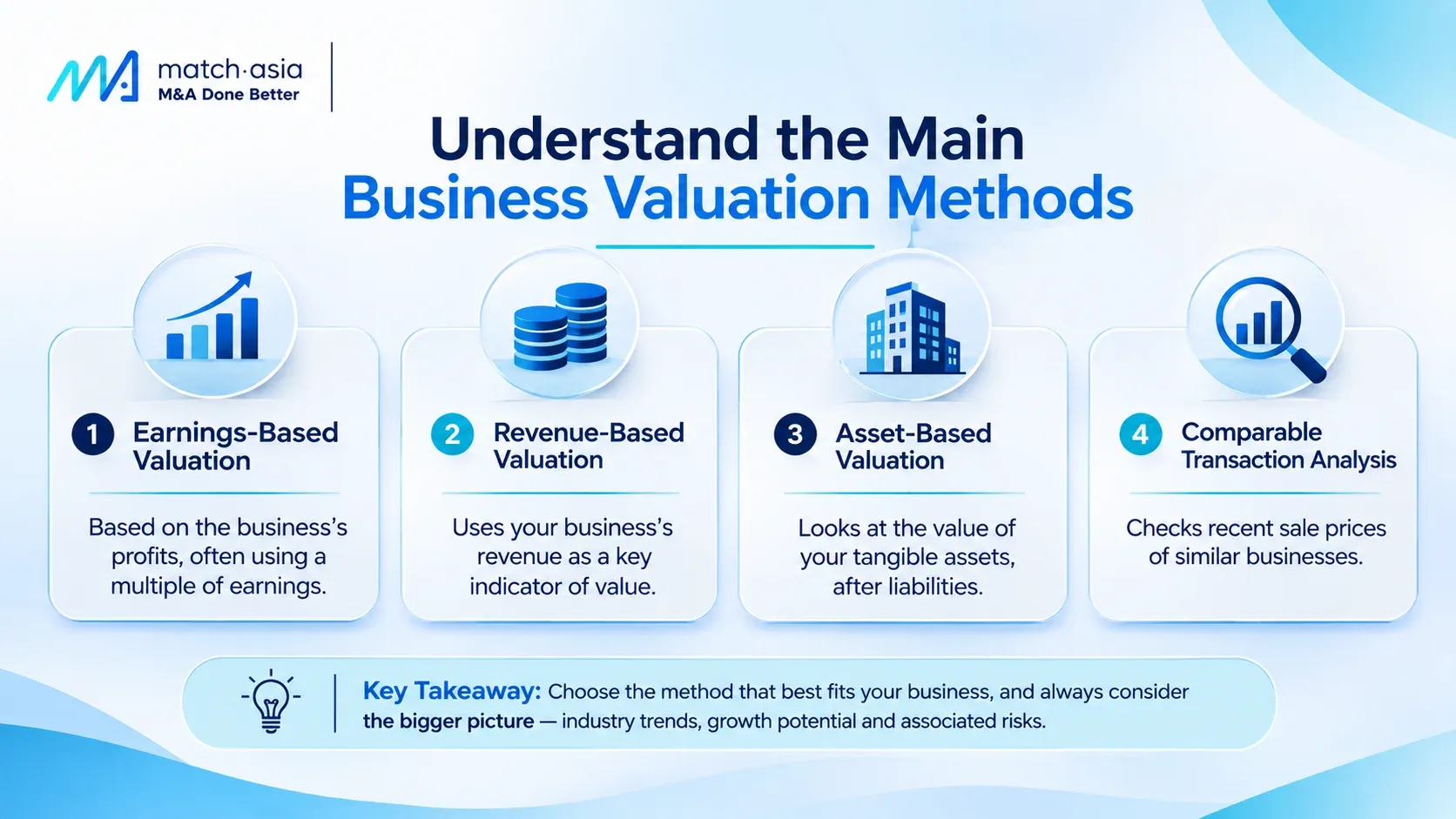
Several business valuation methods can help you estimate what your company may be worth.
1. Earnings-based valuation
This approach considers the profit or earnings generated by the business. Buyers may use a multiple of earnings to estimate value, particularly when acquiring an established company with a consistent operating history. The appropriate multiple depends on factors such as industry, growth prospects, customer concentration, management strength and perceived risk.
2. Revenue-based valuation
Revenue can provide useful context, especially when comparing businesses within the same industry. However, revenue alone does not establish value. Two companies with similar sales may have very different profitability, operating costs and financial risks.
3. Asset-based valuation
This method considers the value of the company's assets after accounting for relevant liabilities. It may be useful for businesses with substantial equipment, property, inventory or other tangible assets.
4. Comparable transaction analysis
This approach examines the prices paid for similar businesses in previous transactions. Comparisons are most useful when the businesses operate in similar markets and have comparable financial characteristics. Each method has limitations. A valuation should reflect the nature of the business and the purpose of the assessment rather than relying on a single number without supporting evidence. You can begin exploring your company's estimated value using the business valuation calculator. Remember that an estimated valuation is not a guaranteed selling price. The final price depends on buyer interest, negotiations, due diligence and the terms of the transaction.
Prepare Your Business for Sale
Preparing a business for sale means making it easier for a potential buyer to understand, evaluate and take over the company. A business that is organised, financially transparent and less dependent on its owner may be more attractive to buyers. Preparation also helps reduce avoidable delays when the buyer begins reviewing the business in detail.
1. Improve Financial and Operational Readiness
Start by reviewing the company's financial performance and daily operations.
- 1. Organise your financial records. Prepare accurate financial statements, tax records, profit and loss statements, balance sheets and cash flow information. Buyers may want to understand revenue trends, operating expenses, profitability, outstanding debts and working capital requirements.
- 2. Review your revenue sources. Identify your main customers, products and services. If the business relies heavily on a small number of customers, be prepared to explain the situation and any measures taken to manage that risk.
- 3. Document important processes. Record how the business handles sales, purchasing, customer service, inventory, staffing and other essential activities. Documented processes help demonstrate that the company can operate consistently.
- 4. Reduce unnecessary owner dependence. If every major decision requires your involvement, buyers may worry about what will happen after the sale. Where possible, delegate responsibilities, strengthen management processes and document key relationships.
- 5. Resolve outstanding issues. Review overdue payments, contractual obligations, employee matters, legal disputes and compliance requirements. Addressing problems early can reduce the risk of unexpected complications during negotiations.
- 6. Identify growth opportunities. Consider whether the company could expand into new markets, introduce additional products, improve efficiency or strengthen its customer base. Explain these opportunities realistically and support your claims with relevant information.
You do not necessarily need to make every possible improvement before selling. Focus on changes that strengthen the business, reduce avoidable risks and help buyers make an informed assessment.
2. Prepare the Information Buyers Will Need
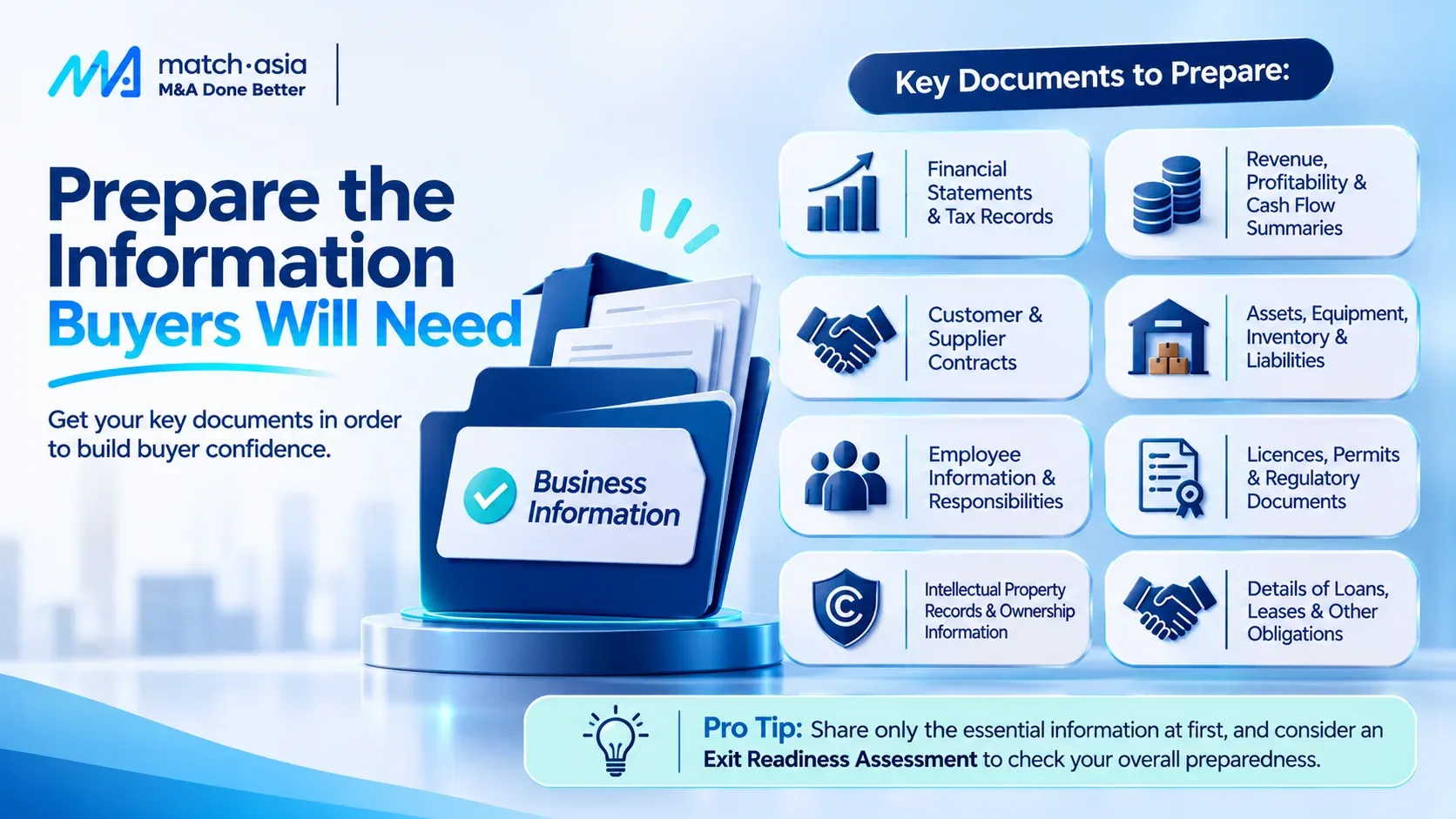
Once you decide to sell, organise the documents that a serious buyer may request. Depending on the business, these may include:
-
- Financial statements and tax records.
-
- Revenue, profitability and cash flow summaries.
-
- Customer and supplier contracts.
-
- Details of assets, equipment, inventory and liabilities.
-
- Employee information and organisational responsibilities.
-
- Licences, permits and relevant regulatory documents.
-
- Intellectual property records and ownership information.
-
- Details of existing loans, leases and other obligations.
You may also prepare a short overview of the company, explaining its history, business model, products or services, target customers, market position and future opportunities. Avoid sharing sensitive information indiscriminately. Initially, provide only the information needed to establish buyer interest. More detailed financial, customer or operational documents should generally be shared with appropriately screened buyers under suitable confidentiality arrangements. It is also useful to assess your overall readiness before going to market. An exit readiness assessment can help you consider important areas such as financial readiness, legal and governance matters, operational documentation, intellectual property and deal preparation.
Choose the Right Way to Sell Your Business
There is more than one way to sell a small business. The right approach depends on the size and complexity of your company, your budget, your preferred level of involvement and the type of buyer you want to attract.
- 1. Sell independently. You can approach buyers directly, advertise your business and manage negotiations yourself. This gives you control over the process, but you will need to handle buyer enquiries, information sharing, negotiations and coordination.
- 2. Use a business-for-sale platform. Online platforms can help you present your company to people actively looking for acquisition opportunities. Before choosing one, review its audience, fees, confidentiality arrangements and available support.
- 3. Work with a business broker. A broker may assist with marketing, buyer enquiries, initial negotiations and other aspects of the sale. This can be useful if you want help managing the process but do not have the time or experience to handle everything yourself.
- 4. Engage an M&A advisor. An M&A advisor may provide more structured support with valuation, transaction preparation, identifying strategic acquirers, managing negotiations and coordinating due diligence. This option may be particularly relevant for established SMEs or transactions involving several potential buyer groups.
- 5. Approach buyers through professional networks. Accountants, lawyers, industry contacts, investors and other business owners may help you identify prospective acquirers. Direct outreach can be effective when you know which companies or investors might benefit from acquiring your business.
Compare these options based on the services provided, likely buyer reach, fees and the amount of work you are prepared to manage yourself. For owners seeking a more structured route to market, an M&A platform for SMEs in Asia can provide another way to explore connections with potential buyers.
Find and Qualify the Right Buyers
Once your business is ready for sale and you have selected an approach, the next step is identifying buyers who have both the interest and the ability to complete a transaction. Not every enquiry will come from a serious acquirer. A structured buyer-screening process helps you focus on credible prospects and avoid spending unnecessary time with unsuitable parties.
1. Market Your Business to Potential Buyers

Your business listing or sale presentation should explain the opportunity clearly without revealing unnecessary confidential information. Include relevant details such as:
-
- The industry and general location of the business.
-
- Its products, services and business model.
-
- Revenue and profitability, where appropriate and supportable.
-
- The customer groups it serves.
-
- Its competitive strengths.
-
- Opportunities for future development.
-
- The reason for selling, if you are comfortable disclosing it.
Financial figures should be accurate and clearly defined. Avoid exaggerating growth prospects or making claims that cannot be supported by evidence. You should also consider how the business will be presented to different buyer groups. An individual entrepreneur may focus on the company's existing income and the role they would play as its owner. A strategic buyer may be more interested in customer relationships, distribution, operational capabilities or entry into a new market. The goal is to explain why the business represents a credible acquisition opportunity for the right buyer.
2. Find Strategic Buyers and Investors
Potential buyers generally fall into several categories.
- 1. Strategic buyers are existing businesses that may acquire your company to expand their operations, enter a new market, gain access to customers or strengthen their capabilities.
- 2. Financial investors evaluate businesses based on their financial performance, risk profile and potential returns. Depending on their investment strategy, they may be interested in companies with consistent earnings, opportunities for growth or potential for operational improvement.
- 3. Individual buyers may want to acquire an established business rather than build one from the beginning. They may focus on the company's profitability, management requirements and ability to operate after the current owner leaves.
- 4. Competitors and industry participants may see value in your business's assets, customer relationships, workforce or market position. However, approaching them requires careful attention to confidentiality and commercial sensitivity.
To identify suitable prospects, consider what a buyer could gain from owning your business. Use that information to prioritise outreach rather than contacting every possible buyer without a clear strategy. Before sharing sensitive information, verify the buyer's identity and assess their acquisition objectives, relevant experience and financial capability. Depending on the transaction, you may request evidence of funding or other appropriate documentation. A confidentiality agreement can help establish expectations before detailed information is exchanged, although it should be part of a broader process for managing disclosure.
Negotiate the Price and Terms of the Sale
When a buyer makes an offer, the proposed price is only one part of the decision. You also need to understand the payment arrangements, conditions, responsibilities and risks attached to the transaction. Before negotiations begin, determine your priorities. Consider your preferred price, minimum acceptable terms, desired completion timeline and willingness to remain involved after the sale. During negotiations, pay attention to:
- 1. Purchase price and valuation assumptions. Make sure you understand how the buyer arrived at the proposed value and whether the offer depends on particular financial or operational assumptions.
- 2. Payment structure. Consider whether payment will be made in full at closing or through an agreed arrangement involving instalments, deferred payments or other conditions.
- 3. Seller financing. In some transactions, the seller agrees to finance part of the purchase price, allowing the buyer to repay that amount over time. This may help bridge a funding gap, but it introduces credit risk for the seller and requires careful legal and financial review.
- 4. Assets and liabilities included. Clarify which assets, contracts, debts and other obligations form part of the transaction. The treatment of these items can affect the effective value of the offer.
- 5. Transition obligations. Determine whether you will be expected to train the buyer, introduce customers, assist employees or provide other support after closing.
- 6. Conditions of completion. Offers may depend on financing, due diligence, regulatory approvals or other requirements. Understand what must happen before the sale can be completed.
When the parties broadly agree on the proposed transaction, they may document the key terms in a letter of intent (LOI). Depending on how it is drafted, the LOI may be non-binding overall while containing certain binding provisions, such as confidentiality or exclusivity. Have qualified legal and financial professionals review the relevant documents. A well-negotiated deal should reflect not only what you expect to receive but also the obligations and risks you are accepting.
Navigate Due Diligence and Finalize the Deal
Due diligence is the process through which the buyer examines the business before completing the acquisition. It helps verify the information provided by the seller and identify potential risks. The scope depends on the transaction, but buyers commonly review financial performance, legal obligations, contracts, employees, operations, assets and regulatory compliance. To prepare, organise your documents and ensure the information you provide is consistent and accurate. Respond to reasonable questions promptly, and keep track of outstanding requests. If the buyer identifies an issue, discuss it openly and determine whether it can be resolved, clarified or reflected in the transaction terms. Attempting to conceal material problems can undermine trust and put the deal at risk. The parties may need to finalise several matters before closing, including:
-
- Agreeing on the final purchase price and deal structure.
-
- Completing legal, financial and tax reviews.
-
- Obtaining required approvals or consents.
-
- Finalising the sale and transfer documents.
-
- Confirming payment arrangements.
-
- Planning the transfer of relevant assets, contracts or ownership interests.
The exact requirements depend on the jurisdiction, business structure and type of transaction. In cross-border transactions, additional legal, tax or regulatory considerations may apply. A transaction is not complete simply because the buyer and seller agree on a price. Completion generally occurs when the required conditions have been satisfied and the agreed transfer and payment steps have taken place.
Plan the Transition After the Sale
The sale does not necessarily end your responsibilities immediately. Depending on the agreement, you may need to support the buyer during a transition period. A clear transition plan helps the new owner understand how the business operates and reduces disruption for employees, customers and suppliers.
Consider documenting:
-
- Key operational processes and responsibilities.
-
- Important customer and supplier relationships.
-
- Employee roles and reporting arrangements.
-
- Relevant systems, records and access requirements.
-
- Upcoming business commitments and deadlines.
-
- Any training or advisory support you have agreed to provide.
Communicate changes to employees, customers and suppliers at the appropriate time, taking account of confidentiality requirements and contractual obligations. You should also clarify the limits of your post-sale involvement. If you agree to provide training or consulting support, document the expected duration, responsibilities and compensation where applicable. For owners who have spent years managing every part of a company, stepping away can be a significant adjustment. Planning the transition in advance can help protect the business's continuity while allowing you to move towards your next personal or professional goal.
Selling a small business is a process, not a single event. A realistic valuation, careful preparation, qualified buyers and well-managed negotiations can help you approach the transaction with greater confidence. By understanding each stage and seeking appropriate professional advice, you can make better-informed decisions about your business's next chapter.
Conclusion
Selling a small business requires careful planning, realistic expectations and the right approach to finding buyers. From understanding your business's value and preparing financial records to negotiating terms and completing due diligence, each step plays an important role in achieving a successful sale. By preparing early, protecting confidential information and focusing on qualified buyers, you can make the process more organised and improve your readiness for negotiations. For SME owners exploring opportunities across Asia, match.asia offers an M&A-focused platform to connect with potential buyers and take the next steps towards a business sale. With the right preparation and support, you can move forward with greater confidence and position your business for its next chapter.